There’s so much stuff to keep track of these days that it’s easy to lose track of stuff that seemed so great to watch, read, or even glean. So, this took a longer time to assemble than previous lists because it took that long a time to process the maelstrom that was 2022. I’m not going to tell you what I think is missing here because you’ll all have your own lists, some of which will likely include, say, the January 6th hearings or Everything Everywhere All at Once. The Multiverse itself likely deserves a slot all its own, except how do I know I don’t have a whole other list somewhere that’s all different. But there’s no time left to figure all that out. This is what I’m going with, and, except for the very last item, I feel altogether good about it. As always, these are not in any particular order – except, again, for the last one.
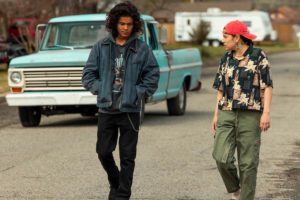
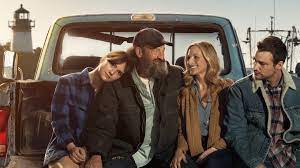
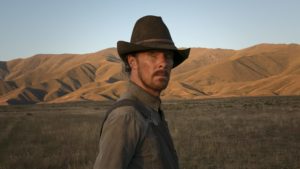
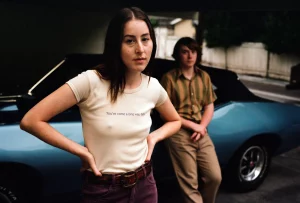
Reservation Dogs – Two things, I’ve recently decided, make life worth living: a sense of purpose and an active connection with each other’s souls, no matter how remote or hostile. Such were the animating forces of Sterlin Harjo and Taika Waititi’s poignant blend of teen anomie, vacant-lot naturalism, and stoner surrealism. As with its predecessor, Season Two found its indigenous American kids adrift in their ramshackle Oklahoma hood, still grieving the suicide of their friend Daniel and still getting haphazard and not altogether lucid counsel from varied elders, living and dead. My personal favorites among the latter demographic include, among the dead, William “Spirit” Knifeman (Dallas Goldtooth), a Lakota ancestor to confused-and-abandoned Bear (D’Pharoah Woon-A-Tai), whose half-baked advice to his teen descendant include lyrics from “Carry On Now Wayward Son” (yes, that one); among the living, it’s a three-way tie between Officer Big (Zahn McClarnon), a tribal policeman who stumbles his way towards a wholly innate sense of law, order, and even (such as it is) justice; woozy, weed-mongering Uncle Brownie (Gary Farmer), and the oracular-if-shabby Bucky (the great Wes Studi), with his hard-won cosmic wisdom. Still, it’s the kids who occupy the series’ fitful center; not just Bear, but also Cheese (Lane Factor), Willie Jack (Paulina Alexis), and Elora (Devery Jacobs), whose single-minded path towards California anchored the second-season narrative, and now appears ready to affect her friends’ destinies. Whatever happens and wherever all the rest of the grownups and kids end up, I hope I see more of those rapping, bike-riding bros LilMike and FunnyBone. Even if I don’t, I’ll happily settle for more Bucky and Brownie.
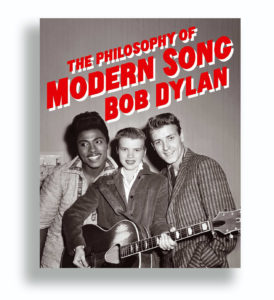
The Philosophy of Modern Song — Don’t call it “Bob Dylan’s Pop-Rock Criticism” or apply any socio-political ideology to its 60-plus selections. More than anything else, this is the authentic follow-up to Dylan’s 2004 memoir, Chronicles, Volume One and should be acknowledged as the autobiography of a personal aesthetic. Its illustrations and its text are as illuminating, evocative, cryptic, funny, and exploratory as “Bob Dylan’s 115th Dream,” “From a Buick 6,” “Positively 4th Street,” or any other Dylan song, even those with no numerals in them. Also as with a Dylan song, whatever its intentions or origins, much of the raw content of these mini-essays, addenda, outbursts, and eruptions may arouse your subconscious to something it never considered before but recognizes as familiar. And no, I’m not going to explain what I mean by that. (At least not here. Later on, I do. Sorta.)
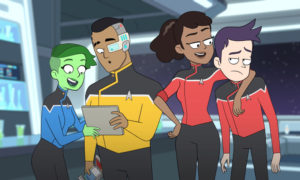
Star Trek: Lower Decks – I’ll always place Matt Groening’s ribald space opera Futurama first above equals among animated science fiction TV series, even above the underappreciated, trailblazing, and scarily prescient Jetsons, which marked its 60th anniversary this year. Nevertheless, after three seasons, this doughty, wily offshoot of the ever-expanding-like-the-universe-itself Trek franchise has not only leaped towards the front of this personal pantheon, but it also threatens to become my favorite among the Trek shows that streamed into being over the last five years. As its title implies, the show moves its focus away from the Alpha Dogs of Star Fleet like Kirk, Spock, Sulu, Picard, Riker, La Forge, and other Heroes on the Enterprise Bridge and more towards the scrubs, swabs, and junior grade drudges several floors down from whose ranks would routinely come cannon fodder with imperiled landing parties in previous Trek incarnations. The series’ core clique waiting and serving on the USS Cerritos (itself a relative second-stringer among Star Fleet ships) is made up of science nerd D’Vana Tendi (Noêl Wells), super-striving Brad Boimler (Jack Quaid), sweet-tempered cyborg Sam Rutherford (Eugene Cordero), and last-and-certainly-not-least Beckett Mariner (Tawny Newsome), thorny, determinedly underachieving daughter of the ship’s captain Carol Freeman (Dawnn Lewis), whose own insecurities and thwarted ambitions are of such comparable dimension that you come away from this ingenious, often touching series affirmed that even in deep space, nobody ever gets out of high school, dead or alive.
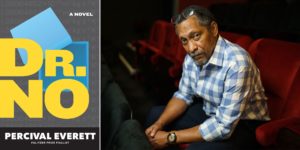
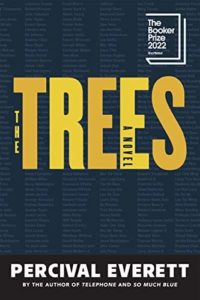
Percival Everett – Suppose Chester Himes was an actual cowboy who spent as much time working out ontological riddles as riding ranges and fishing in mountain lakes. At age 65, Everett, who claims Himes as an influence, along with Herman Melville, has published more than twenty works of fiction of startling range, deadpan humor, and formidable intelligence. This year, for instance, he published Dr. No, where he borrows both a title and a plotline from Ian Fleming’s James Bond’s novels to fashion a blackout-adventure spoof judiciously seasoned with red herrings and philosophical conundrums. If I told you it’s about Nothing, you’d still read it, right? You’d have to read it. But if I were you, I wouldn’t start with the new one, but the one just before that was short-listed for the Booker Prize: The Trees, a very different, but no less provocative and inspired comedy thriller in which cool, dry Black agents from, the Mississippi Bureau of Investigation (MBI) investigate the serial murders of white racists whose bodies are somehow accompanied by the corpses of long-dead lynching victims, including Emmett Till. It made you almost wish Hollywood had made this into a movie instead of Till. But Hollywood was barely ready for that straight-ahead story to be told on-screen. And I doubt it’ll ever be ready for Percival Everett. But you might be. (Other recommended titles: Glyph, Erasure, I Am Not Sidney Poitier, For Her Dark Skin, Damned If I Do.)
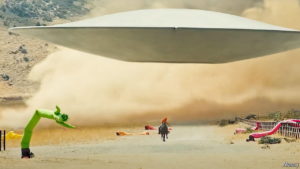
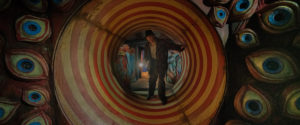
Nope – Though I honor the memory of Rod Serling and what he did for me as a child in the warm bath of his Twilight Zone, the grownup I am now is less drawn to those Serling-esque episodes making broad and direct sociopolitical points and more towards those Zone stories written by Richard Matheson and Charles Beaumont that were more interested in pure jolts and unsettling visions for their own sake. Maybe that’s why I think this third feature by Jordan Peele is his best thus far for the same reasons much of the word-of-mouth I’d heard when it came out was so antagonistic: it was all over the map, in both theme and tone; it didn’t sustain a straight storyline or deliver a hard, sharp point. And it left me with more to unravel and think/dream about than either Get Out or Us. Yes, there’s a racial subtext (what Hollywood did for, and mostly to its Black workers, on- and off-camera), but it’s only one of several layers in this aliens-from-outer-space movie that manages to evoke the dry-mouth aura of a 1950s drive-in chiller while being up to date with its eccentric supporting cast, especially the marvelous Keke Palmer as steely, feisty sister to Daniel Kaluuya’s dispirited horse trainer. For the record, Michael Abels’s score reaches new heights here, too. Almost as high, maybe higher, than the big black disc in the sky that causes all the trouble.
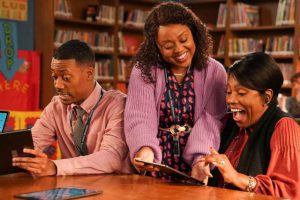
Abbott Elementary – As I’ve previously testified in public, I was so much in love at first sight with Quinta Brunson’s tender and whimsical workplace comedy series about an economically challenged South Philly public school that I took its premature cancellation as an inevitability. Now it’s a firmly established hit which may well be single-handedly rescuing the analog network sitcom from oblivion. Somewhere, Mister Peepers is grinning – and idly wondering how he’d cope with a principal like Ava Coleman.
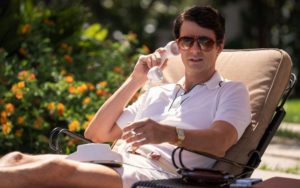
Matthew Goode in The Offer — For most of Goode’s career, I thought I had him nailed down as a pleasant, perfectly comported prototype of the British smoothie capable of an eccentric tic (in the manner of British smoothies) or even a swerve into hysteria because of, say, combat fatigue from whatever beastly war harshed his erstwhile empire’s mellow. Watching him bring Robert Evans back to life in The Offer was a massive revelation. Those who know or have seen the 2002 documentary The Kid Stays in the Picture don’t need to be told that Evans was something of a Hollywood superhero in the mid-1970s when the movie business was generally lost at sea while the art form was at its peak. Evans’ one major misfire of that decade was The Great Gatsby and what you see in Goode’s evocation discloses where he went wrong: to do Gatsby right, what Evans really needed to do was to let cameras follow him around for a year and have somebody edit all the raw footage into a feature. That hypothetical verité could have been just as innovative and grand an achievement as both Godfathers and Chinatown. As it was, Goode’s rendering of a Gatsby-esque Hollywood legend, a “Last Tycoon,” if you will, elevated an otherwise middling docudrama to near-classic tragedy.
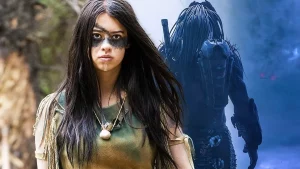
Prey – This was the prequel to the Predator franchise than no one, not even those who don’t care about hunter-gatherers from outer space, knew they wanted until it materialized in front of them. Set in a primeval American Great Plains more than three centuries before Arnold Schwarzenegger was a gleam in his mother’s eye, the film stars the magnetic Amber Midthunder as Nuru, an indigenous young warrior itching to show her brother and the other young tribesmen that she’s as great at stalking and hunting as they are. But the first in a series of hairy, insect-faced extraterrestrial hunters begins to pick off the incredulous young braves, eventually leaving her to figure out how to protect the rest of her village from being harvested. The special effects are, in their elemental way, just as spectacular as the hi-tech pyrotechnics of previous installments. (You will believe a bear can fly.) But Midthunder is, on many levels, the most dazzling of the movie’s assets, her character’s intensity and self-possession announcing both a young woman’s coming-of-age and a screen star’s arrival.
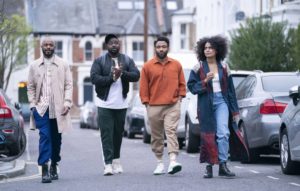
Atlanta: The Final Season(s) – Where to begin? The crew’s WTAF adventures during Paper Boi’s (Bryan Tyree Henry) European tour, including strange encounters with, among others, a friendly-but-oddly-abusive Liam Neeson, some well-heeled gourmet cannibals, a Blackface Dutch Christmas icon, along with streams of misread signals, overpriced fashion goods, exotic and dangerous drugs, and a missing phone. Or what about the seemingly “free-standing” stories, including the one about the wealthy white Manhattanites who discover their little boy is emotionally and psychically closer to their recently deceased Caribbean caregiver? Things got even weirder when Earn (creator-producer Donald Glover) and his posse returned to Atlanta where things are as dislocated as ever; how Van (Zazie Beets) somehow ends up searching for her daughter within a sinister cult-like entertainment complex run by the exploitative, enigmatic Mister Chocolate (Glover), all of it finishing off somehow with harrowing adventures in sensory deprivation with perpetually stoned Darius (Lakeith Stanfield). And that just scrapes the surface of this layers-within-layers, worlds-within-worlds cultural excursion that resembled exactly nothing else anywhere on any screen. They say it’s over. Not in my head, it isn’t.
Top Gun: Maverick – This is on the list primarily for its significance as a cultural phenomenon and not so much because it’s a great, or even very good movie. Not that I didn’t like it. In fact, I liked it a whole lot more than its 1986 predecessor, when its star’s grin was devouring everything in its path, symbolizing both the era’s avarice and obliviousness. TG:M provided such a massive, exhilarating surge to theaters struggling to shake loose from the COVID-19 doldrums that some audiences used the word “great” without qualification or irony. There were great things in it, most having to do with aerial ballet. But as all-American paeans to duty go, I much prefer John Ford’s calvary trilogy (Fort Apache, She Wore a Yellow Ribbon, Rio Grande) and even with Ed Harris around for the first act, I’d still rather watch The Right Stuff than either Top Gun movie.
In that first act (and if I’m really spoiling things for you here, then, dammit, go watch it on a streaming channel), Tom Cruise’s Maverick flies a state-of-the-art craft based on the now-decommissioned SR-71 “Black Bird” modified to reach Mach 10. Harris’s crusty admiral is about to shut down the manned flight experiment in place of drones, which kinda sorta makes sense. But “Mav” being “Mav”, he takes the plane up into the stratosphere and not only reaches the optimum speed but decides to stretch that old envelope a tad past Mach 10, which causes the plane to break up in flight. The next thing you see is Maverick, woozily lugging his parachute into a small-town diner, chugging ice water and asking where he is to which a small boy replies, “Earth.”
Now I don’t claim to be an aeronautical engineer. But I’ve absorbed enough histories of test flight and space travel to know that any corporeal being who even tries to eject from a flying object traveling past Mach 5 (a.k.a. hypersonic speed) will at the very least break every single bone and rend almost every tissue in its body, even in the highly unlikely event that a parachute opens. I’ve heard explanations (a.k.a. excuses) that the plane was likely equipped with some manner of “escape pod” that broke away and carried its pilot safely to the ground.
It’s only a movie, right? And a movie that works so conscientiously to please its audience as Top Gun: Maverick needs to sacrifice credulity to roll the turnstiles and leave everybody happy.
But suppose, just suppose, that what we see when that plane breaks up high in the sky is the death of Captain Pete Mitchell, USN? And what if everything we see afterwards, including – and especially – Maverick’s reunions with his ailing wingman and the embittered son of the Lost Goose, make up an extended posthumous dream sequence, a Sixth Sense with G suits and F-35s? You’d have a less satisfying popcorn epic. You might also have a resonant masterwork of American storytelling. As it stands now, it’s likely the loudest, most ornately apportioned shout of “olly-olly-oxen-free” ever issued to the moviegoing public. Thus, it’s a masterstroke of some kind. But not quite the one we, or the movies, really needed.
Comments Off on Gene Seymour’s Top Ten 2022 List of Everything Else
Not one of the better years for recorded jazz, I’ve decided, though what’s listed below is still, as Spencer Tracy once put it, “cherce.” I’ve spent more than three decades insisting that jazz’s yearly yield of recordings showed that its energy and quality was surging despite the relative and not-so-benign neglect of what used to be called the music industry. But I now think we may have finally hit, if not a wall, maybe a bump, or a dip in the road.
Then again, I wasn’t expecting much from this past year since everybody and everything is still recovering from the last couple years of lockdown and loathing. With a couple of exceptions, most of what I heard last year sounded tentative and restrained, as if jazz were feeling its way through the emotional wreckage of the previous six years (or so) to get its bearings; just like you, me, and everybody we know.
Which I wouldn’t have minded so much if 2022 hadn’t also been Charles Mingus’s centennial, reminding me of a time when jazz was ALL affirmation, thrust, and drive. Even the best jazz music I heard on record this year seemed to make its way hesitantly, even diffidently from the edges of space while Mingus, the prototype of whatever’s meant by “force of nature,” went all out, coming at and for you, whether you were amenable to what he was laying down or not. When reacquainting myself with the polyphonic momentum and high drama of “Black Saint and the Sinner Lady,” “Pithecanthropus Erectus,” “Fables of Faubus” and other Mingus landmarks, I found myself wandering further back to Fletcher Henderson’s deco-dynamics of the twenties and thirties and wondering where all that hotfoot urgency and furious invention had gone – and whether it’ll every come back.
Why wonder? The founder of Rolling Stone was quoted this past year saying rock-and-roll had declined so much that it’s never coming back. “It’ll end up,” Jann Wenner said, “like jazz.” Burn! From wherever he’s calling home, Wenner likely hasn’t even heard of Cecile McLorin Salvant or Maria Schneider or (maybe) even Robert Glasper, no matter how much their work engages the present moment. What I suppose he’s really saying is that rock-and-roll, as with jazz, blues, or even, I’ve been hearing lately, hip-hop no longer own or compel the present moment as they once did. (What does? Podcasts? Hulu? The noises in Elon Musk’s head?)
But as much as it hurts to admit it, Wenner’s right. The dual queens of pop, Beyoncé Knowles and Taylor Swift, now preside over the music zeitgeist without much of a challenge. We could do worse. We could do better. In the meantime, we tend to our gardens and fend off negativity. And it’s hard not to be negative given the losses in the past year of people like Creed Taylor, Ronnie Cuber, Sue Mingus, Ramsey Lewis, jamie branch, Joey De Francesco, Ron Miles, Charnett Moffett, Grachan Moncur III, and Pharoah Sanders. When one or more of them leave, we cast about for replacements until we accept that there are no replacements for any of them. There’s just us, the originals who remain, and those whose names we don’t know yet, but can’t wait to get into the action. Zeitgeist or no zeitgeist, these folks go on, no matter how messed up or constricted the rest of the world is.
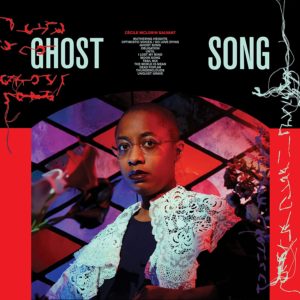
1.) Cecile McLorin Salvant, Ghost Song (Nonesuch) – We have a right to expect our best artists to make deep, hard connections to the present from whatever angles they choose. This latest act of insurgency from the finest, shrewdest, most adventurous jazz vocalist of her generation didn’t only connect (as it were); it seemed to be inventing the emotional whirlwind of the entire year as it spun wildly into being, anticipating hope and dread at every shaded turn. Remember that song from The Wizard of Oz when Dorothy, Toto, and their shabby retinue have escaped the toxic poppy fields and are skipping towards the gates of Oz? The ditty that goes: “You’re out of the woods/ You’re out of the dark/You’re out of the niiight…” Tell me something like that didn’t pop into your head the morning after this year’s midterms and in exactly the wifty, pop-eyed, kewpie-doll fashion Salvant’s rendition does here before it gives way to Gregory Porter’s more ruminative “No Love Dying,” whose lyrics are far less credulous towards life’s possibilities, but instead encourage abiding faith in love’s persistence however many “broken wings” materialize in rebuttal. Salvant has from the beginning of her meteoric rise to the pinnacle of her profession displayed rapier-like smarts towards relevance and applicability of song, which comes through in blending not just Porter and Harold Arlen, but also Kurt Weill (“The World is Mean”), and Sting (“Until”) along with orchestrating, in “Dead Poplar,” a letter Alfred Stieglitz once wrote to Georgia O’Keefe. She’s not just showing off her erudition…OK, maybe she is, a little. But this formidable sound collage is enhanced by her own compositions, some of which play along the edges of introspective passion, if there is such a paradox. (From “Obligation”: “Promises Lead to Resentment/ I could Love You if only it would stop your weeping, and start your smiling/ But is that Love?” Your move, Taylor Swift.) She closes her recital, unexpectedly, yet impeccably, with the old English folk ballad, “Unquiet Grave,” which at once recognizes the pain and depth of loss, while imploring for the necessity of letting go and moving on. It all sounds a lot like what we’ve been thinking lately – and a lot more like what we’ll be feeling forever after.
2.) Matthew Shipp Trio, World Construct (ESP) – This version of Shipp’s trio – with bassist Michael Bisio and drummer Newman Taylor Baker – has lasted the longest and the fruitfulness of their collaboration becomes wildly, emphatically apparent on their fourth – and best – album. Shipp’s virtuosity on the piano is as spiky and as spiny as ever. There’s even a track titled “Spine,” followed by one called “Jazz Posture” and both evoke painstaking, but undaunted ascent to full upright position and forward motion. What compels your attention throughout is the easy-does-it flow of layered motifs between Shipp, Bisio, and Baker. On “Beyond Understanding,” a whisper from the drummer ‘s hi-hat can stir both the bassist and the pianist to reply with their own streams of color and insinuation. Their shared comfort level is infectious, and you get swept up in the momentum of, say, “Abandoned” in the same way you’re riveted by a Hitchcock set piece. The climactic title track, also the album’s longest, has this unit coalescing into one shape-shifting organism insisting on the prerogative to change minds and break through the clouds without holding back or hugging corners. Shipp sustains the spirit of go-for-broke assertion in jazz music and, especially with this unit, has made his progressive vision more accessible without compromise. More than ever, you can’t wait for their next one, and with these guys, you don’t have to wait very long.
3.) Ryan Keberle’s Collectiv Do Brazil, Sonhos Da Esquina (Alternate Side) – In a handful of innovative ensembles, Keberle has transformed the slide trombone into a nimble, dulcet, near-crystalline singing voice, perfectly suited for, among other things, Brazilian music. The story behind this gorgeous panoply of sonhos (dreams) begins in 2017 when Keberle took time off from directing the jazz studies program at Hunter College to travel to Brazil and get cozy with the nation’s tradition of soft beats and intricate melodies. In the process, he hooked up with the working trio of pianist Felipe Silveira, bassist Thiago Alves and drummer Paulinho Vincente, finding communion and transcendence in live performances throughout Sao Paulo. They recorded these tracks about a year later and you can feel both the air-tight seamlessness of their interaction and how each of them stands out in their soloing. The compositions of both Milton Nascimento (“Cio Da Terra,” “Clube Da Esquina”) and Tonino Horta (“Aqui, Oh!,” “Francisca”) dominate the proceedings and are given fresh reinvention through arrangements by Keberle and Silveira. The intricacy of Brazilian song tradition infuses Keberle’s originals, including the bold, sinuous title track and “Carbon Neutral,” as haunting (ominous?) an anthem for confronting climate change as one can imagine.
4.) Samara Joy, Linger Awhile (Verve) – Working within tradition still delivers decisive shocks to the system. Case in point: this Bronx-born, 22-year-old prodigy whose second album delivers on the bright promise of the first with startling dividends. Her prize-winning vocal chops show both exuberance and intelligence in near-perfect equipoise and their lively reanimation of familiar standards makes those warhorses seem frisky, airy, and ripe for discovery by a new century of listeners. She unravels the unadulterated melodrama of “Guess Who I Saw Today” with plenty of glissando flourishes. But by keeping clear of cocktail lounge mannerisms and gratuitous histrionics, she lets the story tell itself and sticks the landing without wobble or excess. She also knows her way around vocalese and the lyrics she applies to Fats Navarro’s “Nostalgia” (which could have been the title track) displays her own adroitness with delivering an absorbing narrative all her own. If you think you’ve heard enough versions to last a lifetime of “Misty,” “Round Midnight,” and “Someone to Watch Over Me,” you’ll reconsider, especially after hearing her duet with guitarist Pasquale Grasso on the Gershwin tune. The greats of an earlier time, from Ella to Sarah to Carmen to Dinah, are evoked, but she arrives in the here-and-now in early triumph as her own person with rich tones and inventive agility belonging to nobody else but her. Of all the sundry delights that come with this album, the most tantalizing is the prospect of watching her already considerable talent grow with greater refinement, broader resources, and more formidable challenges.
5.) Marta Sanchez, SAAM (Spanish American Art Museum) (Whirlwind) – At once forbidding and enrapturing, Sanchez’s music confronts the sense of loss endemic (so to speak) to these times with grounded resolve and melancholy rumination. From the opening track,” The Unconquered Vulnerable Areas,” through the keening, wailing harmonies of “The Eternal Stillness” title track to the incendiary closer, “When Dreaming is the Only,” Sanchez’s piano lays down a tempestuous swirl of motifs to galvanize her crack ensemble of saxophonists Alex LoRe and Roman Filiu, bassist Rashaan Carter and drummer Allan Mednard. She dedicates this album to her mother Marivi, who died in December 2020 in Spain while Sanchez was moored in New York because of COVID-19-travel restrictions and the two pieces written in her memory, “December 11th (the day she died) and “Marivi” carry added poignance, especially the latter, which is buttressed by Ambrose Akinmusire’s plaintive trumpet and Camila Meza’s limpid vocals.
6.) Keith Jarrett, Bordeaux Concert (ECM) – He always gave you everything but the kitchen sink at these solo recitals. But in what is now supposed to be his absolute last such recording that will ever be released (which is what they said about 2020’s Budapest Concert, performed three days before this one in July 2016 during his valedictory tour, so I withhold concurrence), that “everything” means something different than it used to. Where he once kept you on the edge of your seat wondering whether he’d stroll, stomp, or bear down on his next steep curve into the next sonic weather system, here he teases out his motifs into mostly (and understandably) elegiac patterns, giving you wave upon wave of lyricism, whether blues-, or folk-based. The pastoral and wistful elements of his solos were always close by, with or without his trios. The first, and longest, of his numbered installments warns of tangled, wayward emotions at the outset, struggling for a calm place where he can lay out and reflect. No splinters or raw edges are in evidence from tracks II to XIII. But you’re still on the edge of your seat in anticipation of some fresh bloom or shaft of sunlight. The way he trails off at the very end may be the one discomfiting moment of the whole performance. This irresolution could be his idea of an appropriate farewell, an ambiguous flight into fading sunlight. Or you could choose to believe it’s a sign that there may well be yet another Absolutely Positively Last Solo Recording after this one. If I were prone to betting, I’d push.
7.) Tyshawn Sorey Trio, Mesmerism (Yeros7) – Any trio with Aaron Diehl at the keyboards is a force to be reckoned with. But there’s an excellent reason why this ensemble carries the drummer’s name. Sorey has been widely acclaimed and decorated (with a 2017 MacArthur grant, for instance) not just for his percussive work, but for his compositions in classical and jazz idioms. So, in seizing the reins of a traditional acoustic jazz trio, it’s to be expected that Sorey brings his formidable gifts as a conductor, arranger, and conceptualizer to such standards as “Detour Ahead,” with a sidelong approach to the melody that spurs breathtaking, epochal solos from Diehl and bassist Matt Brewer. The group’s dynamic and, at times, riveting interplay channels the spirit of the late drummer Paul Motian and, appropriately, Motian’s “From Time to Time” is included on the playlist and its thematic essence is lovingly contained, even as it is transformed here into a landscape so impressionistic as to be close to surreal. Each piece, whether it’s Horace Silver’s “Enchantment” or Muhal Richard Abrams’ “Two Over One,” maintains a center of gravity around which each member can either roam freely within the harmonies or stay in his zone and decorate the changes at will. Some suggest that in putting out a “conventional” trio recording, the protean Sorey is taking a breather between more ambitious work. But that point-of-view makes Mesmerism sound like a relative trifle that any trio can toss off. By the time you get to this trio’s version of Duke Ellington’s “Rem Blues,” you’ll be convinced that any group that swings as smartly and as impeccably as this is hardly anybody’s idea of a day at the beach – except for the lucky listener.
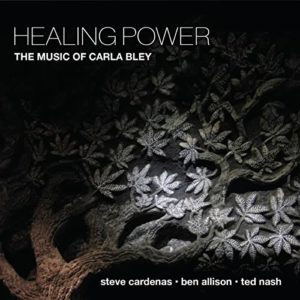
8.) Steve Cardenas, Ben Allison, Ted Nash, Healing Power: The Music of Carla Bley (Sunnyside) – Another trio, this one without a drum or piano, strongly redolent of the groundbreaking chamber sessions of the late 1950s featuring Jimmy Giuffre and Jim Hall. The arresting, resourceful interplay of guitarist Cardenas, bassist Allison, and reedman Nash were last heard working within and around the score of West Side Story on 2019’s Something Else. They now wander into Carla Bley’s comparably fabled precinct of American music and their elemental, lyrical approach to her varied oeuvre gives it plenty of space to breathe and circulate. The album opens with Bley’s best-known work, “Ida Lupino,” whose near-incantatory melody allows each musician to invent their own countermelodies branching off the main theme. When hearing such lithe, witty, and buoyant classics as “Donkey,” “Ictus,” and “And Now, The Queen,” all of which are more than sixty years old, you’re blown away at how up-to-the-minute they still sound. Then there’s “Lawns,” a ballad whose deceptively simple melody barely cloaks the song’s implications of disappointment and heartbreak, much of which are dislodged by Cardenas’s and Nash’s probing, revelatory solos. The case has been made many times over for Bley, now 86, as one of the greatest living jazz composers. We still need to talk about why, whether amongst ourselves or with others. Healing Power is such a fresh addition to this conversation that it makes you feel that it’s only just started.
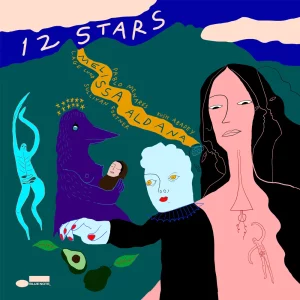
9.) Melissa Aldana, 12 Stars (Blue Note) – The Chilean-born Aldana, who turned 34 this week, seemed to arrive on the scene more than a decade ago fully-formed and already at the top of her game as a master of the tenor saxophone. (One frequently hears the word “athletic” in describing Aldana’s performances.) All she needed was a suitable framework for her expressive gifts and her much-anticipated Blue Note label debut delivers a mature artist with her own style and an insistent, but contemplative point-of-view. Her tenor carries a fluted, at times plaintive tone, cruising the middle and upper registers with fluidity and elegance. She gets the support she needs from bassist Pablo Menares, drummer Kush Abaday, pianist Sullivan Fortner, and guitarist Lage Lund, who also collaborates with Aldana on her mosaic-like compositions, including “The Bluest Eye,” inspired by the Toni Morrison novel of the same name, where she supply knits together an arresting pattern of deep-toned, meditative phrases suggesting what it felt like for her – and, possibly, you, too – to edge up to Morrison’s complex prose. Even when her themes are more direct, as in “Los Ojos de Chile,” inspired by the recent political upheaval in her native country, you can hear her thinking her way towards affirmation and resolve.
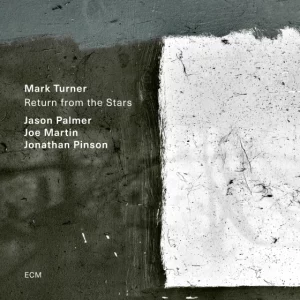
10.) Mark Turner, Return from the Stars (ECM) – As with its predecessor, 2014’s Lathe of Heaven (yeah, it’s been a minute), Turner’s latest borrows its title and, to some extent, its vibe from a modern science fiction classic. In this case, the book is Stanislaus Lem’s novel about an astronaut returning to Earth after what he thought was a ten-year mission only to find that it’s been closer to 130 years. The resulting dislocation, upheaval, trauma, and general unease are all within reach of Turner’s dry-guy aesthetics, as titles like “Terminus,” “Waste Land,” and “Unacceptable” suggest. “It’s Not All Right With Me” is a cheeky reply to Cole Porter’s standard whose thematic reversals arouse pretzel-logic modal mischief that, one suspects, Porter would appreciate for its rambunctious cleverness alone. This edition of his quartet – trumpeter Jason Palmer, bassist Joe Martin, and drummer Jonathan Pinson – seem especially attuned to wherever Turner’s radar happens to be pointed. Do we have to wait another 10 years to find out how their interchange evolves? Or is there a way for – what’s it called again? – “time dilation” to make the years fly by?
HONORABLE MENTION
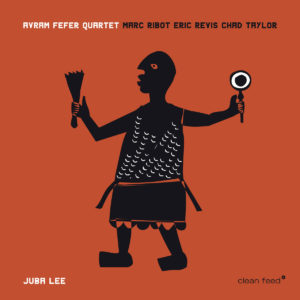
Avram Fefer Quartet, Juba Lee (Clean Feed)
Mary Halvorson, Belladonna (Nonesuch)
Miles Okasaki, Thisness (PI)
Kirk Knuffke Trio, Gravity Without Airs (Tao Forms)
Al Foster, Reflections (Smoke Sessions)
Javon Jackson, The Gospel According to Nikki Giovanni (Solid Jackson)
BEST LATIN JAZZ
Ryan Keberle’s Collectiv do Brasil, Sonhos da Esquina HONORABLE MENTION: Miguel Zenón, Música De Las Americas (Miel)
I never wanted it in the first place. As I’ve told people over six decades, from Grade 4 on, I wanted almost anything but a flute. A trumpet was my first choice for elementary school music education. With Miles Davis lulling me to sleep practically every night from toddler-hood and other pieces of my living-room soundtrack ranging from Chet Baker and Clifford Brown to Gerald Wilson and Art Farmer, what else could I want but a trumpet?
No dice.
“We. Can’t. Afford. A. Trumpet,” my father said, staring deep into my eyes and enunciating every word as if it were one of those times I’d done something irreparably bad to the sofa or the bathroom sink. “If. You. Want. To. Play. An. Instrument. We. Can. Only. Afford. A. Flute. Now. Are. You. SURE. You. Want. An. Instrument? Are…You…SURE…You…Want…A…Flute?”
Well…No…Dad…I had my heart set on a trumpet. (And Jesus, does that speech stretch longer in one’s memory or what?) Any brass instrument would have been A-OK with me. When, not many years later, my younger brother was given the chance to try the trombone, I picked it up out of curiosity and found, to my surprise, that I could actually get a note out of it on my first try.
As for the flute…let’s just say that I was a slow learner when it came to things like metal mouth-pieces and where exactly to align the mouthpiece beneath my lower lip. “It’s just like blowing into an empty Coke bottle,” others would insist, and I had to take their word for it because I didn’t think empty Coke bottles were useful for anything besides the nickels you could get in those days for their return.
Thus began a near-lifelong grind, a lengthy arranged marriage with scattered intervals of mutual understanding and, once in a great while, unexpected joy. The flute and I decided that if we were stuck with each other, we’d try to make the best of it. Understating matters, I was not the most devoted partner in this transaction, especially in the beginning. I understood perfectly that practice was the gateway to musical proficiency, and I tried. But I simply could not meld my being with this long silver tube, this slender, imperious enigma with padded keys. It never beckoned me to do great things.
Also – and this is unfair, mortifying and fucked up in at least a half-dozen ways (consider this a trigger warning), there was in those ancient early-1960s a consensus stigma attached to young male flautists since most flute players in junior high and high school orchestras were female. (“Whassamatter, Eugene?” one fifth grade wit asked me. “They run out of clarinets?”) My awkwardness in all things athletic and most things social already marked me as, putting things as baldly as my contemporaries did, A Pussy! I internalized this ugliness for much of my early years carrying a flute around and it added to the brick wall of self-consciousness that I lugged around with me along with my flute and briefcase. (Why, yes, I did! Talk about asking to get beat up!)
And in case you think the times we live in are more evolved: sometime near the start of this new century I was casually conversing on the phone with a friend of mine who told me one of her school-age daughters was taking up the flute. My subsequent “Hey, so did I!” aroused a deep sigh at the other end of the phone and eventually the following query: “Were your parents trying to make you gay?” Understand that she was merely commenting, drolly, as ever, on the presumptions and superstitions of a more savage time and place. So I wasn’t offended. I’m betting today there’d be many more who are.
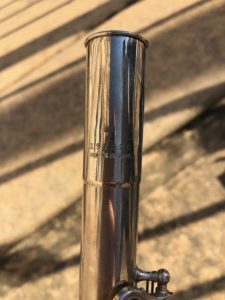
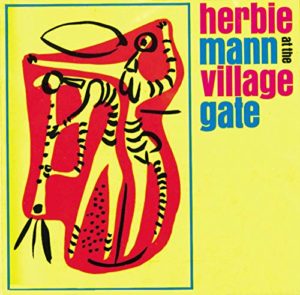
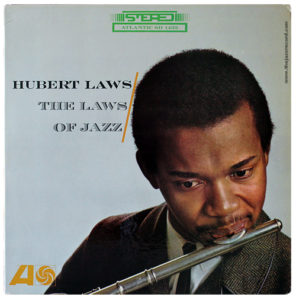
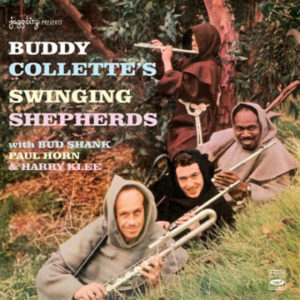
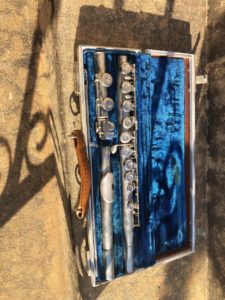
Still, the flute did enable me to read music. It never gave me total facility and absolute confidence in fusing sound with notation, but at least I knew where everything was supposed to be when I practiced sufficiently. And after the flute (by then, the Boosey & Hawkes model you see pictured above) followed me to high school and got me into the marching band and orchestra, I made still another discovery: I could actually seek and find notes with my ears and even string together familiar melodies from scratch. I could poke my way through the first chorus of “The Swingin’ Shepherd” and even the occasional pop hit, especially “(Sittin on) The Dock of the Bay.” No one would then, or ever, mistake me for Hubert Laws or Herbie Mann, but it was nice to know that I had at least a modicum of ability, even if there was no teacher at the school in those days who could help me take my jazz leanings to the next level.
Somewhere in my junior year of 1968-69, I stumbled into what was likely my peak as an instrumentalist: a chance to play flute interludes for The Open Stage, a Hartford-based theater company that was putting on “A Hand is On the Gate,” Roscoe Lee Browne’s staged renderings of African American poetry. There were other, better young musicians my age recruited for a backstage combo and to this day I find it somewhat miraculous that I was able to hold my own with them. One of them even asked me to help her out with an audition tape. Was it possible that, after years of approach-avoidance games with each other, the flute and I were discovering, if not passion, something close to respect for one another? A spark to be kindled into, at the very least, a productive, long-term alliance of sorts?
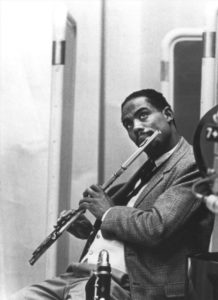
Again, no dice. And the person who finally got between us was Eric Dolphy, the nonpareil reed magician whose music I’d only casually encountered at other people’s houses. Not my father’s brand of whiskey, saying the least. He’d seen Dolphy live a couple years before the latter’s death in 1964. It was at a Newport Jazz Festival and Dolphy was honking back at seagulls in mid-solo with his saxophone. Dad thus determined him to be weirder than Roland Kirk, which is to say, too weird for further study. I came to love both of them without reservation, especially Dolphy. “Left Alone,” “Sketch of Melba,” along with the flute solos Dolphy took with Charles Mingus, Oliver Nelson, Chico Hamilton and his own bands were enough to convince me that he was the undisputed heavyweight champion of the flute. Any presumptions I ever had of even approaching Dolphy’s magnitude, much less tooling along securely in a slower lane were deflated. It didn’t help that as far as my fellow jazz aficionados were concerned, the flute placed at least third among the instruments conferring immortality upon Dolphy, probably even fourth. Thomas Chapin, another reed master and Rahsaan Roland Kirk devotee who, as with Dolphy, died too soon, also played a killer flute. But also as with Dolphy, it wasn’t the only instrument he played. It wasn’t just that I could no longer imagine myself playing the flute as well as these and other greats. It was that I couldn’t imagine giving as much dedication to playing the instrument as it required – and deserved.
And besides, given that I’d by age 15 fully committed myself to writing, I would find then and in years to come a new outlet for my natural inclination for fusing sound and meaning. I frequently wonder whether I would have discovered that impulse on my own without a flute or any musical instrument at all. I’m sure the flute helped; a significant factor mitigating my earliest reservations, even my grievances over not getting that trumpet I’d wanted at the outset. All I know is that I began to feel more like a musician when I wrote than when I was merely Playing Music.
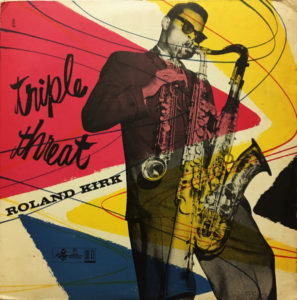
So I let things go with the flute, even as the aforementioned Boosey & Hawkes followed me in subsequent years from Hartford to three other cities and at least five other homes. After my most recent move back to Philadelphia last June, I took the old thing out just to see if I could still get a sound out of it. I could. But it turned out that a sound was all I wanted, and my flute deserved more attention, certainly less neglect. Not wishing to wait for a buyer, I searched for an appropriate local charity and found one in Play On, Philly, which provides music education to students from Kindergarten through Grade 12. Just before the flute left my long and fitful stewardship, I noodled with it one last time by playing along with one of Rahsaan Roland Kirk’s earliest tracks, a 1956 recording of “Triple Threat” on which no flute is heard – except for mine.
Taking everything into account, it was worth the time and — guess what, Dad? — the money, too.
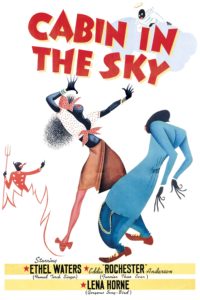
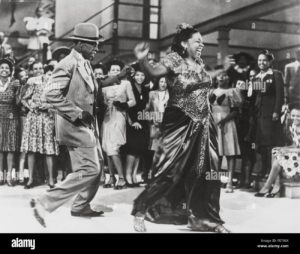
Reposting this essay I wrote twelve years ago about Vincente Minnelli’s 1943 classic all-Black musical because a.) people besides me like it a whole lot and b.) because of its more-timely-than-ever admonitions against too-easy dismissals of what is believed to be Anachronistic and (thus) Patronizing. Also if you’ve never seen it before and it happens to come your way again, jump on it. You won’t be sorry.
At the hinge of the 1960s and 1970s, Cabin in the Sky embodied everything we young, gifted, and solemn black college students thought we were fighting against. All we blinkered baby cultural-nationalists could see back then in those idyllic depictions of small-town African American folk life were unhealthy levels of honeysuckle and hambone. Eighty-six those rolling dice and eyeballs, all that cornball piety and undignified shucking! Is that really what we wanted our collective profile to look like after King and Malcolm and countless others had died for our advancement?
It’s a measure of how much time has passed that I can’t even LOOK at that previous sentence, much less write it, without wincing; the same kind of wincing we aforementioned Children of the Movement were doing whenever Cabin poked out from TV’s wee-hour wilds or was screened at collegiate film societies. Exaggerated nose-turning-in-a-vertical-direction is at least as embarrassing as pronounced eye-rolling – and not nearly as funny. Given the choice between retroactive scoldings from what some new-jack pundits have come to label the “soul patrol” and the to-be-or-not-to-be anxieties displayed by Eddie “Rochester” Anderson, I know whose party I’d rather go to.
The distinction no longer needs raising. A few days ago, I’d hosted a screening of Cabin for a Wednesday-night Lenten supper at our predominantly black Episcopal church in lower Manhattan. It was a small audience, mostly older and just about all of its members had seen the movie before and loved it without predisposition or qualifiers (even though the DVD released three years ago opens with Warner Home Video’s contemporary disclaimer apologizing about “stereotypes” that were “wrong then and wrong now.”) The tiny audience appeared to appreciate the concern, though it didn’t need to be told what was or wasn’t appropriate. They just wanted a warm black-and-white memory bath. Even the sole 20-something in the room, recruited to help with projection, was caught up in a movie old enough to be his (grand) mother.
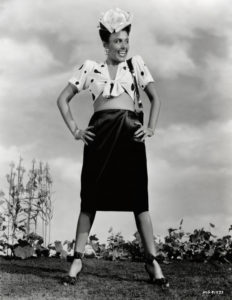
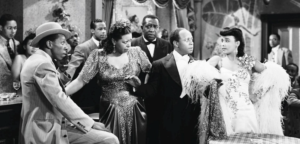
Each time I see the movie, I’m more galvanized by the sheer magnetism of its performers. Even in the reproachful seventies, it was hard not to be waylaid by the glory that was Lena Horne in her twenties. What she was then and what she remained throughout the sixties and beyond was so legitimate & enduring to young black fogies like us that we gave her quick dispensation for Cabin; the kind of pass that that didn’t easily go to, say, Ethel Waters (about whom, more later),“Rochester” Anderson or John “Bubbles” Sublett, whose song-and-dance recital of “Shine” is at once the movie’s most glaring anachronism and its most flamboyant affirmation of poise and skill.
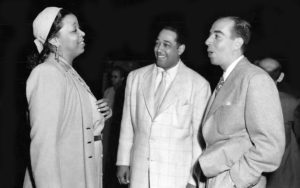
Which in no way slights everyone else in the movie, though you wish Louis Armstrong got to do even a little bit more than set off a few elegant licks while wearing those ridiculous devil’s horns. You also wish you could see more of Duke Ellington’s orchestra at work beyond flashes of its suave, imperturbable leader. (That IS Johnny Hodges in the front with the alto, right?) But first-time director Vincente Minnelli was too caught up in the dancing and singing – and rightfully so. His own eye is so greedy and avid for movement and energy that you can almost feel him sitting next to you as you’re looking for the next big moment.
Almost all of which moments are owned by Waters. Donald Bogle has elsewhere noted how often contemporary audiences are drawn to screenings of Cabin by the promise of seeing the young, cat-like Horne, yet leave those screenings dazzled by Waters’ charisma. If younger moviegoers had easy access to Waters’ recordings from the 1920s and 1930s, they’d be better prepared for her vocal agility. (Critics and historians, not that anyone pays them any mind, argue with conviction that Waters’ chops as a singer were the equal of Armstrong’s – and that her influence on jazz singing was just as emphatic & far-reaching.)
But hardly anyone at any age is prepared for the moment when Waters’ Petunia, backsliding into “sin” to “save” Anderson’s Joe from the Devil’s clutches, sashays into a startlingly graceful jitterbug with Sublett’s Domino. One has read in books about both women of tension between Horne and Waters throughout Cabin’s shooting. (In her own memoir, His Eye is On the Sparrow, Waters doesn’t go into detail about the friction except to say that she “won every battle” and that her scrapes kept her away from the movies for another six years.) Whether Waters ended up dominating Cabin by fair or foul means, her triumph endures just as Dilsey, the character she played in her last film, 1959’s The Sound and the Fury, endured.
After the church screening was over, I asked the audience if there were still aspects of the movie that offended or seemed out-of-date. No one could think of any – and I honestly couldn’t come up with any that mattered. I do wish, in retrospect, that I’d asked them if it seemed as though the folks who were either in hell or engaging in “sinful” partying had a better time – and heard better music – than those who stayed close to Petunia’s righteous path. I decided against bringing that dilemma up in a Lenten discussion, though it now strikes me that there were folks willing to talk it over.
I did, however, bring up the closest present-day corollary to Cabin in the Sky’s blend of low comedy and Manichean melodrama: the films of Tyler Perry, especially those featuring Madea, Perry’s pious, pistol-packing alter-ego. Since I knew that all those assembled had seen more than one Perry movie more than once, I asked if there was any real difference between the depictions of black life in Cabin and those in, say, the recently released Madea Goes to Jail. They said there were none; a surprise to me since I expected them to mention the relative rawness of Perry’s depictions of single motherhood, class animus and teen pregnancy. Cabin’s dichotomy between Petunia’s milk-and-honey world view and the temptations of the flesh embodied by Horne’s duplicitous Georgia Brown seem like old school Disney by comparison. But in both cases, a simplistic (as opposed to simple) solution to mortal weakness and moral sloth is submitted to audiences for whom broad laughs and big emotions are the only justifications for entertainment.
Perry continues to astound the mainstream (white) world with the bushels of money he reaps for his movies. And his entrepreneurial moxie serves as a reminder that, unlike the 1940s (or the two decades subsequent to or preceding them), it’s possible for African American artists to have some control over how they’re depicted on screen, for better or worse. I still wonder whether future generations of black people will someday accuse his work of, at best, being too over-the-top or (so to speak) too black-and-white in their moralistic aims. I doubt it somehow. But of one thing I have no doubt: Madea, whatever her own martial skills or swaggering mojo, is no Ethel Waters.
Comments Off on Seymour Movies Retrospective: Watching “Cabin in the Sky” for Lent (2009)
I’ve never believed there was a useful distinction to be made between “popcorn movies” and whatever’s meant by “prestige films.” Good movies are good movies and whatever’s left to talk about is marketing, nothing more.
And so, for that matter, is all this year’s pre-Oscar chatter about the decline in TV ratings for the awards ceremonies and the relative apathy among the public for movies considered “Oscar bait.” Do pundits and other assorted “observers” really think nominating Spider-Man: No Way Home for Best Picture is going to revive the Academy Awards’ profile among the masses? I don’t think so – and I happen to believe movies like Spider-Man should be nominated – as long as they’re good; just as I was pulling for Deadpool’s nomination (and for that matter, Leslie Uggams’) a few years back and wouldn’t have at all minded if Black Panther had won Best Picture over Green Book three years ago. It was, after all, the better movie in addition to being the bigger success.
Neither factor has ever really mattered when it comes to the Academy Awards. As I keep putting my blood pressure at risk to tell people who refuse to believe otherwise, the Oscars are trade awards voted and decided upon solely by those who work in the film industry. That means whatever gets nominated and rewarded depends on whatever mood prevails each year among a crowd of Hollywood working stiffs. And these mood swings are somehow immortalized (for at least three months or so) as the Best Movies of their particular year by cable news channels, slick magazines, and whatever’s left of the newspaper industry.
The social and economic upheavals of the last three years, especially the pandemic’s ongoing reverberations, are causing even legacy media institutions to wonder if this venerable charade is, at last, over and out. The celebration of the 50th anniversary of The Godfather’s release is a melancholy reminder of theatrical cinema’s once prominent place in American life and of how the old apparatus of making and hyping movies at all levels of society hasn’t existed since at least the second Clinton administration. Once again, I find myself asking, if we’re no longer sure what a movie is, then what the hell is an Oscar? And more to the point, what’s any of it worth?
I still don’t have an answer and I bet none of you do either. It’s one of those many 21st-century dilemmas for which an answer will surface on its own rather than materialize as a lightbulb over the head of an Instagram follower. For now, The Show in whatever form and however it’s packaged will go on as will the usual griping and grousing from those who don’t care and never have about Academy Awards. I’m no longer sure I care much either. But I’m here. Again. And many of you are or will be. I can hear you growling and snapping.
Once again, projected winners are in bold and, whenever applicable or appropriate, an FWIW(For Whatever It’s Worth) note will be added to each category.
Best Picture
Belfast CODA Don’t Look Back Drive My Car Dune King Richard Licorice Pizza Nightmare Alley The Power of the Dog West Side Story
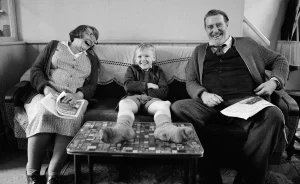
Even before cowpoke’s cowpoke Sam Elliot blurted his indelicate critique against Power of the Dog (and these days, Oscar Season just isn’t Oscar Season without some occasion for public outrage and virtue-signaling to keep the yahoos distracted), Jane Campion’s western was showing a slight drop from the front-runner status it seemed to nail down upon its premiere last fall. The first wave of acclaim, along with the initial flurry of critics’ awards and field-leading 12 Oscar nominations, was followed by an unusually quick and acerbic blowback. I’d expected Belfast to be the principal beneficiary of this shift in Power/Dog’s fortunes – and it still might be. But lately it’s CODA that’s been gathering a head of steam since it won a best-movie-ensemble award from the Screen Awards Guild (SAG).
Not that SAG’s record as a Best Picture harbinger can be counted on to float without sinking. Less than half of the last 26 winners of that award carried their luck over to Oscar’s big prize. And besides (trying not to spoil things here), CODA’s story of a working-class teenager choosing between fulfilling her destiny as a singer and helping her financially strapped deaf family fits snugly into how SAG’s members see their own careers and aspirations. You wonder if that story arc is likely to patch into other Oscar voting blocs. Heck, yeah, it is, especially if it makes everybody cry as they’re watching. At the time I’m writing this, it’s still Power of the Dog’s race to lose, and as one of my correspondents suggests, Sam Elliot’s “POS” tirade could end up gaining added sympathy for Campion and her movie. But recent history has me regretting every time I’ve underestimated the power of “feel good” movies.
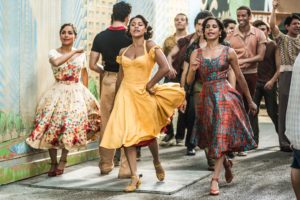
FWIW: Here’s where I usually talk about what I liked best last year, Oscar-nominated or not. Mostly I am, and plan to remain, confounded and aggrieved over Passing, its two stars Tessa Thompson and Ruth Negga, and its first-time director Rebecca Hall getting skunked out of any nominations whatsoever. In the long run, it may be all for the best; movies that are bold and enigmatic in their own time often find greater acceptance in another time – and I still believe in time. Speaking of boldness, I keep insisting that Nightmare Alley wasn’t a “remake” of a 1947 noir classic so much as a total reimagining as though 1945’s Detour (a far bleaker and grittier exemplar of “noir” movie than the original Nightmare) had a head-on collision with a Stephen King movie adaptation from the mid-to-late-1980s. It got a few Oscar bids in technical categories, but you’ll never see it win anything on live TV because of how they’re planning to telecast this year’s ceremonies. The Steven Spielberg-Tony Kushner revival of West Side Story deserved much better upon its theatrical release than it got from the public and from industry wise guys too quick or, maybe, too eager to stamp it as a disaster. These days, I’d say, the word “disaster” weighs too much to casually fling at a movie whose biggest mistake was having the bad luck to pile into movie houses during a pandemic. To me, there’s no greater portent for the inevitable fall of the multiplex than the turnaround in overall reaction to West Side Story 2.0 in the weeks since it dove into the streams, as it were. I also have a qualified recommendation for The French Dispatch that reflects the latent generosity, or greater tolerance from my older, more indulgent self towards Wes Anderson’s intricate jewelry boxes. Or maybe it’s that I’ve lately found his knee-jerk critics more insufferable as time passes for their all-too predictable carping and jeering.
Best Director
Kenneth Branagh, Belfast Ryûsuke Hamaguchi, Drive My Car Paul Thomas Anderson, Licorice Pizza Jane Campion, The Power of the Dog Steven Spielberg, West Side Story
Even if Power/Dog doesn’t get the Big One, it won’t keep its director from Getting Hers, as it were. It used to be an anomaly for Best Film and Best Director winners to diverge. It’s now happened often enough in recent years to be taken for granted. Campion still has lots of support for this one whatever Sam Elliot says. And, as I said earlier, he may even have unintentionally helped her stay in front of this pack.
FWIW: If I had a vote on this one, Spielberg would get it; if nothing else, just for withstanding all the catcalls he was getting, even as he was still trying to finish it against stiff odds. (e.g., “Why are you bothering? The first one was just fine!” Or: “Why are you bothering? This old warhorse is too creaky, an anachronism, etc.”) Branagh could also pick Campion’s pocket, but only if Belfast wins Best Picture.
Best Actor
Javier Bardem, Being the Ricardos Benedict Cumberbatch, The Power of the Dog Andrew Garfield, tick..tick…Boom! Will Smith, King Richard Denzel Washington, The Tragedy of Macbeth
As good as I am at intuiting such things, I still can’t tell for sure how much Hollywood still loves Will Smith, despite the hugs, kisses, and backslaps he got for winning the SAG prize a few weeks back for this same role. And yet I can’t imagine anybody else from this list taking the Oscar from him except possibly …Denzel, whom I’m sure Hollywood loves for still being able to open a movie on name recognition alone while always delivering nothing less than an A-level performance. His Macbeth isn’t his very best, but it’s good enough. Smith’s rendering of the Williams sisters’ volatile, complicated daddy, on the other hand, IS his very best. Not a slam dunk, maybe; Cumberbatch also lurks in the weeds. But taking everything into account, it’s close to a no-brainer.
Best Actress
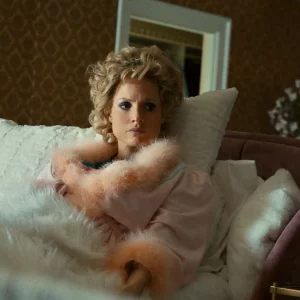
Jessica Chastain, The Eyes of Tammy Faye Olivia Coleman, The Lost Daughter Penelope Cruz, Parallel Mothers Nicole Kidman, Being the Ricardos Kristen Stewart, Spencer
Chastain’s SAG award vaulted her to the foreground of a not-terribly-strong-but-highly-competitive field. It’s a big, bravura performance, exactly the type that actors love to reward. And however effective, say, Kidman and Stewart (especially) were at embedding themselves in their real-life personas, it’s now Chastain’s to lose.
Best Supporting Actor
Ciarán Hinds, Belfast Troy Kotsur, CODA Jesse Plemons, The Power of the Dog J.K. Simmons, Being the Ricardos Kodi Smit-McPhee, The Power of the Dog
Another case where the SAG vote seems to have locked this one up. McPhee had the early lead, but with Plemons’ nomination for the same move came that hoary old saw about “splitting the vote,” which I never thought mattered much and won’t this time either. The veteran Hinds enjoys much affection and esteem among his peers and his turn as the grandfather in Belfast is lovely and touching. But Kotsur’s movie now has greater momentum and his is the far more compelling backstory.
FWIW: There was a moment early on when I thought Simmons had a fair shot of getting his second one of these and it had mostly to do with how even those who disliked Being the Ricardos were always happy to see his William Frawley appear on-screen.
Best Supporting Actress
Jessie Buckley, The Lost Daughter Ariana DuBose, West Side Story Judi Dench, Belfast Kirsten Dunst, The Power of the Dog Aunjanue Ellis, King Richard
Rita Moreno made me tear up when she soloed on “Somewhere” in West Side Story. I was sure that alone would have made inevitable another nomination, even another win 60 years after she copped this same award for playing Anita. Still, DuBose is getting unadulterated props – and prizes — for her fiery, effervescent, and deeply touching turn in the same role. She should have little-to-no trouble adding another trophy to the pile…
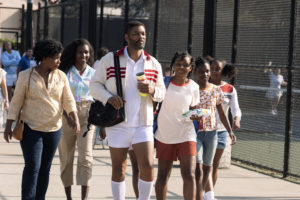
FWIW: …but if it were up to me, I’d ship this puppy posthaste to Aunjanue Ellis for all but stealing her movie out from under the Fresh Prince’s fabled jawline. Her character’s confrontation with a meddling neighbor was an aria of last-nerve enervation with Other People’s Bullshit. Love her, even if hardly any other forecaster seems to notice, or care.
Best Original Screenplay
Belfast Don’t Look Up King Richard Licorice Pizza The Worst Person in the World
Paul Thomas Anderson may be the most original and audacious living American filmmaker – which won’t necessarily help him win this one. You need to be in the mood for Licorice Pizza’s first-this-happens-then-this-happens-and-then-this-happens storytelling, which would be far more welcome to moviegoers in the 1970s when this story takes place. I was down with it because that decade was my most formative as a cineaste and it is probable there’s a majority of voters in this category who are likewise disposed. But I sense this one’s heading to Northern Ireland.
Best Adapted Screenplay
CODA Drive My Car Dune The Lost Daughter The Power of the Dog
This one’s wider open than it seems with all except, maybe, Dune carrying strong, if not overpowering cases on their behalf, and none as innovative as Kushner’s delicate, detailed upgrade of West Side Story‘s book, which was totally ignored. Even with CODA‘s late surge to the finish line, I’m thinking Power/Dog may have the edge. But not by a lot.
Best International Feature
Drive My Car Flee The Hand of God Lunana: A Yak in the Classroom The Worst Person in the World
Drive My Car’s triumphant ride through last year’s festival circuit made this elegiac dissection of grief an early favorite in this category. But this is an especially strong field, with both the groundbreaking Flee and Worst Person in the World drawing homestretch buzz. The Ukraine invasion could be a rogue factor favoring Flee if not in this category, then in one of the other two where it’s contending. Even past winner Sorrentino’s Hand of God has a puncher’s chance. Keeping my finger here for now but prepared to move it at any time.
Best Documentary Feature
Ascension Attica Flee Summer of Soul Writing With Fire
I’ve had dismal luck forecasting this category in recent years and I’m not quite sure about this pick either. As in past years, the outcome of this contest depends on whether Hollywood votes its hopes or its fears. Both impulses are very much in play in the present tenseness. As much as I was transported as everybody else by Summer of Soul’s found objects, I’m going to presume that both innovation and urgency count for a lot with this crowd and believe this is where Flee collects its Oscar.
FWIW: Once again, the grizzled ex-newspaperman in me is rooting for the nominee that shines a light on journalism overcoming formidable odds in foreign lands. Last year it was Romania’s Collective; this year it’s India’s Writing With Fire. Next year, it’ll be some doughty, put-upon independent weekly near the Urals – or, more likely, Central Florida.
Best Animated Feature
Encanto Flee Luca The Mitchells vs. The Machines Raya and the Last Dragon
Sony Animation’s rowdy, whip-smart sugar rush of a techno-satire is, in every sense, the wild card of this bunch. That it’s already won 25 awards from critics’ associations and other groups may come as a surprise to those who’ve watched only its first ten minutes or so on Netflix (where, BTW, you can still find it, even if it’s not always highlighted on the home page). It seems at the outset like such a typical example of formulaic dysfunctional-family slapstick that you’re almost shocked by how meta it gets without losing its edge, its warmth, or its run-amuck tempo. It’s by no means a sure thing, especially with not one, but two Disney entries and the aforementioned Flee as competition. But brains-and-heart, along with the much-beloved Olivia Coleman providing the voice of a megalomaniacal smart phone, seem to me a formidable combination of factors for victory.
FWIW: Unless I’m wrong and either Encanto or Luca end up in the winner’s circle after all.
Best Cinematography
Dune (Grieg Fraser) Nightmare Alley (Dan Lautsen) The Power of the Dog (Ari Wegner) The Tragedy of Macbeth (Bruno Delbonnel) West Side Story (Janusz Kaminski)
Once again, a good, strong field, all of them deserving. Because of that, I choose to go with my personal preference. Fraser may win it anyway. But this movie’s images keep crawling back into my head the way Dune’s do not.
Best Original Score
Don’t Look Up (Nicholas Ball) Dune (Hans Zimmer) Encanto (Germaine Franco) Parallel Mothers (Alberto Iglesias) The Power of the Dog (Jonny Greenwood)
Greenwood deserved this award in 2017 for Phantom Thread and he’d probably get his first win this year for his appropriately itchy and eccentric arrangements for Power/Dog if Zimmer, who’s only got one Oscar (The Lion King, 1994) to show for his 12 nominations, hadn’t done some of his finest work ever in laying down tracks, as it were, on Planet Arrakis.
FWIW: I’m going to assume, however, that the Encanto soundtrack’s prolonged stretch run on the pop charts isn’t lost on voters, many of whom likely have kids in the house who’ve played it to death on whatever platform or machine they have. Not that such factors have always tipped the scales; voters in this category like to think they’re above such matters. But nobody should be surprised if Encanto’s name is called. On any of these.
Best Song
“Be Alive” from King Richard “Dos Oruguitas” from Encanto “Down to Joy” from Belfast “No Time to Die” from No Time to Die “Somehow You Do” from Four Good Days
Does Billie Eilish beat Beyoncé? Do either of them expect to beat Disney? Or Van Morrison? (Well, yeah, because we’re all supposed to be ticked off at Van Morrison, right?) And what about Reba McEntire? Nobody knows from her movie anyhow. Maybe that’s why she’ll win. But I’m going with who’s hot right now and that would be…would be….could be…um…
Comments Off on Seymour Movies Thinks This Could Be The Last Time It Goes All Out on Oscar Predictions
Going to live performances for most of the past year was pretty much out of the question for me (with one notable exception cited down below). And there were so many reasons for this that relatively few of them had to do with the pandemic. (Here, for example, was a big one.) As for the brave not-so-new-anymore world of streams and clouds, one wasn’t always sure where one wanted to dump several hours of one’s life into binge-watching. Most evenings found me staring at the available options, all but completely immobilized by the sheer mass of “content” to the point where I frequently found myself saying, “The hell with all this noise!” and go to sports or Turner Classic Movies – or both. Or neither.
So given the myriad, metric tons of possibilities for my favorite things. of 2021, it’s possible that there may be things I’ve neglected, passed by, haven’t caught up with or entirely forgotten about. It may say something about the sheer glut of “content” that my top pick was a 2020 release, but it took me most of this year’s first half to absorb its content, and even longer to assess its impact. It’s still Up On Top, so to speak, because it’s too important to ignore – even if much of the culture, popular or otherwise, pretty much has:
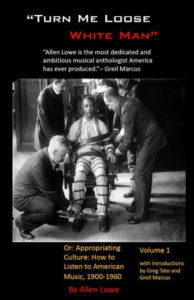
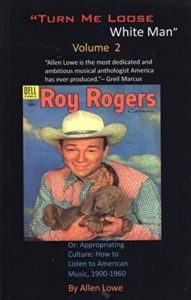
Turn Me Loose, White Man– Now that “critical race theory” has affected state and local elections, driven school boards up a wall and perplexed a mass media that doesn’t quite grasp the concept (or know exactly what it means), it may be time to consider the possibility that we’re all going about this “racial dialogue” thing the wrong way. Mostly we need to stop worrying about making Black and White people “feel better” about being what they are. “Feelings,” after all, are what got us all into this mess in the first place. Somebody needs to break the news, however gently, that none of us is as “Black” or as “White” as we think we are, thanks in large part to an ongoing cultural transaction that began centuries ago with music created by African slaves, propagated by their descendants, absorbed and, yes, appropriated by Whites only to be reinvigorated and even reinvented into new forms by pink and brown alike. Fellow Americans and worthy constituents, it’s in all our DNA, whether we like it or not. We’re all different, and always the same. Few people this side of Ralph Ellison’s ghost care to even consider such concepts, booby-trapped as they are with anachronisms, racial slurs, ribald and sacred outbursts swarming and popping on scratchy old 78-RPM records, archaeologic souvenirs of an earlier, exceedingly weirder America. But Allen Lowe, saxophonist, composer, historian, educator, and cultural gadfly, has long believed that if you gathered as much aural arcana as can be assembled, you could approach something resembling a unified field theory about what makes up the American soul in all its contradictory restlessness and conflicting exuberance.
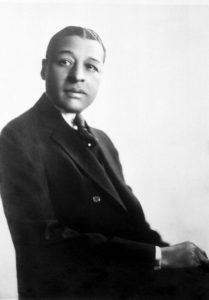
It takes 30 compact discs with almost 900 songs and two volumes of hypertext for Lowe to fashion Turn Me Loose, White Man, a survey of the national sound in all its permutations, blues, bluegrass, gospel, jazz, burlesque, C&W, R&B, rock and rockabilly in so many mutant and mongrelized strains that “genre” loses all meaning. As, Lowe implies, it probably should. Lowe’s archival efforts have been compared in range to those of such intrepid pioneers as Alan Lomax, Paul Oliver, and Harry Smith. But there are far more idiosyncratic and illuminating patterns Lowe draws from and, in some cases, imposes upon his discoveries. You’ll probably need to follow along, as much as possible, with Lowe’s written text (pure pleasure on its own) to gauge how and why on the first volume he chose to follow, say, the great Black vaudeville comedian Bert Williams’ 1906 recording of his deathless “Nobody” with the more obscure May Irwin’s whimsical 1907 sliver of minstrelsy, “If You Aint Got No Money, You Needn’t Come Around.” Note the use of dialect in the title’s first clause and the grammatical precision of the second. Such tensions are played out in big and small ways throughout this cosmic juke box whose selections cover the 20th century’s first sixty years. From the shuck-&-jive of Irwin’s “coon song” (defined by Lowe as “that odd phenomenon of progressive melody and harmony, advanced white singing, significant black co-optation and racist bait”) through the 1920s emergence of Black blues queens Bessie Smith and Ethel Waters and a panoply of artists from the widely celebrated (Louis Armstrong, Jimmie Rodgers, Al Jolson, Leadbelly, Count Basie, Bill Monroe, Bing Crosby, Kitty Wells, Charlie Parker, Roy Rogers, Little Richard) to just-below-the-radar legends (Geeshie Wiley, Babs Gonzales, Blue Ridge Quartet, Helen Merrill, Jimmy Yancey, Riley Puckett) and many more obscure or little-remembered artists whose contributions glow like searchlights struggling to be seen through twilight mists.
The zillions of epiphanies and discoveries along the way are too numerous to adequately summarize. The best I can do for now is to mention the shock of hearing the original bust-out 1911 recording of Sophie Tucker’s “Some of These Days,” composed by Black songwriter Shelton Brooks and thus an early example of appropriation; but one whose impact was galvanic enough to give safe passage to Tucker’s stardom well past the 1960s. Another shock: the spare, haunting 1941 recording of “Why Don’t You Do Right?” by the ill-fated blues singer Lil Green that Peggy Lee credited with influencing her own hit version the following year. And on and on…
Whether things should have turned out this way (and artists like Lee are the ones least deserving of blame) shouldn’t be a matter of concern to contemporary listeners anxious to throw as many red “racism” flags at the past as can be flung. (You’re better off blaming the Southern segregationist bloc in Congress for ruining what could have been a nice party for all.) The main point, as Lowe continually asserts, is that such push-pull dynamics, this braiding of cultures on record, as it were, didn’t validate or encourage racial separation. It was very much the opposite, even when the lyrics were far from conciliatory or respectful to Black people earlier in the century.
Lowe’s magnificent treatise comes to us as a gift we’ve needed for a long time, though this era being whatever it is, I don’t know whether the skittish, hopelessly judgmental masses who now dominate social media are prepared to deal with its sheer weight or its propensity for nuance, irony, wit, and surprise. For the moment, I choose to be optimistic enough to speculate that when these masses are ready for Turn Me Loose, White Man, it’ll still be around somewhere to both explain and evoke a world where the Light Crust Doughboys are as “ivey-divey” as the Sun Ra Arkestra.
The rest, as usual, are in no particular order:
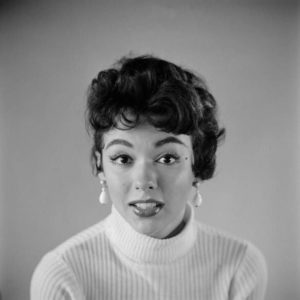
Rita Moreno – You know how you have those people in your life or in your personal pantheon of whom you always say, “If you don’t like —-, then I don’t want to know you”? Well, Rita Moreno has for most of my life been at or near the top of that list for me and it was as much for what she did when she was Being Herself on talk shows and interviews as for when she exploded on-screen in the original 1961 film adaptation of West Side Story and collected her supporting-actress Oscar the following year. As most of the known universe knows by now, she’s also in the Steven Spielberg-Tony Kushner version and not a few people believe she can win the same Oscar sixty years after she got her last one. It may not matter much either way as she’s practically a charter member of the EGOT sisterhood. What does matter is that this year, at a supernaturally energetic 90 years old, Moreno has been given her proper due and then some; not just with the new West Side Story (of which she is also a producer), but this past year’s release of Just a Girl Who Decided to Go for It, a PBS documentary about Moreno that gained viewership when it streamed on Netflix. She made being Rita Moreno look easier and much more fun than it likely was, especially when struggling through her dispiriting and (especially) demeaning early years as a studio ingenue. From those experiences, she developed superior emotional intelligence and fervent empathy towards all who struggled as she did. At about the five-minute mark of this interview clip, she talks about how when working as a series regular, she would go out of her way to make guest actors feel more welcome in unfamiliar, and in some cases, less hospitable surroundings. It’s not in the documentary, but it’s yet another reason, as if any more were needed, to cherish her forever.
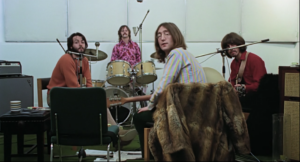
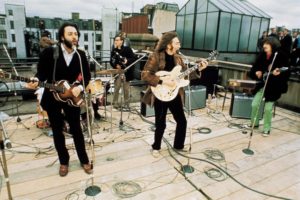
The Beatles: Get Back – As Samuel Johnson didn’t say, but would have, whosoever gets bored from watching four active imaginations pooling their resources to make music in a studio is bored with life. Eight hours of footage didn’t seem an exceptionally long time to get embedded in a handful of hard day’s nights in the studio. Much as they may have wanted to get back, so to speak, to live concerts, their basic instincts turned out right: they were better together in a studio than they would have been on stage in their latter days as a group. (The guess here is that if they’d stayed on the road any longer than they did, one or more of them would have gotten physically, seriously hurt as the decade they helped create began curdling like cream left open too long on the patio.) Even with all the tiffs, tantrums, and tensions sharing the room with them, the guys were in their safe space, as capable of mutually assured generosity (still loving the sequence where George is helping Ringo erect a bridge for the latter’s “Octopus’s Garden.”) as of sticking tiny needles into each other’s self-esteem. All of which happens when you’re just “hanging out” and this may well be for all time the sine qua non of cinematic “hangs.” The sainted Cassavetes couldn’t have pulled it off if he’d staged everything in advance: he could never have drawn up those two “what’s-all-this-then?” constables trying in vain to get the lads to shut down their rooftop concert. Questions for further study: Can we be sure Phil Spector didn’t put the old lady up to calling the cops? And where, in all this footage, was Phil Spector anyway?
Passing – With episodic television now firmly in the center of popular storytelling, it’s perhaps inevitable that some of the year’s most critically-lauded feature films tended to leave more of their narrative details to the imagination, much as producers, directors and writers tried to do in the mid-20th century as commercial television squeezed movie houses into tight corners. Jane Campion’s award-winning western noir The Power of the Dog was a revelation to many for its calculated ambiguity. I preferred Rebecca Hall’s directorial debut if only for the daring aesthetic and personal choices she made in adapting a Harlem Renaissance classic and thus proving (a.) that Nella Larson has earned serious reconsideration as a major American novelist and (b.) judging from some of the reactions to the movie, there remain some things about skin color we feel uneasy about.
Samantha Fish – So let me tell you how this happened: I was wandering around YouTube this past summer in search of vintage fifties black-and-white videos of the great country-rockabilly pioneer Wanda Jackson to show a friend of mine what she’d been missing. In the process, whatever algorithm mediates such things kicked up more recent live performances from a guitarist/vocalist I’d never heard before. Among the many things that led me from the Telluride thing was this solo recital above for New Orleans’ fabled WWOZ from a year ago when things were too locked down for live audiences.
Damn! I said to myself. Where’d she come from? I then asked myself.
Born 33 years ago this coming January in Kansas City, Fish’s been performing kickass blues, soul, and country rock for more than a decade and has recorded seven albums under her name, the latest of which, Faster, came out this past September on the Rounder label. She plays several different types of guitar at several different speeds and may well be the master of the amplified cigar-box. With composure and conviction, she can belt, purr, growl, and shout like a grizzled juke-joint veteran, a swampland Marilyn Monroe with a surfeit of sang-froid. She’s always on the move from one medium-cool venue to another, her smitten fans following her trail and hanging on her every well-wrought lick and riff. By autumn, I was so enamored that when I found out her tour would land at Philadelphia’s Union Transfer on my birthday night, I gave her concert as a present from me to me as the first live music show I’d attended since lockdown. I keep wondering why this woman isn’t ruling the world. One answer, the best I can come up with for now, is that the world as it is now constituted would need to be at once older and newer to deserve her reign. As things stand now, she already travels the world, finds love wherever she goes, and, as The Fugs would say, is doing all right.
Tear Across the Dotted Line – In a time like ours where narcissism and its toffee-nosed sibling solipsism rule the populace regardless of ideology, anything that chips away at what legendary basketball coach Pat Riley famously labeled “the Disease of Me” is worth your time. I’m certainly glad for the time I spent absorbing this six-episode animated series by the Italo-Franco cartoonist Zerocalcare, who also voices (in the Italian-language version) his cartoon alter-ego Zero, a snarky, self-absorbed, and self-sabotaging professional illustrator whose personality is best expressed by the giant orange armadillo who hangs around as his sardonic Jiminy Cricket: “You’re a black belt at dodging life.” Exhibit A for the armadillo’s diagnosis is Zero’s fraught, constricted relationship with Alice, a shy, enigmatic young woman with whose feelings Zero plays an exasperating game of keep-away, until tragedy forces him to confront his own mangier inhibitions. On this description alone, you may be inclined to take a hard pass. But there is genuine charm, wit, and ingenuity in execution, and it wins your heart, fairly and honestly, at the end, even if you’re left feeling that Zero would still be more annoying without the armadillo tagging along.
The Love Song of W.E.B. DuBois – “We are the earth, the land. The tongue that speaks and trips on the names of the dead as it dares to tell the story of a woman’s line. Her people and her dirt. Her trees and her water.” If you’re going to try writing a “great American novel,” you better come at it with a killer lead, especially if what follows is almost 800 pages long. Award-winning poet Honorée Fanonne Jeffers fulfills this first obligation in her first novel, an audacious, dense-star potpourri of bildungsroman, multi-generational history, socio-political inquiry and, as the title implies, love story. The coming-of-age story belongs to Ailey Pearl Garfield, habitually impertinent, intensely probing, and passionately engaged in the pursuit of her family background with all its upheavals, hardships, duplicities, and hard-won victories. For those who wonder if going so long and deep is worth the trouble, I yield the floor to culture critic Davin Seay who in 1982’s The Catalog of Cool posed the rhetorical question, “Ask yourself…you looking for something to do while the coffee cools or do you want to read a book?”
Lashana Lynch, Ana De Armas & Lea Seydoux – No Time to Die took its sweet time getting its business done, making Daniel Craig’s long goodbye to the James Bond franchise seem even longer than necessary. Still, the movie’s generosity of spirit towards its cast and its audience compensated for any number of longueurs and Craig’s comfort level with the 007 persona was never more evident, or more disarming, than it was on his way out. What also helped was a dazzling trio of what would have once been branded “Bond girls” for convenience’s sake, though somehow, they each seem emblematic of Things to Come rather than What Once Was. We’ll start with Lynch as Agent Nomi of MI-6, who in the wake of Bond’s resignation from the secret service, was granted “license to kill” status and made the most of it with a skill set formidable enough to get her out of any jam the franchise could conceive. Seydoux, reprising her role from SPECTRE as Bond’s enigmatic love interest Madeleine Swann, got to show additional bad-assery in an unexpected place beyond Bond: as the truculent prison guard who doubles as an artist’s nude model in Wes Anderson’s The French Dispatch. Last, and by no means least is Armas, who made perhaps the biggest splash with critics and audiences as Paloma, the callow, but poised CIA agent, whose one action set piece with Craig’s Bond showed she could take command of the screen on her own. When Armas’s Paloma split for Parts Unknown, you felt she’d taken much of the movie’s vitality with her. It’s been whispered that Paloma will be given her own movie as will Lynch’s Nomi. It’d be OK with me and I suspect millions of others if they paired up somehow, if the world could withstand so much magnetism from the same place.
Succession – For those who haven’t watched the third season, or for that matter, its two predecessors (and what are you all waiting for anyway?), I’ll try hard not to spoil anything for you by being of no real help whatsoever. Moving stuff around without changing anything about their miserable selves: that’s what being a member of the Roy family is all about, beginning with Mister “Fuck Off “himself, his satanic majesty Logan Roy (Brian Cox). Part of the reason Season 3 reached a new peak in dialogue was its many cogent deployments of the f-word as verb, adjective, noun, and adverb. beginning with what retains pole position as Snap of the Decade: not-as-smart-as-she-thinks sister Shiv (Sarah Snook) telling her not-as-hep-to-the-jive-as-he-thinks-younger bro Roman (Kieran Culkin): “Oh, you love showing your pee-pee to everybody, but sooner or later, you’re actually going to have to fuck something!” Then there’s Shiv’s not-as-pliant-as-he-seems husband Tom (Matthew Macfayden) telling nowhere-near-as-cool-as he-thinks renegade son Kendall (Jeremy Strong) why he can’t join the latter’s uprising against Big Daddy: “I don’t mean to be insulting, but having been around a bit, my hunch is you’re going to get fucked. Because I’ve seen you get fucked a lot. And I’ve never seen Logan get fucked once.” In the end, there’s Logan (and, as Tom says, this shouldn’t be a spoiler to those of us who’ve “been around” these jackals since 2018) proclaiming “I! Fucking! Win!” closely followed by Shiv’s doleful last words till next season, “Mom fucked us.” That’s more than enough fucking “fucks” for you to begin piecing together where things go from here. And you can count on so much more — and potentially worse — fuckery to come.
Comments Off on Gene Seymour’s Ten Favorite Things in 2021
I’m not altogether sure what it says about this year – or, rather, my year – in jazz that for the first time since I started putting these things together, a single artist dominates my annual list as William Parker does this one. It’s not as though he’s an overnight sensation; he’s been a redoubtable and influential fixture on the progressive jazz scene since the 1970s when the music’s cutting edge could be found working through its experiments in big-city lofts. But his impulse to outwork, out-produce and out-gig his peers both within and outside the (so-called) avant-garde has been especially apparent this year, not just with the significance of the ten-disc omnibus that leads the list (see below), but in the appearance during the past 12 months of at least six albums bearing his name, including three that are also on the list. (5, 6 and 10) It helps that Parker is something of a polymath: a grandmaster of the upright bass with a formidable body-of-work as a composer along with an ability to express himself on many other instruments and an accomplished, if relatively unsung poet. From reading Cisco Bradley’s Universal Tonality: The Life and Work of William Parker (Duke University Press), also published this year, one gets the impression that irrepressible curiosity and a multiplicity of interests are among the things that drive Parker forward. I’m sort of thinking that most of us who have struggled throughout 2021 to recuperate in various ways from 2020 while still feeling wary and uneasy about what’s happening now and whatever’s ahead could profit from the example set by somebody like William Parker, who at 70 has cultivated and honed his craft to a glistening edge while retaining an active abhorrence of injustice, a profound sense of cultural history and a steadfast, self-effacing core of spiritual equilibrium.
Most of the other artists on this year’s list have in different ways released albums that convey those same values. Some are declarative in expression, others more contemplative. They engage the prevailing disquiet, not (necessarily) in anger, but with a determination to face turbulence and dread with clarity and understanding. (I almost said “correctness.” I refuse to say “woke.” Never mind why.)
Also: if you’d somehow found my 20-something self under siege in the seventies and told me that more than a half-century later, albums headlined by both Pharoah Sanders and Archie Shepp would be included among my personal top-ten list, I’d have said you were either daft or irrationally optimistic. Their octogenarian triumphs make me wonder whether, “irrational optimism” is a legitimate and necessary response to whatever’s now threatening us all, whether from nature or from humans. It may well be that both Sanders and Shepp persist because they’re both still somehow necessary to fight the power in their different ways. Feel free to suggest that in another few decades, four of Wynton Marsalis’ albums will find their way to the upper half of such lists, assuming we’ll still have albums, or lists, or…
No. Let’s not go to there. We’re going to try “irrational optimism” for a while longer. At least, I am.
1.) The Music of William Parker, Migration of Silence Into and Out of the Tone World, Volumes 1-10(AUM) – On its own, this imposing gallery-without-walls is a Top-10 list. And not just for jazz, but also for world music, art songs, soundscapes and “spoken poetry.” Think of it also as a ginormous prism that, when held to natural light, emits wildly varying arrays of color and echo. The first volume, “Blue Limelight,” sets the table for its successors as Parker’s musical autobiography suffused with childhood memories and dreams (“Cosmic Funk,” “A Great Day to Be Dead”) and reminiscences of such colleagues as Cecil Taylor and lesser-know-but-still-legendary Hoboken trumpeter Bennie Bishop. The remaining volumes comprise a portable universe of possibility – and of orchestration: a whole disc of solo piano pieces played by Eri Yamamoto taking off from some of the composer’s personal iconography (Malachi Favors, Malcolm X) and his abiding engagement with Native American history and culture; another volume, “Cheops,” whose title track is named after an Egyptian pyramid, places in its foreground the startling range and pyrotechnics of vocalist Kyoko Kitamura with Parker not only playing bass, but also a bass dudek (an ancient Armenian double-reed instrument) and fujara (a “fipple flute,” tall enough to stare down a bassoon). The composer provides plenty of space for voices to lay out, notably on a volume where Lisa Sokolov does a stunning a capella recital of Parker’s “Afternoon Poem.” Parker throughout is less of a presence on bass than he is on other such exotic instruments whose deployment emerges in all manner of settings whether they are reveries of Harlem, Mexico or the films of Fellini, Visconti, Antonioni, and other Italian filmmakers (“Lights in the Rain.”) To find the best encapsulation of this ambitious collection, you need to go all the way back to the first volume’s third track, “I’d Rather Be” in which this titan of what is still regarded as jazz’s “avant-garde” has a character from one his “tone poems” declare that she “would rather be a human being than be avant-garde [because] the most avant-garde thing you can be is a human being.”
2.) Jazz at Lincoln Center Orchestra Septet with Wynton Marsalis,The Democracy! Suite(Blue Engine) – The leanest, tightest, toughest-minded music released under Wynton Marsalis’ name in decades made its public debut in the Appel Room of J@LC’s Frederick C. Rose Hall in September 2020, just about the time when the shattering events of that year were propelling the nation towards its Election Day rendezvous with destiny. There was no live audience because of the COVID-19 lockdown. But there’s urgency, momentum and focus merging together in Marsalis’ eight-part composition in ways not often encountered in his previous work. The first track, “Be Present,” is as declamatory as its title, throwing punches at the prevailing chaos without flailing. Once this group has your attention, it keeps up the pace with “Sloganize, Patronize, Realize, Revolutionize (Black Lives Matter),” a piquant rouser upon which Marsalis’ old boss Art Blakey would have pounced with polychordal brio. Of the ensemble’s soloists, J@LC mainstay Walter Blanding makes his tenor sax growl deep and dissonant on this track, in case there’s any doubt that Marsalis and his men are out to kick Trumpism in the teeth. But it’s not all grievance and exasperation. Things perk up with “Ballot Box Bounce” anchored by reed master Ted Nash’s breezy rendering on flute of Marsalis’ witty melody and “That Dance We Do (That You Love),” with Blanding, Nash, trombonist Elliot Mason, pianist Dan Nimmer, drummer Obed Calvaire, and bassist Carlos Henriquez helping their leader here and elsewhere make his most emphatic case yet for jazz being the consummate expression of, and metaphor for the democratic process: individual freedom flourishing within the collective imperative. And if the resilience of that paradox isn’t clear to all, or even some, Marsalis composes a movement for that, too: “It Come ‘Round ‘Gin.” As everything, good, bad, and indifferent, always does in America.
3.) Veronica Swift, This Bitter Earth (Mack Avenue)— For Swift, the classic pop song repertoire is more than an arena for her fearsome vocal agility. It is also a mode of interrogation, an agency of dissent. Think of how her sister Millennial phenom Cecile McLorin Salvant assembled a concept album of standards, 2015’s For One to Love, illuminating the often-casually toxic quirks of the male gaze. The title track of Swift’s latest album, which until now seemed the sole property of Dinah Washington, signals thoughtful and passionate engagement with the anxious present. She applies shading and intensity to the Clyde Otis dirge, which at once contains its majesty while maximizing its power. It’s an exquisite balancing act that sets the table for the creative and virtuosic renditions of stage musical standards and such Brill Building oddities as “He Hit Me (And It Felt Like a Kiss),” Carole King and Gerry Goffin’s disquieting dissection of abusive love, which she sings to the stark accompaniment of Armand Hirsch’s guitar. She carries this inquiry into questionable behavior between the sexes to such grand old war horses as “As Long as He Needs Me” from “Oliver!” and “How Lovely to Be a Woman,” from “Bye Bye Birdie,” whose effervescent interpretation barely conceals the gimlet-eyed contempt for its implicit sexism. She trains her sights on racism with Rodgers and Hammerstein’s “You’ve Got to Be Carefully Taught,” which is immediately, but no less trenchantly (or imaginatively) countered with that same duo’s “Getting To Know You.” Her range of concerns is as deep and wide as her vocal resources, taking in Bob Dorough’s bopping “You’re the Dangerous Type” and Dave Frishberg’s “The Sports Page,” cheekily summing up why so many of us seek refuge in scores and highlights from the exasperations of whatever “hard news” delivers. The present spreads all over This Bitter Earth. But Swift’s mesmerizing chops remain Beautiful and True in any time frame.
4.) Floating Points & Pharoah Sanders featuring the London Symphony Orchestra,Promises(Luaka Bop) – OK. John Coltrane’s Ascension, right? Pharoah Sanders was one of the eleven musicians who played on that landmark 1965 album that drew a line in the sand between those who were totally onboard for the Free Jazz rocket flight and those who wanted no part of it. After a six-decade career which he began as an avatar for “outside” saxophone inventions, Sanders, now 81, aligned himself with British electronic music artisan Sam Shepherd, alias Floating Points, who composed a nine-part suite he and Sanders recorded with the LSO not long before everything locked down. So, what does the tempestuous Ascension, which I’ve routinely characterized (in a good way) as a “sonic maelstrom” or a “polyphonic orchestrated abstraction” have in common with a sequence of suggestive, near-pastoral impressions? (A glibly convenient, if not terribly useful shorthand description might be, “trance music with soul.”) For one thing, both works take off from a simple progression of notes that become an ongoing riff: Ascension takes off from five while Promises sets sail from seven. Each work also wears its own brand of inscrutability, daring you to poke around its layers, resisting any effort towards “understanding” what makes each of them tick. With Promises, there are tensions winnowing throughout between space and time, declaration and insinuation, abandonment and resolve. Sanders’ voice, downier, warmer, but every bit as probing and incantatory as it was when he was in his mid-twenties, is what carries you along the contours laid out by Shepherd’s keyboards and the LSO’s strings. (At various points, you hear the saxophonist’s gentle singing voice seeping into the mixture with his own non-verbal lyrics.) On the whole, the album delivers nowhere near the same kind of intensity associated with Ascension. It is a far subtler, more enchanting, and comparably provocative experience that coerces repeated listening in search of more secrets, not resolutions necessarily, just more secrets.
5.) William Parker, Painter’s Winter (AUM)
6.) William Parker, Mayan Space Station (AUM) – Two very different trios make the case for Parker’s mastery of both his principal instrument and of guiding small bands of any size towards expansive and productive interplay. With electric guitarist Ava Mendoza setting off harmonic firestorms propelled by the equally combustible drummer Gerald Cleaver, Mayan Space Station is redolent of the riveting mosaics of amplified sound forged in trios led by the late Sonny Sharrock. Parker’s bass playing does as much breakaway running as his two partners, though most of the time he’s content to drive this vehicle forward and let their younger people go off. The acoustic trio on Painter’s Window that includes multi-instrumentalist Daniel Carter and drummer Hamid Drake seems a lot more composed. But their collaboration is just as intense and deeply committed with Carter’s solos on trumpet, saxophones and flute unfurling intricate patterns as Drake’s percussive momentum shifty enough to keep up with the indefatigable bassist. Besides Parker, the only quality these two discs share is narrative drive that’s both refined and rugged.
7.) Kimbrough (Newvelle) – Frank Kimbrough died just before last New Year’s Eve at 64, setting off a still-resounding wave of shock and grief from generations of jazz musicians who played with or studied under him. Among these artists, Kimbrough was beloved as a “pianist’s pianist,” a droll and ubiquitous presence on the New York City scene, an archivist tending diligently to the legacies of Herbie Nichols and Thelonious Monk, a crucial member of the critically acclaimed Maria Schneider Orchestra, a devoted teacher who mentored aspiring musicians at NYU and Julliard, and a gifted, uncompromising, and prolific composer. It is mostly to that latter aspect of Kimbrough’s life and work that this extensive, ambitious tribute album was recorded almost six months after his death. There are 61 tracks featuring 67musicians in 55 different combinations. Any random sample of the players involved – Ben Allison, Fred Hersch, Michael Blake, Dave Douglas, Craig Taborn, Joe Lovano, Matt Wilson, Helen Sung, Noah Preminger, among many others – is enough to suggest the breadth and depth of Kimbrough’s influence on his peers and ex-pupils alike. The compositions they play, sometimes on one take and in different versions (“Reluctance” is rendered in solo and quartet form) offer so many revelations as to suggest decades to come of workshops, repertory orchestrations and ensemble performances of Kimbrough’s mostly unsung work spreading out to concert halls and colleges here and abroad. In the immediate aftermath of Kimbrough’s passing, one of his heartbroken friends wondered whether it marked the end of an era or the beginning of a new one. This album’s release reinforces my belief that it’s more the latter. I’m sure Frank would agree.
8.) Archie Shepp & Jason Moran, Let My People Go (Archieball) – There was always something of the old-time spiritual revivalist in Shepp, even as far back as the mid-1960s when he emerged as one of the more stridently political of the emerging tenor saxophonists inspired and nurtured by John Coltrane. At 83, Shepp doesn’t let his phrasings wail with the sustained force he exerted on such classics as 1966s Mama Too Tight, 1972’s Attica Blues or (my all-time favorite) 1975’s A Sea of Faces. His mature style relies more on space and timing, the vocalizing more contained, but no less intense. In this collaboration with the mighty, simpatico pianist Jason Moran, Shepp sings with and without the tenor or (mostly) soprano sax with a depth of feeling that releases itself in bursts, especially in the “sorrow songs” such as “Go Down, Moses” and “Sometimes I Feel Like a Motherless Child.” Shepp’s stark, weathered vocals allow you to hear each line and word with a deeper sense of desolation and yearning on these spirituals and Moran’s own spare and impeccably timed comping provides an elegant frame for Shepp’s arias. On the other tracks, Shepp and Moran are more conversational, their measured, lively exchange of themes and ideas inspiring fresh ways of engaging such familiar standards as Ellington’s and Strayhorn’s “Isfahan,” Monk’s “Round Midnight,” Coltrane’s “Wise One,” Shepp’s own “Ujamaa,” and, in an especially multi-layered rendering, Moran’s own “He Cares.” Shepp’s patented blurts, bleats and squawks flare up over the cushions of chords Moran sets loose or holds back whenever the occasion demands. It often sounds as though both are collaborating on separate dramas with their synchronistical dialogue weaving seamlessly into place. One remembers that back in those 1960s, Shepp was, among other things, a playwright.
9.) Julian Lage, Squint (Blue Note) – Anyone whose curriculum vitae includes gigs with Nels Cline, Charles Lloyd, John Zorn, Bela Fleck, Gary Burton, David Grisman and Yoko Ono should have your attention from the jump. And Lage (pronounced “lahzh,” as in “lozenge”) goes all out on his first release with the fabled Blue Note label to show he can do anything and everything he wants to with a guitar, whether it’s a neoclassical a cappella solo (“Etude”), straight-ahead swing (“Boo Blues,” the title track), classic covers (Johnny Mandel’s “Emily,” Gene Autry’s “Call of the Canyon”), country-rock (“Day and Age,” “Twilight Surfer”). Clearly Lage knows more than a little about a lot of different genres. But he makes his best impression as a player not by leading with his learning or virtuosity, but by gently asserting and maneuvering his own sensibility into each piece. It helps to have a rhythm section of bassist Jorge Roeder and drummer Dave King as smart and attentive to his needs as any great piano trio. Indeed, Lage’s trio has drawn comparisons to Bill Evans’ deathless 1961 Village Vanguard threesome both for the seamless interaction between the principals and the insinuating lyricism. Other influences raise their hands for attention in Lage’s style from Chet Atkins to Pat Martino. But Lage, who first gained notice as an eight-year-old prodigy, is still just getting started and with greater name recognition an all-but-inevitable result from Squint , one gets a little tingly over what he’ll be able to do with even broader resources available to him.
10.) William Parker & Matthew Shipp, Re-Union 2021 (Rogue Art) – Though Parker and Shipp have worked together on several projects with larger groups, this Re-Union marks only the third time they’ve played together as a duo. Their respective personalities blend so well together that it’s surprising they haven’t “re-unioned” more often. As with most friends’ conversations, one of them starts out with something small: a thread, a fragment, a half-baked suggestion, the punch line of a joke neither knows about (yet), any of which could make the other either carry the thought towards a tentative conclusion or veer off into another topic entirely. Which is how I’d best characterize the 22-minute title track that kicks things off. If you’re able to keep up with the exchange, you can start taking measure of the two personalities and how they are or aren’t alike. Shipp’s eccentric, enigmatic combinations of chord clusters follow their own logic while Parker’s austere, but fluid bass lines follow him along when they’re not shoving him in an altogether different direction. Neither seems particularly worried about whether the other lands, though the unwary listener should always be alert for shifts in direction, temperament, maybe an impromptu lull in their transaction before picking up the previous thread or finding a new one. They’re both free spirits in different ways – but not so free-spirited that they forget you’re listening. So be ready when Parker decides to pick up his bow to assert himself more or Shipp re-doubles his efforts to deepen his attack. Think of it as just another afternoon of eavesdropping at the coffee house when voices are raised without warning, but nobody’s mad at anybody. In this spirit, we leave the last words to both these gentlemen.
HONORABLE MENTION: Kenny Garrett, Sounds from the Ancestors (Mack Avenue); Vijay Iyer, Uneasy (ECM); Henry Threadgill Zooid, Poof (PI); Gerry Gibbs Thrasher Dream Trios, Songs from My Father (Whaling City Sound); Bill Charlap Trio, Street of Dreams (Blue Note) Artifacts (Tomeka Reid, Nicole Mitchell, Mike Reed)…and then there’s this (Astral Spirits)
REISSUE OR HISTORICAL RELEASE: 1.) Hasaan Ibn Ali, Metaphysics: The Lost Atlantic Album (Omnivore) 2.) Roy Hargrove & Mulgrew Miller, In Harmony (Resonance) 3.) Hasaan Ibn Ali, Retrospect in Retirement of Delay: The Solo Recordings (Omnivore)
Reading J.W. McCormack’s overview in the latest Baffler magazine of Donald Barthelme’s life and work while watching the sixth and final game of this year’s World Series added a thin, but pliable layer of poignancy to a bittersweet evening. I had by then finally decided after days of back-and-forth that I wanted the Astros, Don B’s hometown team, to at least take the Braves to a seventh game, if not (necessarily) Win It All. Part of it was about redemption for the Space Cowboys’ dismal and now apparently embedded reputation for cheating their way to a 2017 championship.
Mostly I was rooting hard for their manager Dusty Baker, who at 72 may be past hope of smelling the metaphoric roses but will likely be remembered as the kind of manager who took unruly, star-crossed and/or degraded franchises and got them to stand upright enough to move forthrightly towards Ultimate Victory. He likewise fell short with the Giants, Cubs and Nationals, all of whom would, in time, reach the promised land without him. While I wasn’t altogether sorry to see the Braves bathing in champagne (paternal family ties to the state of Georgia, plus which they ended up being my late mother’s favorite baseball team) their triumph left a taste of melancholy; an altogether suitable context when reading about Barthelme’s Houston roots, since as his old pal Thomas Pynchon once wrote of him, melancholy was at the core of Don B’s exotic, eccentric body-of-work. Quoth Tom P:
“As any Elizabethan could tell you if they all weren’t dead, melancholy is a far richer and more complex ailment than simple depression. There is a generous amplitude of possibility, chances for productive behavior, even what may be identified as a sense of humor. Barthelme’s was a specifically urban melancholy, related to that look of immunity to joy or even surprise seen in the faces of cab drivers, bartenders, street dealers, city editors, a wearily taken vow to persist beneath the burdens of the day and the terrors of the night. Humor in these conditions leans toward the anti-transcendent — like jail humor and military and rodeo humor, it finds high amusement in failure and loss, and it celebrates survival one day, one disaster, to the next.”
Put another way, it’s the kind of melancholy that accommodates conflicted emotions, whether they come through winning while losing, loving while hating, or resisting while enduring: a natural progression (a musical analogy that Barthelme the jazz hound would appreciate) to the off-off-year election results that yielded a Democratic loss of the Virginia gubernatorial election and an apparent stand-off in the New Jersey gubernatorial race. I knew last night that it was a mistake to switch from the Series’ postgame festivities to CNN for the latest vote tallies, further eroding my mood and devastating prospects for a good night’s sleep. What depressed me weren’t the results so much as the exasperating inevitability of “post-game assessments” by the punditocracy: “Uh-oh. Looks like BIIIIG trouble for President Biden, Nancy!” “How right you are, Cliff! This is clearly a referendum on the administration and the early returns look pretty bad for Biden and the Democrats!” “Yes, they should take a page out of Ronald Reagan’s winning formula and reach out to the disaffected white middle-and-lower-middle classes and blather-cliché-platitude-placate-pander-pander-pander …”
Nobody asked me, but (thanks once again, Jimmy Cannon) I don’t think any of this is Joe Biden’s fault. Or at least it’s not entirely Joe Biden’s fault. In fact, the president seemed to have had, despite some mishaps along the way, a pretty good week in Europe, patching up leaks, reasserting leadership in the climate crisis and generally staying upbeat as is and has been Joe’s way, whatever the situation or the odds. But however pugnaciously he keeps insisting otherwise, #46 isn’t close to getting “moderate” and “progressive” members of his own party on the same page with what seems to any rational human being his vitally needed package of economic-recovery expenditures. Placating those who holler “Socialism!” or (a euphemism I’ve decided I hate now more than any other) “Critical Race Theory!” at them seems to be the Democratic game plan, along with giving the billionaire senator from West Virginia a far bigger public profile than he or anybody else requires.
White Guys, in other words, are The Solution as far as the political establishment and their media enablers are concerned. And yet, candidates-of-color (including one woman) triumphed in mayoral races in Pittsburgh, Boston, and New York City. Cities are cities (especially in the northeast) and states are states. But did anybody in Virginia bother to consider what a candidate-of-color could have done in what experts insist is an increasingly blue state against a Trumpian mediocrity like Glenn Youngkin? Instead, the Democrats ran Terry McAuliffe, who was, besides being Another White Guy, a retainer from the Clinton years. Old news, as even the dimmest bulb in the political press corps could and should have suspected.
Some people think I lean too much on the wisdom of my late fellow worker Murray Kempton. But among his many wise observations was (and I paraphrase) that political success is most attainable by those who ally themselves to the future while bearing little to no responsibility to the past. “The past,” Murray once said in this context, “already has a job.” And yes, I know who’s president (for the time being). But Biden was smart enough back when the primaries were seemingly happening a million years ago to understand that his best chance to get nominated was to leapfrog his way to Black power brokers like Jim Clyburn and make them see that his years with Barack Obama allowed him to perceive as others didn’t the possibilities #44’s presence, if not his policies, signified for the party’s future. Whatever their respective ideologies, Eric Adams (basically as “moderate” as they come), Michelle Wu and Ed Gainey represent, at the very least, the chance for Something Different in their party than whatever came before, including, maybe especially, the Clinton era.
I’m willing to bet whatever pittance I’m carrying in my wallet that you’re not going to hear any Political Insider hired by television say such things. I refuse to take whatever these talking heads say seriously unless they are in any way familiar with the aggregate works of Albert Murray AND James Baldwin, Toni Morrison AND Grace Paley – and, of course, the aforementioned Donald Barthelme (had to get back to him), whose short fiction was once regarded as surreal, but I’ve lately come to believe was farsighted enough in the sixties, seventies and eighties to now comprise hyper-explicit accounts of our present-day reality. Writes McCormack: “[Barthelme] dwelt in the fissures of the conscious mind and made work that was neither one thing nor the other because it was both and neither…a trickster spirit…who took nonsense so seriously it congealed into wisdom, the effect of staring so deeply into the void that not only does it stare back, it becomes cross-eyed.”
Don’t take his word for it, or mine. You’ve got time. Look into him – and don’t be surprised if those stories we’re talking about look into you.
Comments Off on Winners and Losers in the Race for the Future
On the very (very) hot afternoon of June 30, I was walking the four blocks it took to get from the 47th Street and Walnut bus stop to my West Philadelphia condo between Spruce and Pine Streets. My son was striding ahead of me as I struggled to catch my breath. When I got to the corner of Spruce, I suppose I must have been in bad enough shape for my son to ask, “You OK, Dad?”
And that’s when I blacked out and, from what I was later told, fell face first on the sidewalk.
I had come to shortly afterwards, my face covered with flecks of concrete, my left eye oozing and burning. Apparently it was my son, whose home is about 2,900 miles west of us but,, fortunately, happened to be visiting us that week, who called 911 and was instructed to turn me over on my back so I could breathe. The only pain I was feeling was from my eye; there was no chest pain whatsoever even though the immediate diagnosis was that I had suffered a heart attack.
I spent whatever was left of the afternoon and evening in Penn Presbyterian Hospital’s emergency room as all kinds of tests were administered (EKGs, EEGs, ultra-sound and bloodwork, bloodwork, bloodwork). By the following afternoon, a cardiologist came in to tell me that I didn’t have a heart attack, but that I was laid low by something called aortic valve stenosis.
It was not entirely unexpected. I was warned some years back that there was… something going on with my aortic valve. As recently as a year ago, I found myself short of breath on my morning walks but preferred to think it had something to do with having to wear a mask outside because of COVID-19. Except that when I didn’t have to wear a mask, I still needed to take breaks if I walked more than, say, four blocks back and forth from home.
Whatever the case, things had gotten serious enough to consider one of two procedures for dealing with this. The first was an all-out replacement of the valve through open-heart surgery, which the cardiologist believed would be both painful and drastic. The second was the less invasive transcatheter aortic valve replacement (TAVR), in which, as the name implies, a catheter is inserted through the leg or chest and implants a replacement valve into the damaged valve. This was considered the option with the least possible hospitalization time and, as such, sounded preferable. At first.
I was sent home for a while with orders to avoid heavy lifting and other exertions. (“Can you be sedentary?” the cardiologist asked. Like a fiend! I replied.) I had to wait for Penn’s cardio-surgery team to fully inspect my portfolio of scans and X-Rays to determine which of the two options was the best. When the team captain, as it were, told me of “severe calcification” around the exhausted valve I sensed where this was going and by the time they told me they were going to break my chest open and do a full-bore valve replacement, I was OK with it, even at (a kind of) peace.
“You’re young enough,” I was told, “to withstand whatever rigors will happen with the surgery.” Which was the first time I was ever aware that being sixty-eight was “young enough” for any “rigors,” physical or otherwise. Fine, whatever.
Surgery took place August 27 and took several hours. (Or so I was told later.) All went well, except for what I was later told was a helluva time trying to “intubate” me to help with breathing or eating or maybe both. I can’t say which, for sure. The day was kind of a blur for me. As was the day after and part of the day after, which, if memory serves, was a Sunday.
I remained more or less out-of-it for the following 24 hours or so, during which time the chief surgeon and some of his team dropped by and noted how good my incisions looked. That was cute of them, because they felt like hell, all swollen and very sore. To his credit, the chief surgeon did tell me at the outset that open-heart surgery was going to hurt. So no one can say I wasn’t warned.
Oh…I almost forgot…
One of the assurances my procedure offers is that my replacement valve will be totally organic (if that’s the right word) and that it would either be a “porcine” or “bovine” valve. Since my surgeon prefers the latter, there was no chance I was going to get pork instead of beef. So my new valve comes by way of the cow…or, maybe even a bull. I don’t know for sure and neither does anybody else. At least, nobody’s told me.
So, in the absence of such information, I have resolved to do what an old friend of mine did and give my new valve a name: Ferdinand.
Now before any accusations of gender preference are heaved in my direction (I’m still kind of an invalid, people, so cool it), let me remind you who Ferdinand is: the hero of a 1936 children’s book by Munro Leaf (1905-1976) about a nonconformist bull who prefers lying under trees and smelling flowers to charging matadors. It’s proven so popular that it’s inspired more than one animated film and lulled several generations of small children to sleep. It’s also been banned in some libraries for being subversive, accused, by turns, of being anarchist, pacifist, communist and (even) fascist. Mostly, I think of him as the ultimate passive resistor, Gandhi with hooves, horns and a tail. I don’t think I’m the only one.
So Ferdinand and I left hospital five days after surgery and we seem to be getting along just fine even with the residual soreness that logically ensues from having one’s chest bone sawed open and sewn together again. I’ve taken my new bovine pal out for short walks at least twice daily now and am already anticipating our first party, road trip, ball game and live concert.
But not all at once. If there is anything this now receding summer has given me, it is the impulse to take one’s time on everything. And by “everything,” I mean…everything: walking, talking, bathing, eating, even picking stuff off the floor. Is “re-behave” a word? If so, that’s what I’ve been doing these last three weeks and expected to be doing more of the same for the weeks and months to come. Quite likely, it was about time anyway.
Now if you’ll excuse us. The bovine and I have some flowers to smell.
Comments Off on In Which I Get My New Aortic Valve & Take it Out For Walks
If blame is necessary, then it goes to my good friend, humane observer and fellow professional spectator Tim Page, who was inspired by this year’s recently completed Academy Awards to come up with his own entirely subjective Best Picture list for every year he’s been alive. He posted this list on Facebook and the heroism of his effort so inspired me that I was compelled to come up with one of my own.
I had fun with it while I was picking and choosing. But as soon as I was finished, I was all but overcome by a profound sadness. Because as I surveyed this list, it came across more like a melancholy relic of an era of moviegoing that is all but swept away by the streams and clouds of the digital age, along with the countervailing bombast of spectaculars and star-packages contrived to keep whatever’s left of the multiplexes alive and upright, post-pandemic.
Whatever you want to say about my choices, which are presented with little more than random illustrations and no explanations (or, at this point, equivocations), they each came from discoveries I made either at the time they were released or, mostly, long afterwards. They are not commodities to be assessed like IPAs or yoga mats, which seems pretty much how most “consumers” assess filmed “product” these days; these films were means of stretching my senses, deepening memories, sharpening the landscape around me. They are all places to which I am always happy and eager to return so I can re-encounter the arcane joys they gave me and, maybe, find something new to like about them as an older, if not always wiser viewer.
“Viewer.” I like that word so much better than “consumer.” Don’t you?
A couple things before we begin: 1.) It’s entirely possible that some of the things on this list could change over time. They did in at least a few places as I prepared to post this version. 2.) These are in no way intended to be a definitive, all-time-great, etc. or whatever other euphemism you wish to use. They are parts of myself that I and I alone declare as a personal best for each year. You will have your own. I shall be as forbearing towards those as I hope you can manage to be for mine own.
So…
1952:Singin’ in the Rain 1953: I Vitteloni
1954: Rear Window 1955: The Night of the Hunter 1956: Invasion of the Body Snatchers
1957: Sweet Smell of Success 1958: Vertigo 1959: Rio Bravo 1960: Shoot the Piano Player
1961: Yojimbo 1962: The Manchurian Candidate
1963: Charade 1964: A Hard Day’s Night 1965: The Spy Who Came in From the Cold/Pierrot Le Fou
1966: Persona
1967: Bonnie & Clyde 1968: 2001: A Space Odyssey 1969: The Wild Bunch 1970: The Landlord
1971: McCabe & Mrs. Miller 1972: The Godfather 1973: Ganja & Hess 1974: The Godfather II
1975: Jaws 1976: All the President’s Men 1977: Annie Hall 1978: Blue Collar
1979: Being There 1980: Raging Bull 1981: Diva/My Dinner With Andre
1982: Blade Runner 1983: The Right Stuff 1984: Repo Man 1985: Lost in America
1986: Blue Velvet 1987: The Princess Bride
1988: Bull Durham 1989: Do the Right Thing 1990: GoodFellas 1991: Daughters of the Dust
1992: One False Move 1993: Groundhog Day
1994: Pulp Fiction 1995: Toy Story 1996: Jerry Maguire
1997: L.A. Confidential 1998: Babe: Pig in the City
1999: All About My Mother 2000: Yi-Yi
2001: In the Mood for Love 2002: 25th Hour/Talk To Her
2003: Lost in Translation 2004: Eternal Sunshine of the Spotless Mind