Oh, wait…I did. Maybe not exactly in his words. But I have for a while been saying in this space that the movies have been over going back at least a couple decades, if by “the movies,” you mean the process of theatrical releases shot, cut, dried and shipped fresh to as many exhibitors as can take them, the popcorn blockbusters and the rom-coms, the tentpole franchises and the scruffy horror knockoffs, those that are Searchlights and those that are…Everything Else. The COVID lockdown only accelerated a steep decline in the picture industry’s conventional way of doing business. Once-thriving multiplexes were vanishing from urban and suburban territories as far back as the second Bush administration, if not sooner, making the theaters of the present and foreseeable future boutique businesses. Oddly enough, none of these transitions seems to have adversely affected the Academy Awards. They’re still a TV show and TV, obviously, rules the culture from stream to shining stream. Oscars are a reality show, above all, maybe the very first. And the objective of all reality shows as far back as “Candid Camera” is to catch people in the act of Being Themselves, even in a roomful of people whose expertise is to pretend to be Anything But – unless, of course, somebody gets mad enough to slap somebody silly. And that only happens once in a century. Unless we’re lucky…
This year’s show might be suspenseful enough without meaningless violence. If last year’s Oscars were mostly chalk, this year’s competitions are wide-open…with, maybe, one or two exceptions. The BAFTAs and trade awards have been little help in pre-determining this year’s winners since the choices seem to change with each show…again, with, maybe, one or two exceptions.
So, I’m guessing there’ll be some uncertainty leading up to March 2. The larger uncertainty, however, is the extent to which anybody besides movie buffs and industry people will care up to that point. That’s the thing with TV shows. Doesn’t matter what the reason is for them to be on. They need to get eyeballs above all else and the Golden Globes was smart enough to get Nikki Glazer at the peak of her post-Tom-Brady-celebrity-roast moment to host their shindig. No shade on Conan O’Brien, at least from this corner of the room. But has he told enough short people jokes lately to meet the stringent expectations of a bloodthirsty mass audience needing to Feel Seen? After all this time, the Academy still doesn’t have the guts to let Kevin Hart host their show after all his movies have done for Hollywood. And you have to hand it to Hart because he…never mind. You know the rest.
As usual, predictions are in bold and, whenever I think it’s appropriate, amended with a FWIW (For Whatever It’s Worth) comment.
Another note, now that I’ve got these all written out: I’ve seen way too many of these damn things.
Best Picture Anora The Brutalist A Complete Unknown Conclave Dune: Part Two Emilia Pérez I’m Still Here Nickel Boys The Substance Wicked
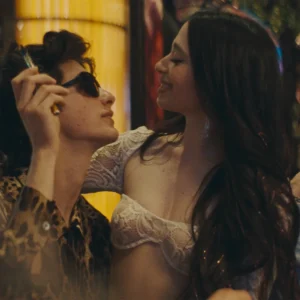
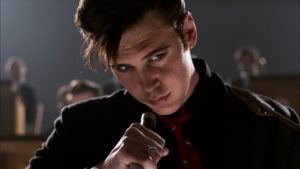
Anora swept up the producers, directors, and writers guild awards in this category, so you’d have to believe it’s All Over, right? But remember that this is the AMPAS and I worry there’s too much T&A from the jump in this movie to rub some older voters the wrong way. Then I think: well, what does “older” mean in an Oscar voter these days? Sixty-something? Seventy-something? I’m 72 now and what my late mother and her sisters would consider “too sexy” or “too racy” isn’t all that “too” for my unapologetically boomer sensibilities. Granted, there are others in my demographic group who feel otherwise, but then there are likely fifty-somethings, or even forty-somethings among Academy voters for whom some of the sequences in Sean Baker’s contemporary fairy-tale-with-toads would be excessively sordid. Assuming that’s the case, where else would these votes go? Early on, it was plausible to believe that Brutalist,Conclave or Complete Unknown would have led the parade, being paradigmatically “prestigious” or “serious” productions.
Consider also that comedies haven’t often won for Best Picture since the 1930s, especially romcoms, (Annie Hall, you say? Maybe the one exception that really makes the rule.) So, at the risk of further spoiling my recent record on this category, I’m taking a shot on a dark horse, even if dark horses have an even poorer track record in this category than comedies. (For rare exceptions, see Crash. Or don’t.)
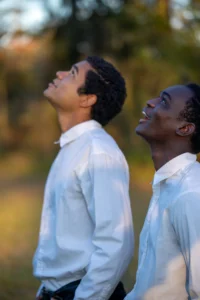
FWIW: But is Anora a comedy? That’s what everybody’s labeling it, even though I happen to think (and I don’t think I’m alone) that Baker’s story all-too-perfectly captures what those with an overabundance of money and power do to those who struggle to survive along the margins. Of the other candidates on this roster, Nickel Boys may be its closest analogue in this arrogance-of-power thematic context and RaMell Ross’s adaptation of Colson Whitehead’s Pulitzer-winning j’accuse is the most artistically daring of the nominees here. If I’d been an Oscar voter and Kamala Harris had won last November, Nickel Boys would have gotten my endorsement. But because the Other Guy got his ticket punched again, I’d likely go for the one about the lap dancer from Brighton Beach who gets fucked (over) by a Russian oligarch prince. Gruesome as Nickel Boys’ true-life horrors were, at least there was a glint of hope at the end, however belated.
Also: You’d have thought, especially at the outset, that the two musicals on this roster would have garnered much more attention and anticipation by now because they’re, you know, musicals. Emilia Pérez did get a lot of attention, though by no means was it the kind it wanted. As for Wicked, the general suspicion is that Oscar’s withholding its love until the second installment drops next year. Which makes almost as much sense as there being two installments in the first place. The exhibitors likely made this call since the idea of a four-hour-plus musical lumbering through the marketplace seemed illogical given America’s fast-shrinking attention spans, especially the teen-girl target demos. I’m in agreement with those who believe that attention spans in general have two settings: forty seconds and three-to-four hours with nothing whatsoever in between. It could’ve been done for Wicked. But it wasn’t. So those witches will have to wait. At least, one of them may anyway. (See further down.)
Best Director Sean Baker, Anora Brady Corbet, The Brutalist James Mangold, A Complete Unknown Jacques Audiard, Emilia Pérez Coralie Fargeat, The Substance
For a while, this seemed Corbet’s to lose and, despite Baker’s DGA and PGA wins, I think he still could win. His unexpected BAFTA win suggests as much. There’s also a slight chance that Mangold could sneak in from behind, given the good will his movie’s sustained throughout the season. But I’ll follow the producers’ and directors’ leads on this, even with my earlier misgivings as to whether Baker’s movie is too racy to be Best Picture.
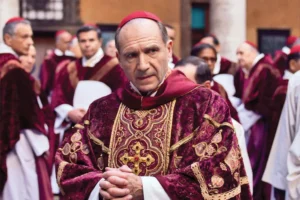
Best Actor Adrien Brody, The Brutalist Timothée Chalamet, A Complete Unknown Colman Domingo, Sing Sing Ralph Fiennes, Conclave Sebastian Stan, The Apprentice
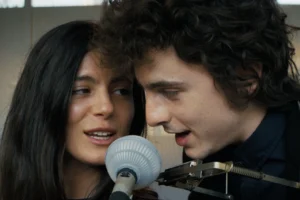
Brody has been securely in front of the pack since his movie’s premiere last fall and there’s been little, if any indication that he’s lost any ground to the competition. Meanwhile, there’s genuine affection out there for Fiennes and his performance, which is one of the slyest and wittiest on-screen turns he’s had in a while. And Chalamet continues to ride a wave of good feeling over his Dylan portrayal, withstanding months of sniping from odd corners about whether his rendering, and the movie’s, are “accurate,” whatever that means. Still thinking it’s Brody’s.
Best Actress Cynthia Erivo, Wicked Karla Sofía Gascón, Emilia Pérez Mikey Madison, Anora Demi Moore, The Substance Fernanda Torres, I’m Still Here
Moore’s moving acceptance speech at the Globes helped raise her movie’s profile, making more people notice how much she went all out in a physically demanding – and distorting – role. The Academy loves it when attractive performers make themselves less attractive in whatever form and so this would seem locked up tight – except for Madison and Torres, the latter of whom has drawn rhapsodies from critics and audiences for her portrayal of a woman who lost her dissident husband in to a right-wing dictatorship in Brazil. Good as Madison is in her movie’s title role, the perception likely will be that her time will come sooner or later, leaving this to be pretty much a Moore-Torres duel to the end.
FWIW: As for Gascón, one wonders whether she’d still be in the hunt if those tweets about George Floyd, the pandemic, Muslims, and other volatile subjects from five years ago had never existed. Or, for that matter, if social media had never existed.
Best Supporting Actor Yura Borisov, Anora Kieran Culkin, A Real Pain Edward Norton, A Complete Unknown Guy Pearce, The Brutalist Jeremy Strong, The Apprentice
An exceptionally strong field has been all but lapped by Culkin, whose performance is one of those ringers that dominate a movie so much that it may as well be a lead role but for the billing. Ignore those chirping sounds you’ve been hearing about Borisov being pulled ahead by Anora’s “momentum.” It doesn’t have that kind of pull and let me repeat, comedies don’t win Best Picture.
Best Supporting Actress Monica Barbaro, A Complete Unknown Ariana Grande, Wicked Felicity Jones, The Brutalist Isabella Rossellini, Conclave Zoe Saldaña, Emilia Pérez
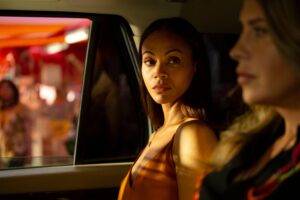
Apparently, Saldaña got through the voting process without the Gascón tweets spilling all over her prospects. If so, this signifies Hollywood showing its appreciation to her for her diligence and energy in and out of the MCU.
FWIW: Grande, however, remains a factor. For whatever reason, she’s the one Wicked principal who’s getting a big push for recognition right now as opposed to waiting till next year. And she’s genuinely magnetic and charming in the movie. No one should be surprised if waiting till next year isn’t the move here.
Best Adapted Screenplay James Mangold and Jay Cocks, A Complete Unknown Peter Straughan, Conclave Jacques Audiard (in collaboration with Thomas Bidegain, Léa Mysius, and Nicolas Livecchi), Emilia Pérez RaMell Ross and Joslyn Barnes, Nickel Boys Clint Bentley and Greg Kwedar; Story by Clint Bentley, Greg Kwedar, Clarence Maclin, and John “Divine G” Whitfield, Sing Sing
If my prediction for a Best Picture upset is realized, Conclave wins this one, too. It may win anyway. But if recent history is any indication, glory in this category has gone to the bold and the Black, and so, I’m going here with my gut – and personal preference. Which aren’t always the same thing.
Best Original Screenplay Sean Baker, Anora Brady Corbet and Mona Fastvold, The Brutalist Jesse Eisenberg, A Real Pain Moritz Binder, Tim Fehlbaum, and Alex David, September 5 Coralie Fargeat, The Substance
Eisenberg’s excellent script notwithstanding, the WGA’s move should get seconded here.
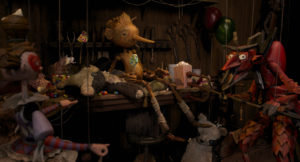
Best Animated Feature Flow Inside Out 2 Memoir of a Snail The Wild Robot Wallace & Gromit: Vengeance Most Fowl
A superb field – with one clear winner, an immediate classic. As I’ve written elsewhere, you know a movie is great when, while watching it, you forget who, where and, at times (like this), even what you are. Flow is a great movie, pound for pound, the year’s best.
Best Documentary Feature Black Box Diaries No Other Land Porcelain War Soundtrack to a Coup D’état Sugarcane
Against formidable odds, No Other Land, the collaborative portrait of Israeli journalist Yuval Abraham and Palestinian activist Basel Adra, has conducted a high-profile campaign for the Oscar despite its lack of a U.S. distributor, which has kept it virtually out of the running for trade awards. This is seen by pundits as an insurmountable handicap, though I’m going to make the archetypical leap-of-faith here and presume that surprises, if not necessarily miracles, can happen this year. The betting favorite, also hyper-charged with topicality, is Porcelain War, a much-decorated account of Ukrainian artists maintaining fidelity to their craft while doing what they can to resist Russian invaders. It’s a theme that sounds like an oozing honey tree for AMPAS voters. But what the hell, I’ll shoot the moon here.
Best International Feature I’m Still Here The Girl With the Needle Emilia Pérez The Seed of the Sacred Fig Flow
Jacques Audiard’s musical gets its reward here, though as in the Best Actress competition, one shouldn’t underestimate the power of I’m Still Here’s theme. Especially these days. I’d pick Flow for a two-fer, but that’s (literally) just me.
Best Cinematography The Brutalist Dune: Part Two Emilia Pérez Maria Nosferatu
Vistavision! Still big! Still bright!! Still somehow Brand New after lo these many years!! Lol Crawley’s got this one sewed up tight.
Best Original Score The Brutalist Conclave Emilia Pérez Wicked The Wild Robot The one qualm about Daniel Blumberg’s chances here is that voters in this category don’t often go for “experimental” composers or, for that matter, the “slabs of sound” approach that sounds as brutalist as the architecture under examination here. But the music is an evocative artifact on its own and too insinuating to ignore, or bypass.
Best Original Song “El Mal,” Emilia Pérez (Music by Clément Ducol and Camille; Lyric by Clément Ducol, Camille and Jacques Audiard) “The Journey,” The Six Triple Eight (Music and lyric by Diane Warren) “Like a Bird,” Sing Sing (Music and Lyric by Abraham Alexander and Adrian Quesada) “Mi Camino,” Emilia Pérez (Music and lyric by Camille and Clément Ducol) “Never Too Late,” Elton John: Never Too Late (Music and lyric by Elton John, Brandi Carlile, Andrew Watt, and Bernie Taupin)
“El Mal” is a stunning performance piece, the whole of Emilia Pérez compressed into one three-and-a-half-minute rant/lament “Mi Camino” also benefits from Selena Gomez’s wistful enactment. I’d like to be wrong, but neither seems like the kind of song Hollywood goes for – and I’ve been burned on this category enough not to trust my inclinations towards the “cutting edge,” no matter who’s won what beforehand. I’m guessing Sir Elton gets another one of these for his mantlepiece, assuming he has one. (A mantlepiece, not an Oscar.)
Comments Off on Seymour Movies Thinks It’s Too Old For This Oscars Shit
Once again, as was the case eight years ago, I find this year’s list to be leaning heavily on women. This time, however, I didn’t plan it that way. It’s just how it happened to work out. I suppose that’s where I’ve invested whatever hope I have for the future, long or short-term.
Nothing else to add, at least for now, except that I couldn’t get to as much out there as I would have liked.
Oh and, as always, these are in no particular order:
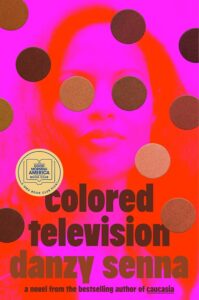
Colored Television – Percival Everett’s James was the Novel of the Year on most lists and, at this writing, it’s nestling in the upper tier of the New York Times Best-Seller List. It deserves every accolade it’s gotten. But so does the latest novel by Everett’s equally accomplished wife, Danzy Senna, who has built her own impressive reputation for acerbic comedies-of-manners as they evolve – or don’t – in the expanding new world of multiracial diversity in the USA. The protagonist of her latest novel is, like its author, a mixed-race novelist and college professor. Her name is Jane Gibson who, with her bohemian artist husband Lenny and their two children, ekes out a life on relatively meagre resources by inhabiting borrowed homes in fashionable SoCal neighborhoods. She puts all her faith and ambition in what she is certain is the Great American Mulatto Novel. (Yes, she prefers “mulatto” to any other term. “’Biracial’ could be any old thing. Korean and Panamanian or Chinese and Egyptian. But a mulatto is always specifically a mulatto.”) When this sprawling tome is spurned by publishers, Jane decides she’s been wasting her energies on literature and, as was the case with generations of writers before her, dives into the gauzy maelstrom of Hollywood screenwriting, specifically by finding space at a writers’ table developing a TV “prestige” sitcom about the “mulatto” experience. The narrative twists, however clever and trenchant, aren’t what keep your head in the game; it’s the streams of zingers, aphorisms, and socio-cultural observations, whether its Jane’s withering assessment of her students’ reading tastes to the mores of hosting her daughter’s birthday party among the L.A. hoi polloi. As a bonus, Senna’s book also serves as a guide not just to navigating one’s way through a multi-culti life, but to writing itself. And, for that matter, teaching writing. (“You couldn’t teach a student by assigning Toni Morrison, it would only create bad imitations.”) Laugh, and learn.
Sally Jenkins – So many of my friends dropped their Washington Post subscriptions after Jeff Bezos’s non-endorsement for president. While understanding the impulse, I insisted that, however exasperating the Post’s direction on this and other matters, there were still people working there who needed and merited our abiding support. Without the Post, for instance, you’d deprive yourself of beholding a great American sportswriter in the midst of a ferocious hot streak. Jenkins has over decades sustained a level of performance as awe-inspiring as any of the superstar athletes she writes about, whether she’s unspooling long-form pieces like the panoramic, vividly rendered account of legendary bull rider J.B. Mauney’s decelerated-but-still-engaged life after a broken neck or firing column after column taking dead solid aim at Received Wisdom wherever it’s stinking up the joint. She places the blame for the hot mess college athletics have become on the institutions that forget or ignore their educational missions. She was laser-like in deconstructing police overreaction to a pregame traffic infraction by Miami Dolphins receiver Tyreek Hill (“…a needless escalation not because of Hill’s conduct, but that of those chesty cops, their belts jingling with tools of submission and voices that demanded bootlicks…”). While the Tom Brady roast delighted millions, Jenkins was decidedly not amused by the “hammy punchlines that fell like refrigerators hitting sidewalks.” And she was, as usual, smarter than almost everybody else in her field when assessing Bill Belichick’s decision to forsake the klieg-light glare of the NFL for the NCAA: “Belichick’s longtime permafrost barrier is less about aloofness than about his suspicion of the corrosive effects of popularity.” Jenkins has been a perennial finalist for the Pulitzer Prize, and I thought her engrossing, deeply moving 2023 takeout on the bond between Chris Evert-Martina Navratilova should have finally put her over the top. Then again, she doesn’t need anybody’s prizes to certify her preeminence – not as much as you need to pay more attention to her day-to-day output.
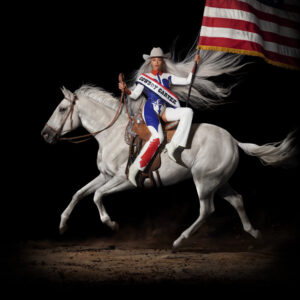
Beyonce, Cowboy Carter (Parkwood/Columbia) – So who needs the CMA anyway? Those are for country-&-western albums, and this was the kind of pure pop product that took in too many multitudes to be contained by any genre. More than anything, as many others pointed out, Beyonce herself was, and is, her own genre. And whatever this album’s head-swiveling popularity and impact on the marketplace and its multiple platforms, I don’t think enough was made of Ms. Knowles’s valiant determination to declare that she, too, sings America – as if the opening track, “American Requiem” didn’t forcefully assert such intention. Nothing about this Mother of All Crossover Projects felt strained or overstuffed – except, maybe, for the Texas radio station motif that almost wore out its welcome. Overall, it’s a cordial, enthusiastic house party with an eclectic guest list (Miley Cyrus, Shaboozey, Stevie Wonder, Paul McCartney, Tanner Adell, Rhiannon Giddens, Willie Nelson, Jon Baptiste, Linda Martell, among others) and a generosity of spirit that makes the album’s nay-sayers seem even pettier — and more bewildering. The election results have too many convinced that the country’s regressing deeper into the swamps of polarization. But I think Cowboy Carter’s arrival is the clearest indication we have this year that the wider, more diverse world the reactionaries are so afraid of has already arrived – and isn’t going anywhere anytime soon.
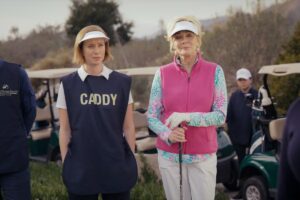
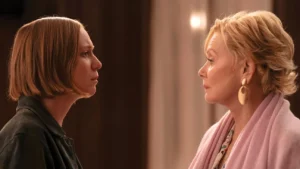
Hacks – Somehow you knew that the perverse bond between Vegas standup comedy institution Deborah Vance (Jean Smart) and her on-and-off-again muse-for-hire Ava Daniels (Hannah Einbinder) was going to need more than just two seasons to evolve. And the third and best season of this series raised the stakes in bringing this oddest of odd couples back together after Deborah cut Ava loose (supposedly) for the latter’s own sake. And it seems, for a time, to have worked out, with Deborah riding a wave of popularity with newer younger audiences who’ve seen her unexpected Netflix hit and Ava scoring a dream gig writing for a satiric news digest. But when the late-night hosting job of Deborah’s long-deferred dreams suddenly becomes attainable, she decides that only Ava’s writing can deliver her to the finish line. So, for better and worse, they reconnect with their respective insecurities and unruly yearnings entwined once again in a fitful tango of codependence and ambition. The sometimes-sordid things they do along the way to get what they want smacks around our sympathies. But there are too damn many things in the culture that pander to simplistic good/evil dualities. Ava’s moments of insight and compassion may not always arrive in a timely manner, but when they do, you wish you could hire her for some odd jobs around the office. And it’s hard to stay mad at Deborah when she makes this rationale for her heat-seeking campaign: “Anything I want to do I have to do it now. Or else I’ll never do it. That’s the worst part about getting older.” No pathos here. Just another shot of raw, aching truth that’ll keep us coming back to these fascinating, damaged women.
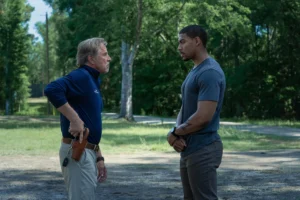
Rebel Ridge – I started watching this on Netflix after several people I trust urged me to do so. When it began with an innocent, unarmed Black man on a bicycle getting rousted and harassed by small-town white men in uniform, I thought: Do I really need to go through this mess again (especially this year, or this decade?) But it didn’t take long for Jeremy Saulnier’s contemporary western to pull me all the way in. Which says a lot, given how totally done I’ve become with this kind of drama (especially in real life). The movie is not only smart about orchestrating its martial arts sequences and chase montages, but also about the jujitsu of legal procedure and the pressure points that won’t always, or easily, submit to the bully-bro tactics of overentitled cops. One more thing: Aaron Pierre, as the unstoppable marine vet kicking ass for justice, is a bona fide star and I hope the Green Lantern franchise, such as it is, treats him much better than it did Ryan Reynolds.
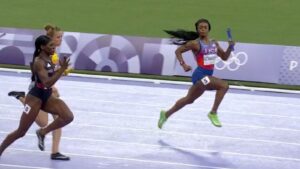
The Paris Olympics – They had me, literally, at hello with Celine Dion’s spectral performance of “Hymne a L’Amour” climaxing a moist, stirring opening ceremony. Dion’s spellbinding resolve was sustained in the steely “I’m Baaack!” sang-froid of Simone Biles throughout the women’s gymnastics competition, whether dispatching the competition or supporting her teammates. The men’s basketball competition honored the elder generation of superstars like LeBron James and Stephan Curry while also acting as a showcase for NextGen stars like France’s Victor Wembanyana and Japan’s Kawamura Yuki. Much was made of Katey Ledecky’s four-pack of swimming medals, and even more was made by the pool of local hero “King” (or is it “Roi”?) Leon Marchand. But as always, I was especially riveted to track-and-field, especially the American women sprinters. If there’s one YouTube clip that I never get tired of watching from the games, it’s of Sha ‘Carri Richardson’s come-from-behind anchor leg of the 4X100-meter relay. That millisecond before she breaks the tape is the best victory glance at the competition since Secretariat’s jockey Ron Turcotte sneaked an over-the-shoulder look at how far ahead they were in the 1973 Belmont Stakes.
Desi Lydic – The big story with The Daily Show this year was Jon Stewart’s return to the anchor desk, albeit in a more limited role. With characteristic generosity, Stewart’s still ceding lots of space to the show’s rotating anchors who have been doing just fine without him. They’re all great, but I think Lydic, who joined the franchise back in 2015, has become one of its stealth weapons. And it’s not just because she had the season’s single best zinger, aimed in Tucker Carlson’s direction the day he was dismissed from Fox News. I’m thinking of a relatively routine night for the show, when she surgically took apart what was supposed to be a major policy address by the once-and-future-president on health care and laid out its sloppy, threadbare components for all to see and hear. I turned on the radio and television the morning after waiting for somebody, anybody else to apply even a little of Lydic’s scorched-earth skepticism and deconstruction to this speech. Crickets. At least, that’s all I’d heard. This, by default, made her my favorite broadcast journalist of the 2024 campaign with no one else even close. I’m not expecting the next couple years (at least) to be fun. But I’m at least encouraged that Lydic will still be ready to apply the scythe and flares to Trump’s foggier rhetoric — if “rhetoric” is what you can call it.
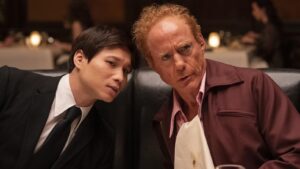
The Sympathizer– The culture-at-large is in love with international intrigue to a degree that it hasn’t been since the mid-20th century days of Counterinsurgency, Sean Connery’s 007, and Mutually Assured Destruction. A partial, up-to-date list of global duplicity to be found on streams includes Black Doves, The Agency, Day of the Jackal, The Diplomat, Lioness, and Slow Horses, the latter of which I am so devoted to that I inhale the Mick Herron novels so I can stay out in front of whatever happens to its motley crew of misfits after each of the series’ four seasons. But even that show hasn’t messed with my head like the HBO adaptation of Viet Thanh Nguyen’s award-winning novel, set during and after the Vietnam War, about the perilous destiny of a double agent (a most excellent Hoa Xuande) spying for the communist North while serving as an officer with the South’s army. The novel claims both Ralph Ellison and John Le Carré as its guiding spirits and the series is more faithful to Nguyen’s dark seriocomic narrative than the agent, known only as The Captain, is to either of his warring masters. He carries his divided soul with him after the Fall of Saigon to late-1970s Los Angeles where the war goes on among his fellow refugees, notably his onetime general (Toan Le), now a liquor-store owner still dreaming of somehow reversing the war’s outcome. Robert Downey Jr., one of the show’s executive producers, plays (riotously) multiple roles as white men with undue, malign influence on The Captain’s life, including a sybaritic CIA cowboy, a doltish California congressman, and a megalomaniacal filmmaker using the Captain for technical advice on a Vietnam War epic. Some viewers complained about the story’s multiple time-shifts and how the narrative didn’t always play fair with the Captain’s motivations – and everybody else’s. All of which, of course, was what I liked most about it.
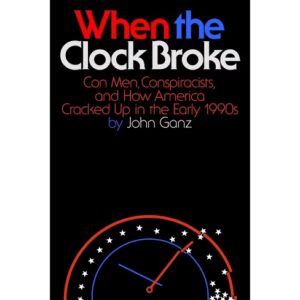
When The Clock Broke –John Ganz’s account of the 1992 presidential campaign was published three days before Joe Biden announced his withdrawal from the presidential race and declared support for his vice president Kamala Harris. The convergence now seems like ages ago, especially when one remembers how suddenly plausible it seemed at that moment that the election results would signal the end — or at least the beginning of the end – of the dismal era that Ganz contends was set in motion by the tempest of reactionary resentment and populist rage abetted by such luminaries of the era as Ross Perot, Pat Buchanan, David Duke, Daryl Gates, Rudy Giuliani, Rush Limbaugh, and others. So omnipresent was this force that even the election’s eventual winner Bill Clinton pandered to it by hanging Black rapper-activist Sister Souljah out to dry in public. Ganz’s mordant, thorough account spares no one in complicity and even brings in John “The Dapper Don” Gotti as a tabloid paradigm of the mob capo as authoritarian ideal. As I wrote this past summer, you’ll find just about everything there is to say about how we ended up in this perilous time for our democratic republic; everything, that is, except a clearly marked exit.
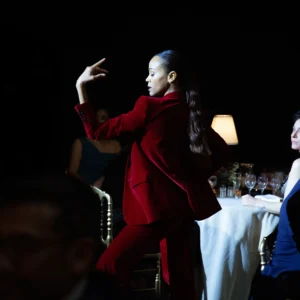
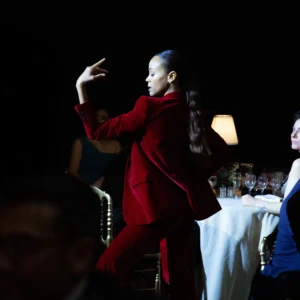
Zoe Saldana – As more than one of my friends insist, there’s nobody better than Saldana at evoking the state of being sick-and-tired-of-everybody-else’s-bullshit, especially when, as the CIA commando in Lioness known as Joe McNamara, she has to be Tough Mommy to her daughters in split-level Virginia and to the grimy, smart-alecky roughnecks she leads into morally ambiguous dark-ops missions. Her character in Emilia Perez is scarcely under less pressure than Joe; she’s a Mexico City lawyer recruited by a notorious drug cartel leader to help navigate his safe passage to a new life as a woman. In both cases, Saldana is a flash point, barely keeping rage and hysteria at bay. She not always at the center of things, but nothing consequential happens, good or bad, without her. While I yearn for the cooler, drier archetype of existential heroism I grew up with, Saldana’s mercurial, intense variation somehow feels closer to where our heads should be now: doing whatever it takes to get through whatever perils get dumped in our pathway
Comments Off on Gene Seymour’s Favorite Things in 2024
OK, so once and for all, what is an album anyway? If most of the people I know who are 35-and-under are asked this question, they’ll likely answer the way I did way back in 1972: it’s a long-playing vinyl recording, wrapped in plastic and sometimes packaged in pairs, depending on the content. It’s an artifact played on turntables and will never let you down as long as you keep your needles up to snuff. Did you know that cactus needles are just as good, if not better than those diamond needles that were big with stereophiles back in the day? I heard this from my dad, who in turn heard it from this guy in Hartford named Ivor Hugh, a really savvy music aficionado who once played Flippy the Clown on local TV and…I digress again, sorry.
But, seriously, folks, help a brother out: What am I talking about when I talk about “albums,” top ten or otherwise? I still get compact discs from record companies Whatever they are anyway! Can’t give the used ones away anymore! But I still don’t believe anybody who says they’re over and done. That’s what they said about vinyl, and I’ve never forgiven whoever “they” are for making me sell off and otherwise give up on all those records I bought in bulk back in the 80s at Third Street Jazz in Philadelphia.
Otherwise, how does music get around and about? YouTube and Spotify can’t be the only analogues for the 78-RPMs sold at food stores and five-and-dimes over a century ago. Streams, clouds, and other water-based delivery systems are all anybody talks about because they carry the ephemeral authenticity of The New and The Now. But so much of musical content is tied to fashion, which means whatever passes for “sexy” these days. And jazz, whatever that is, isn’t a fashion statement so much now, except for those of us who keep faith with its promises to make sounds fit together and come apart in ways we haven’t heard before.
Somehow, even with all the tumult, volatility, and anxiety of the year now staggering to a close, that faith abides with those of us who get the sounds we want in any delivery system we can use. Is it “fashionable”? Paraphrasing a rhetorical question Max Roach asked me when this subject came up, is being human still “fashionable”?
I wonder sometimes.
Anyway…
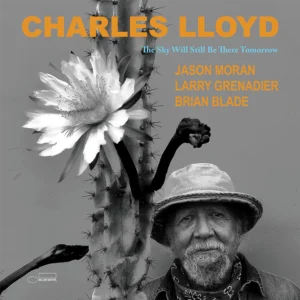
1.) Charles Lloyd, The Sky Will Still Be There Tomorrow (Blue Note)—It was released at the start of the year, so who would have dared predict that so many of us would appropriate variations of its title for reassurance by year’s end? Or that its elegiac, melancholy ambiance likewise synched with those who believed things would turn out differently this past November? Current events aside, this four-album (or-two-disc) set feels like a valedictory for the 86-year-old Lloyd, who otherwise doesn’t sound anywhere close to calling time on his long, mercurial career. The plaintive lyricism that has distinguished his playing on both tenor saxophone and flute over the last couple decades is given its fullest, most expansive platform yet for roaming, probing, and exalting, whether paying tribute to the album’s guiding spirit Billie Holiday (“The Ghost of Lady Day”) or taking us to church, as it were, on “Balm in Gilead” and “Lift Every Voice and Sing”. The whole project is both a balm and an exhortation not just to move but contemplate each step forward. What Lloyd describes as this “offering of tenderness” is seasoned with a wistful sense of play and mischief, as on the title track and “Monk’s Dance.” Pianist Jason Moran, longtime supporter and co-conspirator in Lloyd’s spiritual insurgency, joins bassist Larry Grenadier and drummer Brian Blade in helping Lloyd render his offering to the spirits and to us. The package feels right on time – and somehow beyond time. It’ll be around whenever we need it, as, I suspect, its leader will for a while longer.
2.) David Murray Quartet, Francesca (Intakt) – For much of the latter third of the 20th century, Murray was so prolific as a recording artist on bass clarinet and tenor saxophone that he seemed too hyperactive to so much as take a breath between gigs. He’s performed epochal solo recitals, engaged in spiky duets, and led small combos and big bands alike with fearsome power and relentless invention. Murray, a few months shy of 70, still packs a deep, wooly, and enveloping vibrato that, by itself, seems a living organism with throbbing membranes and raw nerves. Yet of the many units Murray’s played with, I can’t recall one that more effectively channels and contains his formidable expressive range than this confab of pianist Marta Sanchez, bassist Luke Stewart, and drummer Russell Carter. From the evidence provided by this album, Murray enjoys being in their company and they each respond in kind to even his most vertiginous playing with intuition and empathy. Carter is air-tight and precise whether laying down a shimmering groove on “Ninno” (an affectionate homage, if you can believe it, to a life-support dog) or merrily shifting tempos on “Cycles and Seasons.” Sanchez and Stewart are gifted composers, possessing what veteran players like to call “Very Big Ears,” especially for finding ways to catch and release harmonic flow, as on “Free Mingus” where Stewart’s darting and dancing bass lines create a center of gravity for both Sanchez and Murray to unfurl their very different, yet complementary approaches to lyricism. If this is what Murray’s eminence gris period will be like, we’re in for more and better surprises like this.
3.) Patricia Brennan Septet, Breaking Stretch (Pyroclastic) –This one should be issued with weather advisories. Any one of these tracks is liable to toss unwary listeners into storm systems of polyrhythmic density capable of lifting them off the floor and onto the ceiling, dancing, of course. Which assumes the roof doesn’t get blown off before they get there. Do I overstate? You’re obliged to find out for yourself. Brennan, a mallet-wielding wonder from Veracruz, Mexico, has made a priority of building her own perfect rhythm machine with her marimba and vibes at its hot core. She appears to have realized this noble endeavor with saxophonists Mark Shim and Jon Irabagon, trumpeter Adam O’Farrill, drummer Marcus Gilmore, percussionist Mauricio Herrera and bassist Kim Cass. Listening to them on full interlock as they roar and rip through “Los Otros Yo (The Other Selves),” “Palo de Oros (Suit of Coins)”or “Manufacturers Trust Company Building” (no, really, that’s the title) applies a stone-cold high to anyone’s bottom-feeding spirit. Even when the group seems to break its air-tight formation — as on, of course, the title track — the soloists have their own afterburners with fuel to spare at any speed. This feels like an evolutionary step for large ensemble jazz, but its forward momentum is of such dimension and lift that I can’t tell for sure where it’ll end up. With any luck, it won’t end at all.
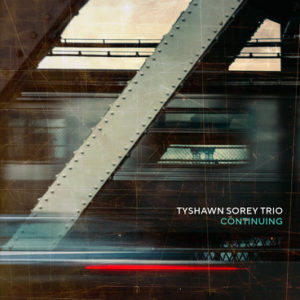
4.) Tyshawn Sorey Trio, The Susceptible Now (PI) – In a year dominated by outstanding piano trio albums, this ensemble led by the Pulitzer Prize-winning percussionist-composer-educator still sets the pace for other such combos with an austere, simple-but-spacious approach to the format. Sorey steers pianist Aaron Diehl and bassist Harish Raghavan with a supple touch that takes them, and us, longer and deeper, the way a submarine helmsman guides his massive ship around the hemisphere and back. McCoy Tyner’s “Peresina” is reconfigured by Sorey’s arrangement into a three-part suite of rhythmic give-and-take while “A Chair in the Sky” takes to heart the lyrics Joni Mitchell wrote to Charles Mingus’ melody (and life) and here becomes an immersive meditation on mortality with a rangy, brightly burning solo from Raghavan woven into its center. The trio’s maximalist-minimalist tension makes a persuasive case for Daniel Gunnarsson’s rakish soul-pop ballad, “Your Good Lies,” as entrancing lounge jazz with Diehl loosening some of his craftier changes over Sorey’s subtly diverse array of grooves. Brad Mehldau’s “Bealtine” keeps some of its original energy, but Team Sorey once again kneads, stretches, and coaxes the tune into broader, more contemplative regions with each solo coming across as its own autonomous composition.
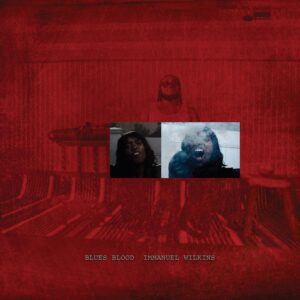
5.) Immanuel Wilkins, Blues Blood (Blue Note)— Its title comes through a 60-year wormhole from a Black Harlem teenager who was one of six arrested and convicted of two April,1964 crimes, one of them the fatal stabbing of a white owner of a used-clothing store. The boy, Daniel Hamm, testified how he and the other five were beaten by police officers while awaiting trial, recounting: “I had to, like, open up the bruise and let some of the blues…bruise blood to come out to how them.” From the “Harlem Six” case, Wilkins, a prodigiously gifted alto playert and producer Meshell Ndegeocello fashion a concept album that’s also a vision of time as a flat circle, melding past, present, and (potential) future of Black America. Along with members of Wilkins’s quartet (pianist Micah Thomas, bassist Rick Rosato, drummer Kweku Sumbry), vocalists June McDoom, Cecile McLoren Salvant, Yaw Agyeman, and Ganavya invoke, incant, and insinuate varied shades of loss and yearning. It may overreach at times on the special effects, the titles alone are triggers for fever dreams: “Matte Glaze,” “Apparition,” “Afterlife Residence Time,” the latter of which oozes into “Moshpit” and in turn leads to the title track, whose hard-driving, time-bending exuberance crack open a doorway to something resembling, if not hope exactly, then resolution, or clarity. For the time being, we’ll have to settle for either.
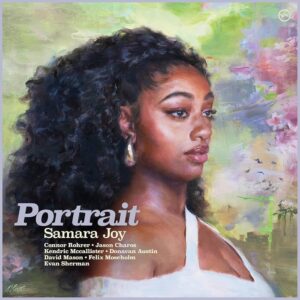
6.) Samara Joy, Portrait (Verve)— Having won awards and acclaim for both following and enhancing the jazz vocal tradition, Joy could have played things relatively safe by serving up piping-hot renditions of familiar and not-so-familiar standards, summoning memories of Ella, Sarah, and (even) Dinah. This one’s got the familiar and unfamiliar stuff, but with stunning twists and head-swiveling departures from everybody’s expectations. She announces her intentions by not only choosing Mingus’s Charlie Parker homage, “Reincarnation of a Lovebird,” but writing her own lyrics. And then there’s her breathtaking rendition itself, starting with an a cappella chorus whose acrobatic displays of melisma hint at the powerful fireworks to come, especially at the rousing finish. She maintains this dizzyingly high altitude at slower tempi on “Autumn Nocturne” and Barry Harris’s “Now and Then (In Remembrance Of…) for which she also wrote lyrics. She takes her biggest swing with a mélange of her own “Peace of Mind” with Sun Ra’s “Dreams Come True,” which comes across as both an anthem of personal uplift and an expression of her own artistic doctrine up to now. When I hear an album like “Portrait,” I don’t just think of Sarah or Ella or (even) Dinah or Billie. I’m thinking of somebody Brenda Lee, belting her heart out for all its worth, whether in Nashville or London, because she’s got the means, the pipes, and the eternal promise that makes everybody’s heart swell up when beholding someone willing and able to bust one, high and hard, far out of the park.
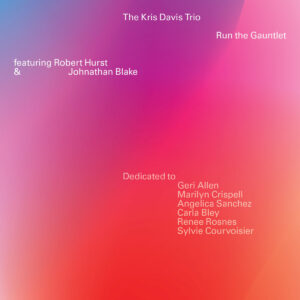
7.) Kris Davis Trio, Run The Gauntlet (Pyroclastic) – For this first album with her new trio mates, drummer Jonathan Blake and bassist Robert Hurst, Davis is honoring six women pianists – Geri Allen, Carla Bley, Marilyn Crispell, Angelica Sanchez, Sylvie Courvoisier, and Renee Roses – whom the Canadian-born Grammy winner extols as “beacons of possibility during different stages of my development, showing me that a career in music – whether as a woman, an immigrant, a parent, or a fan of avant-garde music – was attainable.” The title track follows imperatives set down by her influences with an invigorating progression of riffs and vamps marching, weaving, sometimes ducking and diving towards what you think will be resolution, but instead unleashes more challenging inventions and knottier themes. Her inquisitive creativity as a leader and soloist pervades the rest of the album’s selections, whether on the intense, bottom-heavy “Knotweed,” where her interaction with Hurst and Blake is at its most proficient, the limpid, enigmatic patterns realized in the trio’s rendering of Blake’s “Beauty Beneath the Rubble Meditation” and the pure exaltation given shape and form by the trio on “Heavy Footed.” You don’t hear too many direct references to the women Davis cites in the music and you don’t need to. They’re where they should be: in everything she’s putting down and laying out.
8.) Matthew Shipp Trio, New Concepts in Piano Trio Jazz (ESP-Disk) – Shipp has never showed an inclination towards tribute albums. Yet the “New Concepts” assembled here comprise a kind of homage to the late Ahmad Jamal in the manner of breaking down piano-jazz trio performance to its basic elements. Shipp, known for assembling tone clusters into skyscraping mosaics at the keyboard, plays with more spareness than usual. Nevertheless, the choices he makes in his thematic attacks are as revealing of his insurgent sensibility as any of his more sprawling solos, even though “Brain Work,” his one solo track here, is as quirkily laconic as anything he plays with the others. Bassist Michael Bisio and drummer Nicholas Taylor Baker have worked with Shipp for over a decade and their comfort level with each other is such that it takes just a few interlocking phrases from each to detonate “The Function,” whose loping pulse and recombinant harmonies forge a kind of astral boogie-woogie for the 21st century. As quirky and willfully abstract as ever, Shipp and his men here present what could be the most accessible gateway to the Wilmington Whirlwind’s body-of-work, alone or with others.
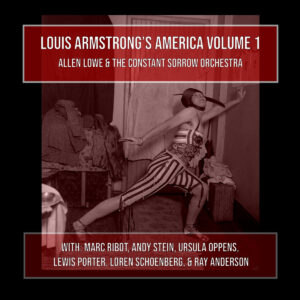
9.) Allen Lowe & the Constant Sorrow Orchestra, Louis Armstrong’s America, Vols. 1 & 2 (ESP) – If you know Lowe, you know better than to expect a Louis Armstrong homage that dutifully trots out the classic Pops songbook and does whatever it can to replicate the great man’s music. Instead, this four-disc set, at once gnomic and epochal, typifying whatever one means by, or expects from the “Allen Lowe Experience,” is more intent on evoking the anarchic spirit of invention that propelled Armstrong’s innovations of a century ago. As with the greatest American inventors, Armstrong used whatever was close at hand to construct his voice as player, singer, and performer and this project carries that same freewheeling, go-for-broke spirit in its tossed salad of gutbucket blues, neo-bop, amplified rock, even a little backwoods swing. It is also worth mentioning here that Lowe, who has faced daunting health challenges over the last several years, plays his tenor sax with greater energy and freer-flowing lyricism. He brings along his customary large and eclectic supporting cast that includes pianists Lewis Porter, Matthew Shipp, and Loren Schoenberg, trumpeter Frank Lacy, guitarist Marc Ribot, trombonist Ray Anderson and banjoist Ray Suhy (who could be the album’s equivalent of the Energizer Bunny, if the leader’s indefatigable performance weren’t as inexorable throughout.) And as ever, there’s the textual stuff, the liner notes that explain why he came up with tunes and titles like “Aaron Copland Has the Blues,” “Lester Lopes In,” “Joi Lansing Escapes from the Web of Love,” “In Dreams Begin Isaac Rosenfeld,” and “Beefhart’s on Parade,” the latter of which is a play on Pops’ “Sweethearts on Parade,” though, as you can already surmise, the former has little to do with the latter beyond the same chord changes. Except, maybe, in the old-time modernist impulse to Make It New – and, if plausible, Make It Swing.
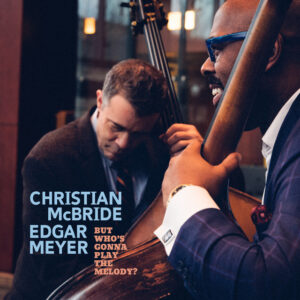
10.) Christian McBride & Edgar Meyer, But Who’s Gonna Play the Melody? (Mack Avenue) – Maybe it’s my age, but I’m finding that lately, whether live or on record, a fresh slice of music is as likely to grab my attention with its bass line than whatever the front-line players are doing. (Genetics. Same thing happened eventually with my dad.) Still, the idea of double-bass players occupying the core of a whole album seemed a bridge too far (or a gimmick too blatant). And so, it took some time for me to suss out the savory charms of this unusual summit meeting. It’d be too easy to declare at the outset that McBride brings out the blues swinger in Meyer and that Meyer conversely brings out the eclectic classicist in McBride because the more you listen to the whole album, the harder it is to discern any difference between them. After McBride counts off at the start of his “Philly Slop,” you presume that Meyer is merrily juking and slipping through the brick-solid 4/4 beat McBride is laying down. Or is it the other way around? It doesn’t matter. The whole point of this colloquy is to blur any distinctions between the Philadelphia-bred R&B kid who grew into jazz music’s most recognizable bass master and the gentleman from Tennessee who can pivot on a dime from the classical repertoire to a bluegrass jam. They both acquit themselves with distinction tearing through Miles Davis’s “Solar” at high velocity just as they do on Bill Monroe’s “Tennessee Blues.” Who’s playing what? In America, they can play whatever they want, however they want, in however big a space they can get. That’s the whole point of this album – and should be the whole point of everything else.
HONORABLE MENTION
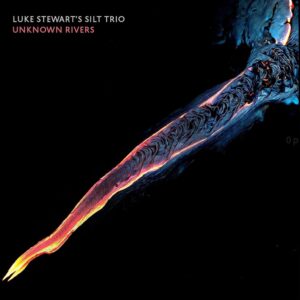
Luke Stewart Silt Trio (PI), Kenny Barron, Beyond This Place (Artwork), Vijay Iyer, Compassion (ECM), Marta Sanchez Trio, Perpetual Void (Intakt), Steve Coleman and Five Elements, PolyTropos/Of Many Turns (PI), Abdullah Ibrahim, Three (Gearbox)
ARCHIVAL
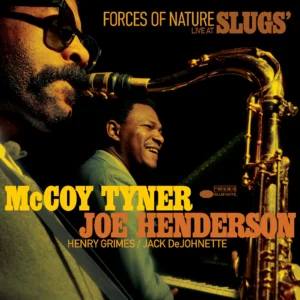
1. )McCoy Tyner & Joe Henderson, Forces of Nature: Live at Slugs (Blue Note) 2.) Bobby Hutcherson, Complete Blue Note Sessions, 1963-1970 (Mosaic) 3.) Ron Miles, Old Man Chapel (Blue Note)
4.) Mal Waldron & Steve Lacy, The Mighty Warriors (Elemental)
5.) Yusef Lateef, Atlantis Lullaby: The Concert from Avignon (Elemental)
LATIN
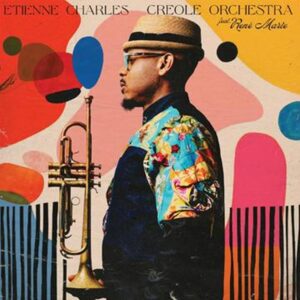
Etienne Charles Creole Orchestra (Culture Shock)
Miguel Zenon, Golden City (Miel Music)
VOCAL
Samara Joy, Portrait (Verve)
Kurt Elling & Sullivan Fortner, Wildflowers Vol. 1 (Edition)
Luciana Souza, Twenty-Four Short Musical Episodes (Sunnyside)
Comments Off on Gene Seymour’s Top Ten Jazz Albums for 2024
Not dark yet, but it’s getting there. I’ve been hearing that lament for years, even before This Guy made it into a song. So, who’s in the mood in these stormy, anxious times for new things to listen to, much less old things, no matter how great or revelatory? I ‘ve always argued that near dark is the best time for music, especially my kind of music. As it happens, there’s been a surfeit of beautiful archival jazz circulating in recent months, evoking eras when Anything and Everything was possible. Most, if not all of them, are even available on vinyl and most are, or soon will be, downloadable. I’ve been diving deep into these recovered sounds for weeks now; I’m at that point where I’m once again living in the Now of whatever’s directly in front of me and not whatever’s going to happen in November, or even October, with or without robots seizing autonomy over the culture.
I’m not suggesting they’ll do the exact same for you. But even if you knew nothing at all about the musicians I’m about to gab about, you can agree it’s understating matters to say there are worse things to do in the summer of 2024 than grab hold of what was hip and cutting-edge in 1959, 1966, or even 2011, when, If you can think that far back, you may remember ever-so-faint signs of hope that you could drag out of the dirtiest, most sordid media pit.
Never mind where. Take my word for it. And, while you’re at it, on these, too:
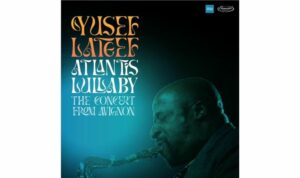
Yusef Lateef, Atlantis Lullaby: The Concert From Avignon (Elemental) – I’m guessing from the many times in the last year or two that I’ve heard tracks from his 1961 LP Eastern Sounds in jazz radio rotation that Yusef Lateef is enjoying a more-than-modest revival in a jazz world that respected his avid, informed eclecticism, but somewhat shortchanged him as a versatile, lyrical player. While he may not have changed the known universe as decisively as contemporaries like Rollins and Coltrane did on their respective tenors, Lateef could wield his reeds with as much force, conviction and relentless invention as anyone in his era. And this live set from the Cloitre des Célestins in July 1972 (unearthed by the indefatigable Zev Feldman) offers a retroactively startling display of his range as a soloist and strengths as a leader. Along with pianist Kenny Barron, bassist Bob Cunningham, and drummer Albert “Tootie” Heath, Lateef knew how to give the people their money’s worth, and then some. Want something straight-ahead? Seventeen minutes and change of the rousing “Yusef’s Mood” will take you for a heady spin around Swingsville. Lateef brings out his flute for both Roy Brooks’ “Eboness” and in tandem with Barron on the latter’s ruminative “A Flower.” Everybody on this date was locked in with the leader contributing impassioned variations on “I’m Getting Sentimental Over You,” Cunningham flexing his own resourcefulness in his solo on “Eboness,” and Heath propelling the apparatus with unflagging energy and invention. But maybe it’s because Barron has now become the acknowledged jazz piano master of the present day that one pays added attention throughout to the whirling dynamics of his comps and solos. In any event, the Yusef Lateef revival can only acquire added momentum from this effervescent gig. It’s enough fun to make one wonder whether there are other live sets of Lateef’s flying under the radar that could benefit from similarly conscientious exposure.
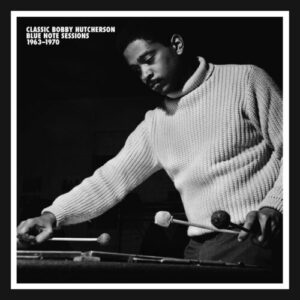
Bobby Hutcherson, Classic Bobby Hutcherson Blue Note Sessions 1963-1970 (Mosaic)— I could scarcely put it better than Richard Cook and Brian Morton in The Penguin Guide to Jazz Recordings: “If Hutcherson were a saxophonist, trumpeter, or pianist, he would be regarded as a major figure in jazz, but the vibes still have a slightly eccentric standing, a prejudice which has kept Bobby on the margins.” He’s still hugging those margins eight years after his death at 75 — even though he expanded the expressive possibilities of his instrument as broadly and definitively as any post-bop innovator. Hutcherson could make the vibraphone do things no other instrument could, whether applying harmonic latticework beneath and around horn sections or pressing forth his own intricate and arresting variations. Having this seven-disc compilation of Hutcherson’s ground-breaking albums from the 1960s should once and for all make the case for his lasting significance. The first of these sessions took place a month after JFK’s assassination and the last is dated almost a year after men first walked on the moon. The gratification of having all these recordings gathered in one place (after years of wandering in and out of print) is matched in degree by the sweeping narrative arc of Hutcherson’s growth in this fertile period. The first Blue Note album under his own name, 1963’s The Kicker, comes across more as a showcase for tenor poet Joe Henderson, though Hutcherson’s own ability to weave compelling stories asserts itself as strikingly, if not yet as prominently. In similar fashion, Hutcherson’s second LP, 1965’s Dialogue, is as much, if not more of a triumph for pianist-composer Andrew Hill, though the latter’s state-of-the-art blend of eccentric rhythms and montage-like themes can now be seen as table-setters for the idiosyncratic sound mosaics Hutcherson would forge more resolutely in the years to come. My own favorite album from this period, 1966’s Happenings is given its own disc in this set and the session’s high point, the spellbinding “Bouquet,” remains an immersive wonder, perfectly aligned with the shapeshifting “Aquarian Moon” along with Hutcherson’s version of Herbie Hancock “Maiden Voyage,” which matches and nearly one-ups Hancock’s 1964 original. Hancock’s on that session and on 1967’s “Oblique,” noteworthy for including the only recorded version of Hancock’s “Theme from ‘Blow Up’” that wasn’t in the score for Michelangelo Antonioni’s mondo-mod movie. Indeed, the whole boxed set is a sixties time capsule with the edgy modal experimentalism of mid-decade giving way to funk-rock fusion insinuating itself into 1968’s Total Eclipse and Spiral, culminating with the 1970 San Francisco sessions featuring Harold Land and Joe Chambers. In many ways, this was the Mosaic set I’d been waiting for since Michael Cuscuna, longtime friend and producer of Hutcherson, helped create the label more than a half-century ago and I used to noodge Michael about it whenever the opportunity arose. This was likely the last such project produced for Mosaic by Michael, who died this past April at 75 and while I still think his loss to archival American music is irredeemable, his legacy is vast and durable, and this boxed set is now a very big part of it.
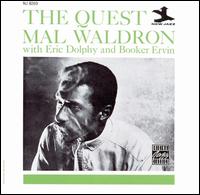
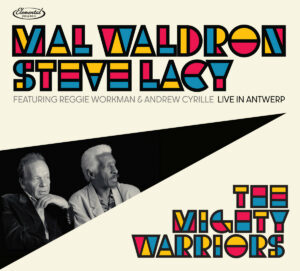
Mal Waldron, The Quest (OJC) Mal Waldron & Steve Lacy, The Mighty Warriors (Elemental)
The Quest (1962), newly re-released in a special vinyl edition, sounds like a score for one of those slate-gray crime thrillers from the late 1950s or early 1960s set in an uptown Manhattan where every male character sports stingy-brim fedoras, the women are enigmatic and volatile, and the sun is an unsubstantiated rumor obscured by tobacco smoke. The album itself has existed partly in myth, having once in its sixty-plus years in existence. been put out with Eric Dolphy’s name out front (as it were) instead of Waldron’s. (Likely, it’s because “Fire Waltz” is forever associated with Dolphy, even though it’s so plainly a Waldron composition in its wit, cunning, and melodic ingenuity.) As it happens, Waldron, a cult legend’s cult legend on the New York jazz club circuit where he was best known as Billie Holiday’s longtime accompanist, is credited as composer on the score for the cinema verité classic The Cool World, which was released in 1963, the same year Waldron suffered an all-but-catastrophic mental breakdown following a heroin overdose. He slowly recovered, relocated to Europe, and, as with generations of jazz musicians preceding him, found greater acclaim, bigger gigs – and even, occasionally, more movie work – overseas. As Waldron’s understated virtuosity and idiosyncratic command of time and space made him an even more influential force among progressive jazz pianists worldwide, he and soprano saxophonist Steve Lacy, another expatriate from the New York scene, forged a sympathetic meeting of minds that often made for high drama and incisive conversation in recitals throughout the 1980s and 1990s. Mighty Warriors, a two-disc discovery brought to the surface by the unstoppable Zev Feldman, catches their colloquy in a 1995 recital in Antwerp with drummer Andrew Cyrille and bassist Reggie Workman. The first disc is relatively poised with both leaders exchanging their own compositions (Waldron’s “What It Is,” Lacy’s “Longing”) and making their customary salute to their shared patron saint Thelonious Monk (“Epistrophy,” “Monk’s Dream”). High adventure beckons on Disc 2 with Workman’s “Variation of III” goading Lacy and Waldron towards ever-spiraling riff extensions and Waldron’s “Snake Out” giving way to his bold-and-brave “Variations on a Theme by Cecil Taylor,” which summons feverish tempests of invention from Cyrille. Someday, somehow, such performances will become as acknowledged as classics by the world-at-large as they are by the generations of artists, not just in music, who have been inspired by their reach for starlight and truth.
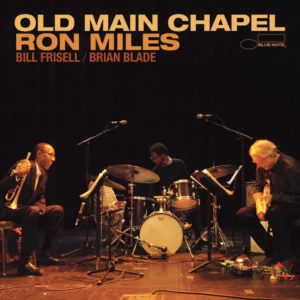
Ron Miles, Bill Frisell, & Brian Blade, Old Man Chapel (Blue Note)— Every premature loss leaves one feeling cheated and trumpeter Ron Miles’ passage in 2022, at age 58, from a rare blood disease felt especially cruel to those of us who saw him on the threshold of greater, wider recognition. Among jazz horns living and dead, Miles (and, yes, that surname does carry some karmic convergence and psychic weight) was a plaintive folk balladeer, as cozy with blues shouts like “There Aint No Sweet Man That’s Worth the Salt of My Tears” (part of the Paul Whiteman band’s playbook) as he was with a classically designed rag like “Guest of Honor” (dedicated to his son Honor) or an anthem as resolute and haunting as “I Will Be Free,” which dares you to come up with lyrics as eloquent and elemental as Miles’ deceptively simple melody. These and more were part of a 2011 live date by Miles’ then-emergent trio with guitarist Bill Frisell and drummer Brian Blade at the Old Main Chapel in Boulder, Colorado, in the state where Miles had made his home. The concert is a pleasant reminder of how seamlessly this trio operated as a synchronous unit with Frisell’s own harmonic impulses filtering through each piece with impeccable acumen and Blade’s zeal for power runs contained and controlled with both precision and discernment. You wish this trio could have done more. You wish for many things
Comments Off on Archival Jazz To Keep the Robot Overlords At Bay
The one thing I can still remember poor Jo Koy saying at his much-derided hosting stint at this year’s Golden Globe Awards came at the very end when he exulted, “Hollywood is back!” Not even crickets could be heard acknowledging this statement, which made me, at least, wonder whether even Hollywood thinks it’s back. A Socratic temperament might press for terms to be defined: What do you mean by “Hollywood”? What do you mean by “back”? “Back” from what? From COVID? From the contract disputes? From the looming specter of A.I.? And is this what being “back” looks like?
It is a certainty that all those who work in the Factory of Dreams are back at their jobs, which means they can campaign and vote in all their various trade competitions leading up to the Academy Awards. But if by “Hollywood,” you mean, the “screwy, ballyhooey Hollywood” of klieg lights, big screens, and its ersatz royalty of big stars…well, only a sentimental naïf wouldn’t have by now figured out that gossamer myth dissipated into the ozone several decades ago and whatever tiny fragments remain are deflating hour by hour in a post-Millennial universe where, as somebody on the recently-completed fifth season of FX’s Fargo might put it, we all get to create our own reality while feeling empowered to throw big, sharp rocks at everybody else’s.
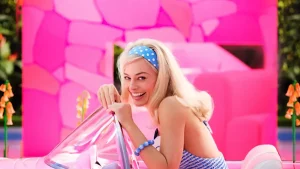
How can any movie, Hollywood or independent, presume to grab a lion’s share of a consensus audience in a determinedly fragmented world like ours? For a while this past summer, Barbie appeared to have pulled it off triumphantly enough to have given Warner Bros. a breathtaking surge in its profit margin. But before long, we stopped having serious fun with the movie and started getting frivolously solemn over whether it was OK to enjoy ourselves so much over such a conspicuous, if cheekily self-referential example of “product placement.” And we’re still arguing about it with one side of the room grousing about Oscar keeping both the movie’s star Margot Robbie and its director Greta Gerwig out of the running while others bloviate about arrested development and whether the whole thing was post-feminist or post-post-feminist, or yet another marker in civilization’s dreary slouch towards Bethlehem.
I shall, of course, deal further with Barbie in the text below. As far as how I liked it, I need only quote the indispensable cultural critic Robert Warshow who is famous for saying the following: “A man watches Barbie, and the critic must acknowledge that he is that man.” OK, I made up the Barbie part. But somehow the original quote, a standby among cinephiles for generations, makes more sense when put this way, at least to me.
The critic that I like to think I still am enjoys the ongoing threads and conversations as they unspool on various platforms. But conversation, after a while, gives way to a kind of annoying “know-it-all”-ism requiring nothing more than loud, emphatic assertions of opinion with little to no room for challenges or even questions from the floor. Often, it’s jaded contrarianism without portfolio (literally) as if standing in opposition to the crowd, or merely believing that you do, is all you need to bring to the microphone. I want more than that. And we should, too, without worrying about how our opinions look to others and how our judgments will be judged in turn.
And if we do like something that everybody else likes, we shouldn’t have to apologize for it in the same way we shouldn’t have to apologize for liking things nobody else cares for. All that is part of what used to be the romance of moviegoing and in romance, looking or feeling foolish is always a liability. But you don’t move anywhere without such risks and neither does art. If we could stop being so self-conscious about what we wear in the digi-verse, we could all come back to the rapture we felt when we first sat down in a dark room waiting for transport. The movies, as we knew them, could truly be “back” – and so, maybe, could Hollywood.
Wait for it…wait for it…
Naaaah!
You know the drill by now. Projected winners are in bold and FWIW (For Whatever It’s Worth) asides will follow some predictions, as needed.
Best Picture
American Fiction Anatomy of a Fall Barbie The Holdovers Killers of the Flower Moon Maestro Oppenheimer Past Lives Poor Things The Zone of Interest
As Barbie continued to dominate industry chatter well into the new year, I wondered whether Academy voters would do the Wild Thang (sic) and give it the top prize, partly to mollify those who think director Greta Gerwig and lead actress Margot Robbie got skunked out of nominations and mostly to give props to its galvanic impact on the Almighty Bottom Line. But devoted followers of this site will recall that a year ago, I believed Top Gun: Maverick would reap voters’ good will for its olly-olly-oxen-free shoutout to audiences that it was not only safe, but mandatory to return to the multiplexes in the pandemic’s wake. I’m not making that mistake a second time. Oppenheimer fits the Oscar prototype for a major movie whose significance surfaces before the movie even begins. The same can be said, even more so, for Scorsese’s Good Fellas of the Purple Sage (my own name for it and I mean no disrespect.). Voters have tended to seek the comfort of Big Important Topics as a way of putting the industry’s best possible face forward into its future. I’m opting now for the one whose importance would have been timelier back in the 1980s in the last tense days of the Cold War. But never mind. Right now, its front-runner status here is secure, even after more than half a year.
FWIW: Despite pundits’ best efforts to coax this year’s categories into wire-to-wire finishes (as they are prone to do), I suspect this is one of those Years of Foregone Conclusions as far as handicapping Oscars is concerned. In other words, chalk is your wisest investment. The past year has so exhausted the industry that it’s hard to imagine any of the nominated films, their casts and crews suddenly catching fire towards the finish line. There’s been enough excitement from all these shutdowns and strikes this past year, thank you very much. Let’s just worry about catching up and getting back to whatever this New Normal in the industry is concerned because there’s an awful lot of stuff to make everybody nervous about the future. So, who needs horse races? Let’s leave them to actual horses.
In case anybody’s interested, Poor Things would get my vote, simply because I had a blast watching all that grotesque slapstick and baroque comedy slithering out of the screen like tentacles. Yorgos Lanthimos’ movie goes about its sticky, gnarly business the way Willem Dafoe’s deformed Doc Baxter went about his: so absorbed in its own process as to be coolly indifferent to the effect it’s having on its incredulous onlookers. It won’t win here, but I’m tickled that I saw it if for no other reason that it gives me added incentive to actually read more Alastair Grey this year. Lanark, I think.
Best Director
Jonathan Grazer, The Zone of Interest Yorgos Lanthimos, Poor Things Christopher Nolan, Oppenheimer Martin Scorsese, Killers of the Flower Moon Justine Triet, Anatomy of a Fall
Nolan has been so routinely unpopular with segments of the critical community (not an oxymoron) that I sometimes think his haters invent reasons not to like any of his movies, even when they work well. With me, it’s always been case by case. Liked Insomnia. Hated Tenet. Admired, without loving, Dunkirk. Loved, without admiring, Interstellar. And on and on. With other directors, as well as craftspeople in various disciplines, it’s a different story. They’ve likely been waiting for just the right moment to give him a party favor and if he doesn’t get it for this one, it’s hard to imagine another chance coming up. Except that directors like him outlast almost everybody else, even, and especially, critics like us.
Best Actress
Annette Bening, Nyad Lily Gladstone, Killers of the Flower Moon Sandra Hüller, Anatomy of a Fall Carey Mulligan, Maestro Emma Stone, Poor Things
All these contenders went all-out in their performances, and each would have been sure bets in other years with weaker competition. History, however, is opening a wide, clear path for Gladstone to repeat Michelle Yeoh’s coup of a year ago by becoming the first Indigenous American to win a lead-acting Oscar. And, as with Yeoh’s becoming the first Asian-American last year, Gladstone has earned it.
FWIW: Still, part of me wishes I could airlift Bening’s nomination to another year with weaker competition. I thought she deserved to win 13 years ago for The Kids Are Alright, which was her fourth and, till now, most recent Oscar bid in more than 30 years. She’s not quite Glenn Close as far as hard-luck Oscar nominees go, but one fears she’s getting there.
Best Actor
Bradley Cooper, Maestro Colman Domingo, Rustin Paul Giamatti, The Holdovers Cillian Murphy, Oppenheimer Jeffrey Wright, American Fiction
People look at Holdovers’ promotions and all they can see and hear are other, lesser nostalgic prep school comedies with cranky adults buddying up with drippy students; the most notable example brought up is 1992’s Scent of a Woman, which finally got Al Pacino his Oscar well into the “She’s-got-a-GREAT-ass!” phase of his career. This essay by Olivia Rutigliano says everything that needs saying about why both the movie and Giamatti’s performance are different – and why he’ll be rewarded for it.
FWIW (2/25/24): Or maybe not. Murphy’s SAG and BAFTA awards, in swift succession, now make him the prohibitive favorite — and the movie’s cast award can only accelerate his movie’s chances for a Oscar night sweep.
Best Supporting Actress
Emily Blunt, Oppenheimer Danielle Brooks, The Color Purple America Ferrara, Barbie Jodie Foster, Nyad Da’Vine Joy Randolph, The Holdovers
Randolph’s already a front-runner, principally because she so deftly conveys the complex, mercurial nature of loss, a theme that makes the movie stand out from others in its sub-genre. Also, the way her character’s aching vulnerability is contained beneath dry, if pliable layers.
FWIW: I still wish there were a way to train more attention on some of the other worthy nominees here, especially Ferrara, who to my mind had an even greater challenge in her overall characterization than the people playing dolls.
Best Supporting Actor
Sterling K. Brown, American Fiction Robert De Niro, Killers of the Flower Moon Robert Downey Jr., Oppenheimer Ryan Gosling, Barbie Mark Ruffalo, Poor Things
I see this as, essentially, Iron Man vs. The Hulk. Iron Man wins.
FWIW: If Wright hadn’t been nominated for Best Actor, I would have liked to see his vulpine rendition of Adam Clayton Powell Jr. in Rustin given its due here. Problem is, everybody else in this category is so formidable that there wouldn’t have been any room for his nomination.
Best Adapted Screenplay
American Fiction Barbie Oppenheimer Poor Things The Zone of Interest
In case you’re still wondering what Barbie is doing here, this will provide the (illogical, unsatisfying) answer. Whichever category it landed in, the script would have been well-positioned to allow co-writer Gerwig to get the statue for which director Gerwig wasn’t allowed to compete. Too bad in a way because the other “Adapted” nominees are all especially worthy contenders…
FWIW: …especially Cord Jefferson’s script for American Fiction. Even though he’s been scolded by some for paring down the serrated edges of his source material (Percival Everett’s acerbic satire Erasure), he managed to fashion an all-too rare and persuasively level-headed depiction of an upper middle class Black family, balanced, humane, and still witty enough to stand out from anything that came beforehand, if you can think of what that could be.
Best Original Screenplay
Anatomy of a Fall The Holdovers Maestro May December Past Lives
David Hemingson’s script for Holdovers isn’t perfect. But it makes for the kind of movie that holds its elements loosely enough for voters to cozy up to. Story, structure (of a sort), snappy dialogue, emotional impact. It checks enough boxes to breeze through here.
FWIW: Then again, there’s always the (very slight) chance that a sleeper like Past Lives could ease its way to the front of the pack for having greater, if subtler emotional weight.
Best International Feature
Io Capitano Perfect Days Society of the Snow The Teachers Lounge The Zone of Interest
Great Britain’s entry is Jonathan Glaser’s chilling, prize-winning depiction of the banality of evil near one of the Nazi death camps. As with recent winners in this category, it also has a Best Picture nomination, which usually means an inevitable win here.
Best Animated Feature
The Boy and the Heron Elemental Nimona Robot Dreams Spider-Man: Across the Spider-Verse
By far, the most competitive race on the docket with predictions weaving back and forth between the new meta-Spidey adventure and Hayao Miyazaki’s Boy and the Heron, the latter of which has already collected a Globe along a rasher of critics’ prizes. The other three, including Diz-Pix’s latest, could legitimately be regarded as classics, especially the smart and daring medieval/urban fantasy Nimona, which almost didn’t make it into any kind of distribution. Even with the Marvel Cinematic Universe (MCU) edging towards eclipse at the moment, I’m going to put my chips on Miles Morales, even though it’s plausible that Oscar will wait for the third installment of that series to drop before full acknowledgment.
Best Documentary Feature
Bobi Wine: The People’s President The Eternal Memory Four Daughters To Kill a Tiger 20 Days in Mariupol
Each of these selections carries enough urgency in their socio-political themes to illuminate a whole nation state. All of them deserve to win and any of them could. I’m betting on the AP/Frontline entry whose depiction of a Ukraine city under siege is wrenchingly, frighteningly intimate in its accumulation of raw detail.
Best Cinematography
El Conde Killers of the Flower Moon Maestro Oppenheimer Poor Things
The relentless march of Oppenheimer ensures that Hoyte Van Hoytema will likely get his first Oscar after his previous work with Nolan’s Dunkirk and Interstellar was nominated but did not win (NBDNW). It’s by no means a lock, but…
Best Original Score
American Fiction Indiana Jones and the Dial of Destiny Killers of the Flower Moon Oppenheimer Poor Things
Of course, I would love it if Robbie Robertson would get some posthumous love for his haunting, old-weird-America score for Killers; his interludes fit so seamlessly with the scratchy, tinny archival recordings weaved into the soundtrack that you almost believe it all came from the same old 78-RPM records. But it’s easier to imagine Ludwig Göransson’s second win being part of the Oppenheimer wave.
Best Song
“The Fire Inside” (from Flamin’ Hot) “I’m Just Ken” (from Barbie) “It Never Went Away” (from American Symphony) “Wahzhazhe” (from Killers of the Flower Moon) “What Was I Made For?” (from Barbie)
Outside of production design, this has to be the only sure bet on the table for Barbie, plus it’s already nabbed a Grammy for Song of the Year.
Comments Off on Seymour Movies: Oscar’s Chalkiest Year
The preponderance of books and television series cited below suggests that I still don’t get out as much as I should. And while COVID isn’t going away (and did, in fact, bite me sometime earlier in the year), there’s still so much to behold in person as opposed to a screen. Or a page.
Still, I did, for the record, travel more than usual in 2023, mostly to northwesterly places on the continent where I saw bears, moose, elk, glaciers, and geysers. By my count, I still have twelve states in the union to visit in my lifetime and sustain the hope, however faintly it is articulated these days, that there will still be a union for as long as I hope to live.
Still.
If democracy is under siege and things are as bad as cable news networks insist (I don’t think they are, but that’s another discussion for another time), it’s not because culture failed us. The items below, even though they represent a relative sliver of what’s available, all tell eternal truths in up-to-the-minute fashion. Even when they depressed me, they gave me hope. So, the lesson here is a clear one: Stop watching cable news. Watch and – especially, for the love of God – read stuff like this. You’ll feel better. You’ll know more. That’s the best I can say. The rest, especially in 2024, is up to you.
Once again, these are in no particular order:
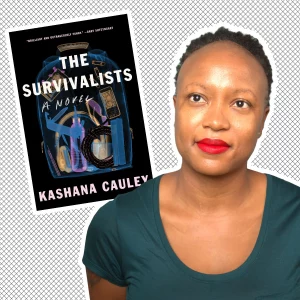
The Survivalists – Another outstanding year for African American fiction – and, at this point (for varied reasons), why don’t we just say, “American fiction,” period? – began with this silken-swift comedy of manners that’s as dark, rich, and intensely stimulating as the gourmet coffee that, along with heavy artillery, is a major trope in Kashana Cauley’s novel. Its central character is Aretha, a fast-tracking corporate attorney whose peripatetic love life seems finally to have found mooring with Aaron, the dashing founder-proprietor of Terminal Coffee, which roasts and sells coffee from his home base in Brooklyn’s Fort Greene neighborhood. Beyond mutual infatuation, Aretha and Aaron are such kindred spirits in their droll hipness, Type-A impulses, and wily diffidence that she moves into the commodious old rowhouse he shares with two somewhat singular housemates: Brittany, a churlish, taciturn “Angry Flo-Jo” who’s responsible for assembling the backyard bunker, and James, a sullen, pallid ex-reporter fired from the Washington Post for plagiarism. It turns out this motley band is warehousing more than coffee beans. There’s also a deep, wide stash of guns and ammo, part of which they’re hoarding as protection from an as-yet unspecified urban apocalypse while the rest is being sold to all manner of dubious buyers in the Tri-State area. Aretha at first keeps a respectful distance from the gunrunning business. But when her hitherto upward trajectory towards full partnership hits the ceiling, Aretha throws herself into Terminal Coffee’s off-the-books operations – and becomes scary-good at it. Cauley, herself a lapsed attorney who was once a Daily Show staff writer, nails down rueful insights about cultivating high ambitions in cloistered times and tallies the ironies in striving for space in a future you otherwise fear and loathe. In other words, it’s about living one’s best possible life near the upper reaches (and below the radar) in the 21st century.
The Bear – I’m going to imagine that at some point during the filming of the second season of The Bear that the ghost of John Cassavetes somehow made it to the Chicago locations where the series was being shot. He (it?) likely felt very much at home, especially within the intimate, more ramshackle surroundings like the restaurant kitchen being ripped apart to make room for a newer, sleeker, higher-end eatery than the one it’s replacing. So much of him yearns to assume corporeal form even for a minute or two, if only to offer advice, encouragement, maybe a few suggestions, once he can find out the storyline, the schedule, and what the theatrical specifications are. First off, he probably can’t believe this is all being made for television. Then, with sheer wonder, he thinks: These kids really know what they’re doing. He is especially galvanized by Ayo Edebiri, who plays the precocious young chef Sydney. Despite her age, she seems the wisest, worldliest person among her stressed-out colleagues; except for those times when she isn’t, and her own insecurities come at her from unexpected places, like muggers in dark alleys. His attitudes towards The Bear’s male leads are more complicated. With both, it’s like staring at a looking glass. Jeremy Allan White’s portrayal of Carmen (“Carmy” or sometimes just “Carm”) Berzato, the perpetually frustrated genius-chef stalked by guilt, haunted by death, keeping fear of failure at bay, is the kind of soulful, belligerent savant Cassavetes used to play all the time. He’d have nailed his role down like an iron fencepost back in his day. The other guy, Richie (Ebon Moss-Bachrach), Carmen’s best bud and restaurant manager, is also a role made for him, meaning the self-sabotaging stick-of-dynamite with the short fuse who needs just one more thing to go south for him to blow himself up and everybody else with him. All these three kids with dreams way bigger than they can carry without tripping on the curb are magnificent creations. But Cassavetes knows they’re not even all of it; it’s also the family background, which all comes to a head in that bravura Christmas episode with the Feast of the Seven Fishes. The ghost thinks: That was something I could have never pulled off the way they did. It managed to fire all over the place and still come through ferociously contained. And besides, Cassavetes thinks, even I wouldn’t have had the stones to end the whole episode with the mother driving a car through the living room. And that the mother was played by somebody you only gradually recognize as Jamie Lee Curtis, but in another time and place, could have easily been Gena Rowlands.
The Chain Gang All-Stars– I’ll admit it. There’s this teeny, microbe-sized Imp-of-the-Perverse way down deep inside me that’s tempted to wonder, if for no more than a nanosecond, whether the alternate universe depicted in Nana Kwame Adjei-Brenyah’s ingeniously dystopian first novel is onto something: that giving the most abject violent criminals in custody the option of fighting televised duels-to-the-death would be something of a win-win situation for them and for a society that can’t get enough of real-world violent spectacle. Before you judge me, you should know that at least one reviewer of Adjei-Breyah novel opened the piece by asking whether he was having too much fun reading about a world in which there is such a thing as a Criminal Action Penal Entertainment (CAPE) program and that such a world could all too easily adapt its moral compass to take in pay-per-view packages showing wanton, all-out bloodshed between otherwise doomed convicts, some with their own fan bases and merchandise. It may not be the kind of thing I’d shell out my hard-earned streaming dollars for, but the fact that I can imagine as easily as Adjei-Brenyah does fans of all ages having wall-poster-sized devotion to gladiators like Loretta Thurwar and Hamara Stacker a.k.a. “Hurricane Staxx,” who, inconveniently, are lovers as well as competitors. In addition to these awkward situations, Adjei-Brenyah is conscientious enough in his world-building to conceive a web of corporate enablers of his madness from all-sports cable networks to the incarceration industrial complex (which is what I’m calling it this week anyway). The heretics travel along with a protest movement stalking the CAPE caravan at every stop on its tour, making some of the arguments you can hear in “real life” about the malign growth of the private prison industry and the seemingly impermeable hold that mandatory sentencing, capital punishment, wrongful convictions, solitary confinement, and other, similar aspects of the “real” legal system has on those who want their loves ones protected. At what point, one asks, does “safety” itself become its own kind of prison? Part of Adjei-Brenyah’s purpose is to arouse such self-interrogations in his readers – who, in turn, could subdue their own meaner instincts enough to ask more questions of our society and ourselves. So you can question your fears…
The Heaven & Earth Grocery Store – …or you can engage with your hopes. We were as urgently in need of James McBride’s depiction of collective strength and courage in the 20th century as we were of Adjei-Brenyah’s more acerbic alternate vision of the 21st. McBride follows up his 2020 triumph, Deacon King Kong, with another exuberantly polyphonic novel in which a community, if not the notion of “community” itself, is the protagonist. It’s a murder mystery set off in 1972 by the discovery of a skeleton, along with a mezuzah, found at the bottom of a well in the Chicken Hill section of Pottstown, Pennsylvania, once a lively, tumble-down community of mostly Jewish and African American residents. The narrative steps back more than 40 years before when Moshe Ludlow, a Romanian Jew owned and operated a theater and dance hall while his American-born wife Chona ran the eponymous grocery store nearby. Events are set in motion when Nate Timblin, a Black employee at Moshe’s theater, asks the couple to shield an orphaned and deaf 12-year-old boy child Dodo from state officials seeking his institutionalization. Moshe is reluctant, but Chona, a woman of deep compassion and iron will, insists, despite threats, explicit and otherwise, from the city’s white power structure, many of whose members disdain the easy-does-it interaction between Chicken Hill’s ethnic minorities to the point of taking part in Ku Klux Klan parades. In clumsier, hammier hands than McBride’s, this is the kind of story whose melodramatic elements can be ramped to needless excess. But here, as McBride’s previous work, it is his exquisite sense of tone, timing, humor, and nuance that allows the novel to earn our tears — and our faith in each other, whenever we need it.
Lily Gladstone – Screen stars always emit a field of magnetism that at once draws us in and keeps us at a distance. With Gladstone, these warring elements somehow merge into an aura of repose that’s eerie to behold. Her less-is-more triumph in Killers of the Flower Moon is powerful and dominant enough on its own elemental terms as to all but redefine the very nature of bravura performance. She is a virtuoso of stillness in ways that harken all the way back, if you can imagine it, to Buster Keaton and other silent-movie icons. And not even they could convey with their faces whole landscapes whose emotional weather systems can shift from wary to vulnerable to kittenish to sensual to bemused, braced throughout by resilience whose sources are probably a mystery even to her. Perhaps one way to account for this composure is Gladstone’s portrayal of Hotki in Reservation Dogs. As jail-bound mother to Danny, whose suicide pitches the series’ teenaged characters into upheaval, anxiety, and confusion, Hotki has distanced herself emotionally and otherwise from everyone in her family except for her niece Willie Jack. When in the series finale Willie Jack brings Hotki an “offering” of snacks and sodas, the “auntie” summons the spirits of the ancestors passing on to the younger woman the obligation of looking after the friends and family members most in need. Once again, a majestic act carried out with understated humor and minimal flourish. She’s a trickster goddess with more surprises in store for us.
Barry – Of the hustlers, victims, losers, loners, narcissists, innocent passersby, and low-life sharpies making their way through four seasons of auteur-star Bill Hader’s inky, deadpan tragicomedy, none was as manipulative or as disingenuous as Monroe Fuches (the amazing Stephen Root), friend-mentor of Hader’s Barry Berkman, the mentally-unbalanced ex-GI who was guided by Fuches through an underground career of lucrative assassination before Barry decided he’d rather be a professional actor. Towards the conclusion of this so-dazzling-it-physically-hurt-to-watch-it season, Fuches, who emerged as something of a crime capo following some hard prison time, confronts his Chechen counterpart Noho Hank (Anthony Carrigan), whose bumptious naivete was darkened and deflated when he was forced by his own bosses to abet his lover’s murder. Now Hank and Fuches are haggling over who gets to kill Barry. (The “why” would take too long to get into here, requiring a rehash of Dostoyevskian proportions). It’s enough to say that Fuches, perhaps more than any other character in the whole sordid story, has arrived at something close to a complete reckoning for his many abysmal acts and is best able to assess where he’s landed in life. And why:
“I used to think I was a soldier, ignoring the fact that I never fought a battle in my whole life. I was a poseur. And I thought myself a mentor fostering other men’s natural abilities. But it wasn’t until I was in prison, and I got beaten to within an inch of my life day after day that I finally cut the bullshit and just accepted who I am: a man with no heart.”
Now, Fuches wants Hank to reach the same self-realization:
“I walk away, You’ll never hear from me again. All you have to do is admit that you killed Cristobal, admit that you fucked up, admit that you were scared, that you hate yourself, that there’s some days you don’t think you deserve to live. And the only thing that’ll make you forget is by being someone else.”
Hank wants none of it. There are consequences.
Now, this wasn’t how the series ultimately ended. Still more grisly jolts are in store. But it figured that Fuches would use his curtain call to sum up the self-deluding, perpetually denying soul of present-day America. Keep his monologue in mind as 2024 unravels like a soggy bedsheet.
Scavengers Reign– Further proof that science fiction flourishes best in a television series format, the better to let ideas and themes grow, bend, and metamorphose in the same manner as the flora and fauna on the planet Vesta Minor, where survivors of the calamitous wreck of the cargo ship Demeter 227 are scattered and struggling to cope with the planet’s astounding and hazardous ecosystem. Horror and wonder are weaved into Joseph Bennett and Charles Huettner IV’s conception with as much fascinating dexterity as the characters’ complications which are themselves transformed by the intractable natural elements coming at them from all sides. Even Levi, the dutiful and empathetic AI, is as susceptible to transformation through Vesta’s organic matter as the humans. Whether the changes are good or bad are difficult to gauge; in fact, “good” or “bad” turn out to have as little use in classifying the survivors as the wildlife. The gorgeous animation, owing as much to the comic strips of Jean “Moebius” Girard as to the films of Studio Ghibli, keeps you alert to illumination and revulsion. Because of the relentless progression of new exotica at every narrative corner, you shouldn’t be surprised if, upon encountering the first of this series’ 12 installments, you find yourself compelled to stay with it all the way through. Nor should you be surprised if, after you’re done, you have a whole new reverence for Earth’s increasingly vulnerable ecosystem, which, as with Vesta Minor’s, should be properly regarded as a single living entity worth engaging at eye level.
Apple TV – I still believe Last Week Tonight with John Oliver is the See It Now of the 21st century (and if you don’t know what I mean by that exalted comparison, let’s go to the kinescope one more time). But occasionally, the host will get a little Too Extra for his, or his show’s own good. Recently, Oliver declared that Apple TV carries shows nobody wants to watch, hammering home the point by saying the streaming network is where celebrities go to hide. I get it, on some level. They canned Jon Stewart, and it’s understandable that Oliver would take the spiked baseball bat out of the glass case to vent his displeasure on behalf of the mensch who made him the force for good he is today. But were I he (sic), I’d think more than twice about that “nobody wants to watch” slur. As I write this, I am happily engrossed in both season three of Slow Horses and season four of For All Mankind and have gone through several digital hoops when away from home to make sure I don’t miss a single installment. Also, I’ve found myself keeping up with series that, however unpromising they seemed at first, got their hooks into me even with their quirks and shortcomings jutting out at odd places. I’m thinking principally of Ted Lasso, which overcame some glitches at the start of its third and final season to bring everybody home literally, figuratively, and, in general, smoothly. And despite what Oliver alleges about the network keeping its talent buried, it was the surprising strength of some big-name performers that carried me through their respective shows. Harrison Ford’s droll, affably wooly presence on Shrinking compensated for much of that series’ overreaching New Age-y kitsch and once Brie Larson’s character shook away the icy veneer on Lessons in Chemistry, her magnetism and charm held the show together. The network even carries what may well be my all-time favorite hate-watch series in The Morning Show, exactly none of whose characters make me want to let them into my foyer, much less my living room. And yet Billy Crudup, as the network president, is having such an insanely good time playing the leering, unapologetically two-faced butthole that every time he exits a scene I feel like applauding. Granted, it’s not Paramount/Showtime, FX or HBO Max — but then again, HBO Max doesn’t feel much like HBO used to be, as even John Oliver might agree.
Jeffrey Wright – Thelonious Ellison, the character Wright plays in American Fiction, bears the first and last names of artists who, among their many achievements, gave permission to subsequent generations of artists to be as crazy and individualistic as they need to be. Such empowerment isn’t enough for “Monk” Ellison whose complex, resolutely philosophic novels confuse so many people that booksellers put them in the African American section only because he’s Black. But not Black enough until…well, you can read about it here. The point to be made here is that Wright’s whole career has been made up of characters you don’t expect him to play, whether it’s Felix Leiter in the Daniel Craig Bond movies or the odd amalgam of A.J. Liebling and James Baldwin he portrays in Wes Anderson’s The French Dispatch (2021) or the enigmatic man-machine doppelganger Arnold Weber/Bernard Lowe on HBO’s Westworld. Wright’s ability to contain giant waves of emotional complexity has expanded possibilities in almost the same manner as Thelonious Ellison’s two namesakes. As with all great actors, Wright’s brilliance shines even in the tightest, narrowest corners, notably in his portrayal of the flamboyant Adam Clayton Powell Jr. in Rustin where the legendary Harlem congressman’s cruel mischief oozes like spilled honey on an expensive carpet. It’s one of those mesmerizing cameos you wish you could pull away from the rest of the movie to expand into a full-length feature all its own. But why stop with Adam Powell? If we’re all serious about widening the stage and screen for color-blind casting, why not place Wright in the role of that great American exemplar of conflicting motives Richard Milhous Nixon? Is it possible that Wright’s Nixon could go deep and broad enough to cut such accomplished renderings as those of Lane Smith, Frank Langella, Dan Hedaya, or even Wright’s old Westworld boss Anthony Hopkins? I wouldn’t bet against him.
Comments Off on Gene Seymour’s Favorite Things in 2023
There’s been so much wonderful music out and about this year that I could have easily plucked a few more from my runners-up without losing any sleep. (A motif to which, as with others baked into this year’s blog, we shall, in roundabout manner, return.) And not to sound like a broken record, as it were, but you wonder why with so much talent and achievement coming from so many directions and from so many generations, jazz remains an afterthought, a marginal presence in the global marketplace. Unless I’m mistaken, nobody’s yet asked Esperanza Spalding – sorry, esperanza spalding – to headline a Super Bowl halftime show. Or even an NBA All-Star Weekend. At least, she headlines this list, or, more accurately, shares top billing. But then, I often wonder whether music, any music, has much of a place in people’s lives these days. If whatever I’ve been seeing lately on Saturday Night Live’s musical guest shots are any indication, presentation and fashion are what matter more than whatever sounds are being made. (I know, I know, whatever the hell am I doing watching Saturday Night Live lately in the first place? Can’t blame COVID anymore, even if it doesn’t seem to have gone away after all…) So maybe it’s no longer just jazz –whatever people believe it to be – that’s getting hit in the face; it’s all the other genres that are now all merely boutiques. There are now college curricula in Hip-Hop History in case you haven’t heard.
Maybe this explains why lately I’ve been thinking about the way past generations, including mine, used to buy records. Briefly: you went to whatever outlet or department store had people you could trust, and you hung out, browsed, and maybe something was playing in the background that made you go, “What’s that?” The people you trusted were happy to not only tell you, but bring out a fresh copy of the thing that turned our head and you decided you needed to take this “ride” home. And then you shared it with other people who trusted you and maybe if there were little people in your house, they would hear it and start getting ideas…
My origin story. If you’re reading this, it’s probably yours, too.
I don’t know what the equivalent of this process is today unless you count tweets and Bandcamp messages in whatever in-box you reserve for such intelligence. I only know it’s not the same and neither is the world that make those earlier, more haphazard encounters possible.
All I know is that the Good Stuff still somehow makes it out and about. Think of me, then, as that guy in the department store or record outlet – whatever that is – tilting his head at the turntable in the corner. Like that? There’s some more over here…
1.)Fred Hersch & esperanza spalding, Alive at the Village Vanguard (Palmetto) – You need to give this one to the wisenheimers in your life demanding to know what’s so special about jazz, or even what jazz is. It’s possible these people at least remember hearing Barack Obama profess affection for Spalding while he was still president; maybe they’ve heard or even seen live performances of her varied bands showcasing her upright bass, acrobatic vocals, and varied ensembles. For this bare-bones live set at jazz’s Holy Dive with the redoubtable pianist Hersch, Spalding left her bass at home and what results from their collaboration – which I’ve been labeling “Herschsperanza,” and try and stop me from obtaining a copyright! – may be the grandest, most insurgent act of her still-ascendant career. Traditional pop standards are blown up, rewoven, and all-but terraformed into audacious counter-narratives through the interaction of Hersch’s polymorphic variations and Spalding’s serpentine, uproarious digressions. From Ira Gershwin’s lines of “But Not For Me” (“I was a fool to fall and get that way/Hi-ho, alas, and also lack-a-day”), Spalding extrapolates the following strain of vocalese: “Oh, me. Oh, my. What a sad case I seem to be. It’s my fault, letting love to lead the way. I should know that there’ll be skies of gray. I can’t say I’ve seen too many, but they say that Russian plays do boast of many gray skies, all right – and then some words I don’t really understand because it’s, like, old English – hi-ho, alas, and lackaday. That’s how I feel, confused about the whole situation…” She carries this willed ingenuity into smart-alecky battle against Bobby Troup’s ring-a-ding lyrics on Neal Hefti’s “Girl Talk, which in her hands becomes a twelve-minute proto-feminist interrogation of male presumptiveness, at one point, veering into issues of “economic sustainability. Reduce, Reuse. Recycle…Am I lying?” while still riding the song’s theme and changes as if she were on a thoroughbred leading the Preakness by a length-and-a-half. Charlie Parker’s “Little Suede Shoes,” in like fashion, weaves a dream of dancing in suede shoes just as Hersch’s “Dream of Monk” becomes, with Spalding’s vocals, a clarion call for diligent, if circumspect weirdness. These tracks were culled from a three-night engagement, and I bet those in attendance felt as you will when this album ends: wishing these two crazy kids never stop.
2.) Matthew Shipp, The Intrinsic Nature of Shipp (Mahakala) –Three years ago, Shipp wrote an intriguing essay/manifesto, “Black Mystery School Pianists” (Monk, Herbie Nichols, Mal Waldron, Andrew Hill, Hassan Ibn Ali, to name a few examples) who each cultivated willfully idiosyncratic styles constituting “the subconscious of the jazz idiom…a secret code, passed through an underground way of passage, a language outside the mainstream.” Shipp’s own body-of-work over the last quarter-century so exemplifies this subversive counter-tradition he’s defined that it’s tempting to think of him as its apotheosis, especially when weighing the considerable assets of this latest solo album, which could be a kind of hypertext to his essay. The performances here feel at once more expansive and more challenging than usual. While he can still pile on the tone clusters with his customary intensity, as on the aptly named “Crystal Structures,” Shipp here lets more air and space flow and settle in his thematic extensions as with the graceful and intricate “That Vibration” and in his enigmatic montage of fugitive riffs on “The” – yes, that’s what it’s called and whatever mood he’s in, there abides in Shipp a punkish “what’s-it-to-you” impertinence that, oddly and appropriately, makes him more endearing, whether he’s throwing down the sledgehammer on “The Bulldozer Poetics” or letting his ruminative side reach for deeper, wider tonal combinations on “Tune Into It.” Shipp cherishes his “Mystery School” progenitors for giving him permission to be as mad, bad, glad, and unpredictable as he wants, and needs, to be. However far he continues to expand on this tradition (and there’s a lot about this album that suggests a transition, even a breakthrough), this school won’t close with him. And times being what they are, I think the school will only increase its enrollment because there’ll always be outliers in America’s backyards and basements searching, as Shipp once did, for affirmation that it’s not only O.K. to be as weird as Thelonious, Herbie, and the rest, it’s necessary.
3.) Jason Moran, From the Dancehall to the Battlefield (Yes) – Visionary badass James Reese Europe (1881-1919) helped make the American Century possible, though you likely never heard of him. He journeyed from his native Alabama to New York in his early 20s to write and conduct show music, then organized the Clef Club, an ambitious collective of Black musicians, whose dance orchestra, 125 members strong, performed a significant recital at Carnegie Hall. His ensembles bent the angularities of ragtime closer towards the looser, more propulsive syncopations shaping the jazz to come. He fought in World War I and organized the 369th Infantry Band, better known as the “Hellfighters.” He hadn’t been back home in Harlem for very long before he was stabbed to death, at just 38, by a drummer incensed with the boss’s criticisms of his on-stage deportment. You would think that a legend of this magnitude yielded dozens of contemporary tribute albums by now, if not a whole Netflix series. But you would also figure that Moran, an artist of comparable vision, would leap to the forefront of an eclectic parade in Europe’s honor, carrying the Hellfighter’s legacy across the century by seamlessly fusing Europe’s arrangement of “Ballin’ the Jack” with the late Geri Allen’s rousing standard “Feed the Fire.” A similar, even greater melding of different eras is executed with Europe’s paean to fallen soldiers, “Flee as a Bird to Your Mountain” transitioning to Albert Ayler’s “Ghosts” with solicitousness and intelligence towards both forms of 20th century modernism. Throughout, Moran’s wide-ranging pianistic gifts and crafty showmanship honors tradition and extends its possibilities with neither undue solemnity nor gratuitous flourish and his various ensembles, anchored by longtime trio mates bassist Tarus Mateen and drummer Nasheet Waits and including David Adewumi on trumpet, Reginald Cyntje and Chris Bates on trombones, Logan Richardson on alto sax, Brian Settles on tenor sax, Darryl Harper on clarinet, José Davila (about whom more later) on tuba, acquit themselves on “Clef Club March,” “Castle House Rag,” “St. Louis Blues” and “That Moaning Trombone” with discipline and energy that would have mightily pleased the demanding Europe. (Available on vinyl and from Bandcamp.)
4.) Henry Threadgill Ensemble, The Other One (PI) – The best jazz book I read this past year is Easily Slip Into Another World (Knopf), Threadgill’s autobiography, written with Brett Hayes Edwards. If you only knew Threadgill’s music, for which he’s already received the Pulitzer Prize, you could have surmised he had an extraordinary life. But…wow! Growing up musical in Chicago and helping create the seminal Association for the advancement of Creative Musicians (AACM) before touring with an evangelical preacher in the mid-1960s and then heading off to Vietnam, hoping to survive jungle combat and racism…And even these experiences, however vividly rendered, are no less significant than all his spellbinding insights into modernism, improvisation, and using time and space to extend harmonic possibilities. Not that you couldn’t retrieve some of those same insights from listening to this three-movement composition, “On Valence,” conducted by Threadgill, rendered by an arresting 12-member combination of musicians, including pianist Davis Virelles, violinist Sara Caswell (about whom more later), violist Stephanie Griffin, cellists Christopher Hoffman and Mariel Roberts, and Threadgill’s longtime tuba player Jose Davilo. Even bassoonists Sara Schoenbeck and Adam Cordero are given opportunities to break off into their own intricate, elegantly woven musings. The 16-minute “Movement II” is a tour-de-force of roiling, extemporaneous interplay of the string section with saxophonists Alfredo Colón, Noah Becker, and Peyton Pleninger Each movement and subsection can be heard as episodes in an edge-of-the-seat pursuit thriller and its myriad arcane pleasures may be more accessible. But then, even at its most abstract and inscrutable, Threadgill’s music, in any configuration, finds a way of inviting you in. At the precipice of 80, Threadgill’s compositional powers seem, if anything, more formidable than ever. And as both his book and this album prove, he’s a helluva storyteller, too.
5.) Darcy James Argue’s Secret Society, Dynamic Maximum Tension (Nonesuch) – So let’s see: Buckminster Fuller, Levon Helm, Mae West, Bob Brookmeyer, Alan Turing…The far-flung subject matter for this wild and, yes, somewhat wooly program of inspirational big-band adventures comes across like a code waiting to be deciphered. Indeed, the first track on the second disc, a tribute to Turing, whose genius helped break down the Nazis, is entitled “Codebreaker” and its opening bars dare you to write out whatever combination of words and numbers its beat is tapping out – except you’ll be too busy digging that beat to care whether it means anything or not. The pleasures are constant, the inventions surprise. “Dymaxion,” a portmanteau of the album title, was coined by Fuller the merry futurist and the rhythmic mischief makes you alert to possibility and transfiguration throughout from “All In,” a tribute to charter Secret Society member Laurie Frank, to “Last Waltz for Levon,” which honors the memory of the late drummer for The Band to “Wingèd Beasts,” whose silky, tendril-like design is reminiscent of Brookmeyer’s arrangements for Gerry Mulligan’s big bands. Elsewhere, Cecile McLorin Salvant (about whom more later) drops by for “Mae West: Advice,” to have her impudent fun with Paisley Rekdal’s dada-like lyrics mimicking La West’s saucy bon mots (“…date a cad and canoodle/be éclat on a cot…”) As brainy as Argue’s music is, thematically and conceptually, it never fails to hit and sustain a solid groove, even on the epic, near-35-minute “Tensile Curves,” an anthology of tension-release motifs, time signatures, and riff extensions inspired by Duke Ellington’s “Diminuendo and Crescendo in Blue.” Once again, you’ll be tempted to take the track apart, shove its fragments beneath an ontological microscope, and probe for methodology by virtue of its sheer dimension. But as with everything else in this bountiful, sunny exhibition of relentless virtuosity and cheeky intelligence, you’re better off just letting the orchestrations wash over and carry you along with its most of its mysteries intact and undisturbed. Not for nothing, after all, does Argue’s 18-piece aggregation roam the Earth as a “Secret Society.”
6.) Cecile McLorin Salvant, Mélusine (Nonesuch) – She keeps raising the stakes on her range of expression, her repertoire, and her conceptual prowess, both as a vocalist and as a maker of albums. Once again, she shows her fearlessness in not doing the same thing twice with this daring, almost imposing array of French chanson and other music woven around the record’s eponymous half-woman-half-serpent mythic figure from the 14th century. (The short version: she turned into a dragon and flew away after her duplicitous lover came upon her snake-like part.) The song cycle fashioned to tell her story begins with “Est-Ce Ainsi Que Les Hommes Vivent” (“Is This the Way Men Live?”) with lyrics by Louis Aragon and music by Leo Ferre, which is followed closely by Charles Trenet’s “La Route Enchantée” and eventually to Mélusine posing the musical question, “Dites Moi Que Je Suis Belle” (“Tell Me I’m Beautiful”), carrying echoes of Salvant’s “Look at Me” from her 2015 For One to Love. Which is as good a prompt as any to how the singer’s gifts as a composer meld so seamlessly with those of the French composers she honors here, most especially in the startlingly gorgeous title song, which she performs bilingually with only Daniel Swenberg’s acoustic guitar as backup. It would be tempting to say that Salvant, like her heroine here, has taken flight it weren’t for the fact – yes, an irrefutable fact – that she is already her own mighty legend, majestically soaring several hundred miles above any vocalist in any medium you can name.
7.) Sara Caswell, The Way to You (Anzic) – One of those cases where a seasoned, resourceful instrumentalist is matched with a first-rate supporting cast (vibraphonist Chris Dingman as special guest star!) and a far-flung itinerary of genres and styles. And what you get is an album that refuses to sit quietly on the shelf all year long. Caswell’s clear tone, fluid dynamics, and agile phrasing on the violin are what you needed all year round, whether to paint sonic landscapes you can imagine drifting by your car window (“South Shore”), pull your coat in frisky, breathless give-and-take on a crowded dance floor (“7 Anéis”), tear off an aromatic slice of classic hard bop (“Voyage” by Kenny Barron – about whom more later), or bathe the senses in balladry, by turns probing (”Stillness”), impassioned (“O Que Tinha De Ser,” “On the Way to You”), and pastoral (“Warren’s Way”). Caswell led her working quartet of bassist Ike Sturm, drummer Jared Schonig, and guitarist Jesse Lewis for a project that, if the album notes are to be believed, took 17 years to put together. She’s very busy; her dance card has names like the aforementioned Threadgill, Spalding and Argue, and prominent jazz bandleaders crowded all along the genre waterfront in pursuit of her services. I speak here only for myself, but I hope it doesn’t take as long for a follow-up to materialize, even though I don’t expect to get tired of this one.
8.) Kenny Barron, The Source (Artwork) – The first thing to mention is the gorgeous acoustics. I’ve never actually been to the Théâtre d’Athenéé in Paris, but after diving deep into this solo recital countless times over the past year, the place is as familiar to me as my family’s basement rec room (where, by the way, I first heard Barron’s piano comping on Joe Henderson’s 1967 album, The Kicker.) As with his immediate surroundings, Professor Barron conveys an imposing, but expansive familiarity in his playing. And yet, as much as you think you may already know about the Strayhorn-Ellington standards, “Daydream” and “Isfahan,” Barron burrows deep within the contours of their melodies rather than spin into virtuosic inventions. The corners, this approach insists, is where you find the gold. He also reasserts his primacy as an interpreter of Monk’s music, speaking fluent Thelonious (while remaining his elegant. dryly romantic self) on “Teo” and “Well, You Needn’t.” But it’s in Barron’s own beautiful and haunting compositions where what once seems familiar is transformed into something you never heard before. “Dolores Street, SF”is a fog-shrouded dawn over a landscape huge enough to contain both possibility and loss and he has you on the edge of your seat wondering how, or if, it reaches resolution. The Brazilian-inflected “Sunshower” has a different, downward trajectory that puts forth its own bittersweet lyricism while the jocular “What If?” and the eerie “Phantoms” are reinvigorated by Barron’s authoritative progressions. The master, all told, is in wondrously durable voice and leaves you waiting for more surprises, alone or with others.
9.) Anat Fort Trio, The Berlin Sessions (Sunnyside) – The world as we know it has been all too much with Israeli pianist Fort, who was forced by the 2020 lockdown to be separated from bassist Gary Lang and drummer Roland Schneider after two decades of working together. Two-and-a-half years later, they reunited in Munich for a one-time gig and then headed for Berlin’s Hansa Studios to release what was apparently a metric ton of pent-up energy. In these sessions, you hear the joy, relief, and exuberance in being able to let chance take its course and play freely with whatever ideas and phrases materialize in their shared space. “First Dance” sets off a four-part, 16-minute suite of reacquaintance that gives the group a chance to loosen up, pitch, catch, and spin off each other’s ideas and, as the cliché goes, it’s as though they’ve never been away from each other. Once they’re settled in, the trio settles in for another series of pieces written by Fort and inspired by pieces of eastern art at New York’s Rubin Museum, making “The Jain Suite” its own gallery of insinuating harmonic and tonal designs. The reunion spills over into another disc with a rollicking blend of Fort originals (“Wish Cloud,” “Fire Drill Blues”), a matched set of old (“All the Things You Are”) and (relatively) new (“Just The Way You Are”) pop standards delivered with conviction and affection, and even a little something from Level 42 (“The Sun Goes Down”) What made this trio session stand out so starkly from others released this year are two meditative pieces that seemed especially affecting given the violent upheavals in Fort’s homeland: “Oseh Shalom,” a rendition of composer Nurit Hirsh’s prayer for peace, and “The World as a Human Being,” which comes across as both a somber lament for squandered opportunities and a defiant plea for renewal and resolution. At least, that’s what I heard. But, as a listener, I’m part of this collaborative process, too.
10.) Allen Lowe & the Constant Sorrow Orchestra, In the Dark (ESP) – These three discs celebrate (if that’s the right word) a more arduous recovery process. Lowe, a protean composite of saxophonist, bandleader, archivist, producer, composer, sound engineer, musicologist, cultural historian, and gadfly (still not sure whether he altogether approves of my using that last one) has had to somehow persevere through these myriad vocations while undergoing more than a dozen operations for cancer, including surgery for removal of a tumor from his sinus. This left Lowe with a debilitating case of insomnia in which he was at best able to doze for minutes at a time, said times being as early at 5 a.m. or as late as, well, 5 a.m. Throughout this harrowing time, Lowe somehow kept writing and composing music and, with the help of his faithful and highly adaptable musician friends – pianist (and fellow musicologist) Lewis Porter, clarinetist Ken Peplowski, altoist Aaron Johnson, drummer Rob Landis, bassist Kyle Colina, trombonist Brian Simontacchi, trumpeter Kellin Hannas, and baritone saxist Lisa Parrott – assembled a formidably eclectic bounty of recordings that manage to evoke several traditions of jazz and blues in ways that sound both cutting edge and mischievously retro in the manner of Lowe’s previous projects. (In case you need it, there’s even a tango called “Velasco’s Revenge.”) Scattered throughout are compositions prefaced by “In the Dark” suggesting they were written at those midnight-or-later hours when he couldn’t sleep. The rest of those titles suggest his moods of those moments; on the one hand, there are “Night Terrors,” “Tears,” and “; on the other, there’s “Dance of the Apparitions” and “Elvis Don’t you Weep.” Along with the tributes to Eric Dolphy, Barry Harris, Jelly Roll Morton, and Duke Ellington, there are other crafty gnomish tunes with such crafty gnomish titles as “Kickin’ the Bucket,” “Innuendo in Blue,” “Blues for Old Jews,” and “Do You Know What It Means to Leave New Orleans,” the latter of which could be a teaser for his long-awaited Louis Armstrong project. Yes, he’s working as you read this, despite the ongoing physical challenges and, lest one forget, he sounds pretty good on his tenor saxophone for somebody who’s been through as much as he has.
HONORABLE MENTION: Tyshawn Sorey Trio, Continuing (PI), Myra Melford’s Fire & Water Quintet, Hear the Light Singing (RogueArt), Christian McBride’s New Jawn, Prime (Mack Avenue), Brad Mehldau, Your Mother Should Know: Brad Mehldau Plays the Beatles (Nonesuch), Kris Davis’s Diatom Ribbons, Live at the Village Vanguard (Pyroclastic), Orrin Davis, The Red Door (Smoke Sessions) Craig Taborn, Joëlle Léandre, Mat Maneri, hEARoes (RogueArt).
VOCAL Fred Hersch & esperanza spalding, Alive at the Village Vanguard (Palmetto) Cecile McLorin Salvant, Mélusine (Nonesuch) Luciana Sousa & Trio Corrente, Cometa (Sunnyside)
LATIN Miguel Zenon & Luis Perdomo, El Arte del Bolero, Vol. 2 (Miel Music) Luciana Sousa & Trio Corrente, Cometa (Sunnyside) Arturo O’Farrill, Legacies (Blue Note)
HISTORIC Geri Allen & Kurt Rosenwinkel, A Lovesome Thing (Motema) Ahmad Jamal, Emerald City Nights: Live at the Penthouse 1966-1968 (Jazz Detective) Sun Ra & His Arkestra, Jazz in Silhouette: Expanded Edition (Cosmic Myth)
Comments Off on Gene Seymour’s Top Ten Jazz Albums for 2023
I discovered Marshall McLuhan where you were supposed to: on television. It was during the late winter of 1967 in what was in those days referred to as the Sunday afternoon “ghetto” for “highbrow” programming. The series was called NBC Experiment in Television and it featured everything from absurdist theater to unknown Black writers in Watts workshopping their poetry and prose. Even then, my teeming high-school-age brain was a sucker for eclecticism served up fresh and hot and that lizard brain somehow seemed especially primed for a white middle-aged Canadian college professor shooting off aphoristic sparklers about my best and most faithful pal, TV, and why it mattered.
The show was called “This is Marshall McLuhan: The Medium is the Massage” which was basically a filmed adaptation of the paperback book with the same title (the latter half, anyway) and whose hip, flashy visual design was laid out by Quentin Fiore. But the book and the documentary ramped up the heat on McLuhan’s then-burgeoning fame for his ideas about “hot” and “cool” mediums; how electronic media has all but overrun print’s autonomy over civilization and that mass communication has transformed the world into a “global village” that is, as McLuhan characterized it in the film and elsewhere, “as wide as the planet and as small as a little town where everybody is engaged in everybody else’s business.”
I was so dazzled by it all that I not only secured a copy of that slick little book as soon as I could get my hands on it, but I wrote my senior AP term paper on McLuhan three years later. On a typewriter, of course, because who knew from computers back then except as those big blocky things with magnetic tape at my father’s workplace. (He, by the way, dug most of what McLuhan was laying down on that NBC special, even if he wasn’t entirely sure of all the specifics.) I ended up reading some of the McLuhan books with no pictures like Understanding Media (1964) and even The Gutenberg Galaxy (1962). even if I ended up cherry-picking my way through the latter for material that I found mostly to be similar, at times word for word, as the later book.
Which was a big reason why my teenage self connected with him. Even without pictures and fancy graphics to augment it, McLuhan’s prose was what many readers, pro and con, called mosaic-like; I’m guessing what they meant was the way his oracular, inscrutable assertions and observations swooped, doubled back, and swooped again (in case you didn’t get them the first time) in flashy, sometimes puffy and dense, but riveting patterns, much like the panels in the Marvel comic books I was devouring at about the same time. He kept you reading for the same reason as Tom Wolfe, one of his first promotors (“What If He is Right?”). Put a toga on him and the Romans would have had to invent their own word for “beatnik” to classify him.
Even at the time I wrote my school paper, he was getting divebombed by scholars and various other defenders of the status-quo believing him to be too slick to be taken seriously. They thought he was a charlatan, spinning the kind of buzzy phrases (“hot” and “cool” mediums, “global village,” “participation mystique,”) that only baby boomers and the advertising agencies that catered to them could embrace as higher wisdom. I might even have mentioned some of these qualms in my paper, though I’m sure that if I did, I chose to give them cursory attention.
But as the 20th century wound down and the 21st began, McLuhan himself seemed less present in the culture than his observations – most of which, thanks to the Internet and its myriad spoils, were coming true. As one writer put it, we were too busy living out McLuhan’s prophecies to go back and read them. Or watch them.
Until I did, for the first time in over fifty years. It’s no longer a matter of, as Tom Wolfe asked, “What If He Is Right?” It’s how “right” is he? Watch the show above. Now watch this excerpt from a 1966 interview. Think he’s just talking about TV? He’s also talking about the Internet…and AI!
Comments Off on “The Future of The Future is the Present”: Tuning Back to Marshall McLuhan
The 2023 Oscar ceremonies bear down on us all like a vacant, runaway bus on an oil-slicked interstate. And yet, people still can’t stop nattering about what happened at the 2022 ceremonies, when somebody’s husband got so mad at somebody else’s bad joke at her expense that he bitch-slapped that somebody else while ABC did its gosh-darndest to keep us from seeing it happen. Now the Motion Picture Academy of Arts & Sciences have assembled a “crisis team” to make sure it doesn’t happen again. Too bad. They could use the ratings. And they know it.
For yet another year, the Academy Awards stagger into view beneath a fog of uncertainty as to whether they should continue to exist at all. In a recent interview, erstwhile Paramount Pictures honcho Barry Diller declared awards season “an antiquity”, along with the movie industry that kept them propped up for more than a century. The business model, Diller says, of a movie “going to a theater, building up some word of mouth if it was successful, having that word of mouth carry itself over” has been overpowered by streams, clouds, and movie theaters closing in America and abroad as a reverberating byproduct of the COVID-19 lockdown. The very definition of a “movie,” he adds, “is in such transition that it doesn’t mean anything anymore.”
He’s right, of course. And yet, here we are again, rewiring this tired old circuitry to get audiences in the mood for another night of triumph, tears, suspense, and whatever else Oscar hype used to promise. What’s kind of ironic, if not all that significant, is that this year, there may be real suspense in a few of the major categories given the mixed results along the way in the awards leading up to March 12. As of this writing, all the trade publications and prognosticators are certain Everything Everywhere All at Once will win everything, everywhere, etc. As you’ll note below, I’m not as convinced, at least not for Best Picture.
I’m also not convinced that this will be the last Academy Awards broadcast, nor, for that matter, the next one, or the one after that. Because, as wobbly as things are with the Oscars, and as more people, even movie lovers, wish they would go away already, no one seems to have any ideas as to what, if anything, would fill the void they would leave behind. As with newspapers, all-star games, and other institutions struggling for new identities in the still-new century, the very nature of what a “movie” is and what the criteria is for assessing its value, artistically or commercially is, unavoidably, under review in several quarters. Whatever the case, the movie business as we once knew it may be dying, but movies are not; any more than opera, live theater, even the damn novel, all of which persist, despite no longer occupying the center of the zeitgeist.
In fact, what is a zeitgeist these days anyhow? If the Oscars are little more than a lame excuse to avoid dealing with that question, then, they’re good for something after all.
As always, projected winners are listed in bold with FWIW (For Whatever Its Worth) notes added whenever I feel like it.
Best Picture
All Quiet on the Western Front Avatar: The Way of Water The Banshees of Inesherin Elvis Everything Everywhere All at Once The Fabelmans Tár Top Gun: Maverick Triangle of Sadness Women Talking
Let’s get this party started by clambering out on a limb. As I’m writing this, the Screen Actors Guild, the Producers Guild of America, and the Directors Guild of America have all given their top honors to Everything Everywhere All at Once with BAFTA dissenting by making All Quiet on the Western Front its choice for Best Picture. That digression, though hardly major, should be a hint that this season’s predictions shouldn’t be, if not set in stone, certainly written in ink. As the New York Times’s Kyle Buchannan tweeted, not since Apollo 13 swept the PGA, DGA, and SAG’s top prizes 28 years ago has a movie winning those awards fell short of winning the Best Picture Oscar. On the one hand, that’s a formidable precedent; on the other, if it happened at least once before…
At the risk of repeating myself (at least to those of you who’ve been paying attention to my annual dithering on these things), the Oscars, even in their present emaciated state, are trade awards, first, foremost, and for however long they go on. In the medium’s customary tug-of-war between Art and Commerce, the latter tends to have the upper hand in the Academy’s consideration. Neither the media nor the moviegoing public are factors in the voting except for those parts of the latter group with craft union cards within the moviemaking industry. Thus, most of the Academy’s final decisions have less to do with the quality of a motion picture and more to do with assessing its overall impact on their industry’s future. Hence, I put it to you: which of these eight movies has done more to bolster whatever’s left of the movie business’s sagging confidence?
Before you answer, I need to remind you that at this year’s annual Oscars luncheon, TG:M’s co-producer and star Tom Cruise made the biggest splash among its record-breaking 182 attendees; he was the Big Man On Campus, its Belle of the Ball, with none of the baggage he’s had to lug over the past 20 years. In a year with as many wide-open categories as this, the top prize may be the widest and most open of the competitions, excepting the feature documentaries. Draw your own conclusions, but at this moment, I can easily see Captain Maverick and his squadron booming and zooming to the winner’s circle. And because the movie was better than anybody had the right to expect, it wouldn’t be the most embarrassing Best Picture award in Oscar history. Too many others compete for that dubious honor.
FWIW: I doubt Prey or Nope, two of my own favorite movies from last year, would have made this list; nor would the tightly wound and ferociously topical Emily the Criminal and the sumptuously Hitchcockian detective story from Korea Decision to Leave. What all these had in common, as far as I was concerned, was a sense of each movie going about its business, doing what needed to be done in their allotted time, and keeping their audiences alert for surprise and possibility within tight corners. In short, they were the kind of movies I sought out in theaters or drive-ins in an earlier, different life.
Best Director
Martin McDonagh, The Banshees of Inesherin Daniel Kwan, Daniel Scheinert, Everything Everywhere All at Once Steven Spielberg, The Fabelmans Todd Field, Tár Ruben Öslund, Triangle of Sadness
Fablemans is a Steven Spielberg movie about Steven Spielberg. Some people have a problem with this, and I don’t know why. It’s not getting skunked the same way that his remake of West Side Story did a couple years ago. But you’d think a love letter to movies and moviemaking would be a slam dunk with voters. Instead, Team Daniel has been riding in triumph throughout awards season and there’s not so much as a pebble to trip them up to the winner’s circle.
Best Actor
Austin Butler, Elvis Colin Farrell, The Banshees of Inisherin Brendan Fraser, The Whale Paul Mescal, Aftersun Bill Nighy, Living
At the start, this category appeared to belong to Farrell or Fraser, whose SAG win may have put him back in play. But maybe it’s kind of a retroactive referendum on what people admired more about Robert De Niro’s Oscar-winning portrayal of Jake La Motta in 1980’s Raging Bull. Was it the all-out depiction in La Motta’s volatile personality or was it the fact that De Niro invested so deeply into the role that he made himself gain weight? Guess we’ll see.
Best Actress
Cate Blanchett, Tár Ana de Armas, Blonde Andrea Riseborough, To Leslie Michelle Williams, The Fabelmans Michelle Yeoh, Everything Everywhere All at Once
Everybody I know, including me, is rooting for Yeoh, though Blanchett’s been mounting a doughty and, it would appear, successful campaign to dispel the negative vibes her movie stirred up in the classical music community. Cate’s BAFTA win teases us into thinking this will be a photo finish, but somehow, I doubt it’ll be that close
FWIW: Every year, the Oscars always seem to single out a “little” movie with a broken, put-upon protagonist struggling with some malady that s/he cannot control until they find redemption at the end. This year, that movie is To Leslie and its principal beneficiary is Andrea Riseborough, whose controversial nomination came through an eleventh-hour campaign with big names (Kate Winslet, Amy Adams, and Gwyneth Paltrow among them) pushing her over. This in turn led to cries of foul, especially among the #OscarSoWhite veterans believing Risborough’s candidacy came at the expense of such Oscar-worthy lead performances as those of Danielle Deadwyler (Till) and Viola Davis (The Woman King), both of whom were nominated for SAG Awards, but lost to Yeoh. Till’s director Chinonye Chukwu accused Hollywood of “unabashed misogyny towards Black women.” She’s not altogether wrong. But it doesn’t mean Riseborough’s nomination is a manifestation of this prejudice. It’s legit. You come away from To Leslie with Riseborough’s all-out investment in her serial-fuck-up character resonating in your head. Do I think she’s better than Blanchett or Yeoh? Apples and oranges. Do I think Deadwyler was better in her movie than Riseborough was in hers? I’d say it’s a draw. Do I think Davis was better in Woman King? You bet I do because, as I’ve stated before on this platform, Viola Davis is God! Then again, I also would have wanted Aubrey Plaza represented here for Emily the Criminal. But who cares what I want? Not Hollywood. That, as we were once fond of saying, is show biz and biz-ness of any kind rarely plays fair. So, I say kudos to the coalition behind Riseborough for making their push. Someday soon, Black and Brown people will make their own Riseborough uprising because of the precedent it set. To repeat: that’s show biz.
Best Supporting Actor
Brendan Gleeson, The Banshees of Inisherin Brian Tyree Henry, Causeway Judd Hirsch, The Fabelmans Barry Keoghan, The Banshees of Inisherin Ke Huy Quan, Everything Everywhere All at Once
By now, a foregone conclusion. And, as with last year’s winner in this category, it’s also a great story: the little boy émigré from Vietnam who played Short Round in 1984’s Indiana Jones and the Temple of Down hitting the jackpot forty years later. Fun fact: Jeff Cohen, who played Chunk to his Data in 1985’s The Goonies, is now his lawyer.
FWIW: Keoghan was a surprise BAFTA winner in this category, and it may be because his poignant presence shined through the outsized personalities of Banshees’ two stars. He’ll get some attention, but, in many ways, he’s already won. As for Paper Boi (Henry), his day’s coming. Count on it.
Best Supporting Actress
Angela Bassett, Black Panther: Wakanda Forever Hong Chau, The Whale Kerry Condon, The Banshees of Ineisherin Jamie Lee Curtis, Everything Everywhere All at Once Stephanie Hsu, Everything Everywhere All at Once
Curtis’s SAG award shouldn’t have come as a surprise. For starters, she’s totally unrecognizable in the movie, at least at first. And Oscar loves it when the glamorous go all out to distort themselves on camera, especially when, in Curtis’s case, they’re Hollywood royalty. I’m now feeling it’s hers to lose. Bassett’s infusion of power and vulnerability helps ground what could have been an unwieldy popcorn blockbuster and made her an early favorite. But the MCU can’t withstand the accumulated might of ancestral movie legacy. Not this time, anyway.
Best Adapted Screenplay
All Quiet on the Western Front Glass Onion: A Knives Out Mystery Living Top Gun: Maverick Women Talking
On the one hand, giving an Oscar to a Nobel Prize winner like Kazuo Ishiguro (Living) would show elevated thinking on Hollywood’s part. On the other, Sarah Polley has quietly, diligently proven herself to be one of the world’s best writer-directors and I can’t see her walking away empty-handed from another one of these ceremonies.
Best Original Screenplay
The Banshees of Inisherin Everything, Everywhere All at Once The Fabelmans Tár Triangle of Sadness
Anything with Martin McDonagh’s name on it is all but automatically placed in this category’s pole position. This one’s an odd chamber piece, an astringent, overextended Laurel and Hardy sketch in which you actually feel the bumps on the noggin and see all the bruises, physical and otherwise. However thin the gruel, I can easily see it winning, though there’s always a chance that the momentum of EEAAO (“…with a moo-moo here and a moo-moo there…”) could sweep this one up.
Best International Feature
All Quiet on the Western Front Argentina 1985 Close EO The Quiet Girl
Given a Best Picture BAFTA and eight other nominations, Edward Berger’s graphic, devastating take on Erich Maria Remarque’s novel is the surest bet on the table.
Best Animated Feature
Guillermo del Toro’s Pinocchio Marcel the Shell with Shoes On Puss in Boots: The Last Wish The Sea Beast Turning Red
I feel relatively alone in asserting that this spikier, darker take on The Puppet Who Wanted to Be a Real Boy may have been a more imaginative and adventurous movie than any of the Best Picture nominees if only in the way it risked pissing people off who cling to their memories of the Disney version, which, for the record, I love, too. Most of the experts think it’s a lock, but I’m sensing a groundswell of support for M. Shell.
Best Cinematography
All Quiet on the Western Front Bardo: False Chronicle of a Handful of Truths Elvis Empire of Light Tár
Another close race, this one primarily between James Friend’s work on All Quiet on the Western Front and Mandy Walker’s on Elvis. If Walker wins, she will be the first woman to do so. But Friend’s movie also is nominated for visual effects and production design, which experts say gives him the edge. Screw it. I’m going to put my chips on progress.
Best Documentary Feature
All That Breathes Fire of Love All the Beauty and the Bloodshed A House Made of Splinters Navalny
By far, the widest-open race this year. If precedent alone was a factor, Sara Dosa’s DGA prizewinner, Fire of Love, with its dual themes of nature and everlasting love (married scientists who perish in a volcanic explosion), would have the edge. Then again, voters’ hearts would be just as vulnerable to House Made of Splinters which is set in a home for neglected children awaiting adoption. But the timeliest of these nominees is Daniel Roher’s tense profile of the Russian opposition leader who survived poisoning by Vladimir Putin’s goons, recovered in Germany, and returned home to a hero’s welcome – and imprisonment. The winner may, as in previous cases, depend on whether voters want to assault the turmoil of what’s been happening in Russia and the Ukraine, or run from it towards more hopeful, or at least more heartening stories. I’ll guess I’ll just what-the-hell my chips on Roher’s film.
Best Score
All Quiet on the Western Front Babylon The Banshees of Inisherin Everything Everywhere All at Once The Fabelmans
Once more, with feeling, to 91-year-old John Williams, though Carter Burwell still hasn’t won one of these yet. Here as elsewhere, I’m not convinced Banshees is strong enough to pull him over the hump.
Best Original Song
“Applause” from Tell It Like a Woman “Hold My Hand” from Top Gun: Maverick “Lift Me Up” from Black Panther: Wakanda Forever “Naatu Naatu” from RRR “This is a Life” from Everything Everywhere All at Once
With Rhianna (“Lift Me Up”), Lady Gaga (“Hold My Hand”), and one third of David Byrne (“This is a Life”) in play, how is it possible that the showstopper in this bunch belongs to a Tollywood epic that somehow stormed the global marketplace? Everybody seems to have already taken its win for granted, but everybody, including me, has been wrong many times before on this category.
Comments Off on Seymour Movies Struggles to Stay Intrigued by 2023 Oscars
I often think Norman Mailer would have been better remembered on his 100th birthday if he’d used his engineering degree from Harvard to write science fiction. Assuming he’d also retained what he’d absorbed from Dos Passos, Tolstoy, Stendhal, Hemingway, James T. Farrell and Rafael “Captain Blood” Sabatini, Mailer might have melded such anomalous elements with the influences of Kafka, Verne, H.G. Wells, Olaf Stapleton, Karel Capek, and the pulp magazine prodigies to lift the SF genre to a higher literary standing – and in the process learned not to be so intimidated by the contingencies of plot. Hints of this furtive lyricism with technology can be found throughout the second half of Of a Fire on the Moon, his freewheeling, undervalued reflections on the 1969 Apollo 11 lunar landing. (Check out his chapter on “The Psychology of Machines” and tell me if you don’t think Arthur C. Clarke wouldn’t have envied such virtuoso empathy with the mechanical.) If he’d followed this aspect of his muse from the start, Mailer could have been the proto-socialist yang to Robert Heinlein’s libertarian-right yin, an Americanized Stanislaw Lem, Philip K. Dick with the sex, drugs, and paranoia ramped up…
Then again, forget it. For better and worse, we got the Norman Mailer he and we likely deserved. If he’s largely neglected and considered irrelevant in the 21st century, it’s mostly because he made himself so visible in the 20th. In his Advertisements for Myself, the 1959 miscellany that jump-started his literary reputation, Mailer proclaimed that he “was imprisoned with a perception that will settle for nothing less than making a revolution in the consciousness of our time.” Of the myriad risks Mailer took with this impulse, however, the biggest was making himself so unavoidable in his own time that his work wouldn’t endure in public renown too far beyond it.
On some level, he asked for it. For much of his lifetime (he died in 2007 at 84), Mailer was not only a household name as a novelist, but he was also a provocateur, an enfant terrible whose public displays of rancor and violence often overshadowed his literary output. He’d stabbed his second wife Adele Morales at a November, 1960 party celebrating his impending candidacy for major of New York City. (He didn’t run for mayor until 1969 and finished fourth in a field of five in that year’s Democratic primary.) He behaved badly on television, made independent movies (in one of which he bit Rip Torn’s ear), sealed his legacy as an anti-feminist after publishing The Prisoner of Sex in 1971 and summarily got into a shouting match at Town Hall with feminists on stage and in the audience. (That was all caught on film, too.)
Even in absentia from the known world, Mailer’s still causing trouble. A year ago, there were online reports that Random House cancelled plans to publish a collection of Mailer’s political writings because “a junior staffer” objected to the title of Mailer’s 1957 essay, “The White Negro.” The publisher, Mailer’s son, and agent denied the reports. But it was a straw fire that made Mailer conspicuous once more and aroused this thoughtful evaluation from Darryl Pinckney, an African American novelist and journalist.
My own relationship with “White Negro” is complicated and all but sums up how I feel about Norman Mailer to this day. When I started reading his work as a teenager enraptured mostly with his journalism (about which more later), friends, Black and White alike, kept urging me to read “The White Negro” before I read anything else. So, I tried. And tried. And tried again. And I couldn’t get past the first, to me, impenetrable paragraphs of that chapbook edition that made the rounds in those days. I tried again when I finally got around to Advertisements for Myself and even then, I ended up sort of going around it as though it were a dead oak that keeled over in the middle of an intersection.
Indeed, it wasn’t until deep into my forties or maybe even fifties, that I managed to read it all the way through and decided that the reason I couldn’t push my frontal lobes past “White Negro’s” first page was that it was totally, ridiculously alien to my own knowledge of what it meant to be Black or, for that matter, to be Hip. In short, I thought it was too absurd (again, not the way he’d likely intended) to be taken seriously as anything more than an anxious glandular discharge. I couldn’t even get angry with it the way Black people did (and still do) because I think it’s too dumb to get worked up over, even after reading Mailer’s subsequent writing about African Americans, as when he argued against Ralph Ellison’s conception of “invisibility” in Black Americans, saying that we were, in fact, the MOST visible people in America. “That’s not how he meant it, dammit!!” I always shouted back — though in his typically adroit sussing-out of individual psyches, Mailer did correctly perceive the depths of anger simmering beneath Ellison’s patrician scholar’s patina.
(And while we’re passing by Advertisements, what has occurred to me in recent years is that his grandiloquent pastiche of stories, novel fragments, reviews, polemics, and autobiographical spritzing can now be viewed retroactively as a precursor to the blog site or Substack page. I can’t possibly be the first one to notice this, but it would be Very Mailer of me to assume that I am.)
You could always count on Mailer being spectacularly wrong when trying to take History’s heartbeat. (I read somewhere that Marina Oswald, no less, was dryly amused by Mailer’s aspirations to be America’s Tolstoy.) But he was so much better with the human than with cosmic than most give him credit for. That was why I kept faith with him even when he self-sabotaged in public and in print.
Besides which, I owe him too much, even if I haven’t – and likely won’t – read every single book he’s written.
I remember the anticipation accompanying a magazine article with Mailer’s byline about a major event that, though it happened months ago, was made fresh and new again by his freewheeling imagination, and flamboyant prose style. We all knew what happened at the 1968 political conventions, Ali-Foreman in Zaire, or the Apollo 11 moon mission. But some of us looked to Mailer for deep, wide dispatches from beneath the surface of things, whether dragged from within the subconscious (his and others’) or projected from the outside. This process allowed him to dig up insights or angles that we either dimly suspected or couldn’t perceive in the moment. At its most lucid and vivid, the prose could lead you in the dark towards a light switch you didn’t know was there. Whole continents could be evoked by this style, as in this lead paragraph to the second section of Miami and the Siege of Chicago from 1968:
“Chicago is the great American city. New York is a world capital and Los Angeles is a constellation of plastic. San Francisco is a lady. Boston has become Urban Renewal. Philadelphia, Baltimore, and Washington wink like dull diamonds in the smog of Eastern Megalopolis and New Orleans is unremarkable past the French quarter. Detroit is a one-trade town. Pittsburgh has lost its golden triangle. St. Louis has become the golden arch of the corporation, and nights in Kansas City close early. The oil depletion allowance makes Houston and Dallas naught but checkerboards for this sort of game. But Chicago is a great American city. Perhaps it is the last of the great American cities.”
Paragraphs like this made me want to write paragraphs like this; also, pages and whole books. It’s an example of what Joan Didion was talking about in her review of Mailer’s The Executioner’s Song (1979) when she wrote: “It is a largely unremarked fact about Mailer that he is a great and obsessed stylist, a writer to whom the shape of the sentence is the story.” Maybe that’s why I go back to Mailer’s sentences more often than his books, though I’m one of the few people I know who’s read The Naked and the Dead three times, most recently just three years ago. Though it made history in its time as a contender for Best World War II Novel by an American, Naked and the Dead is, I believe, better viewed as one of the very last novels of the Depression (its flashbacks to the past lives of its soldiers) and among the first to intimate the coming socio-political tumult set off by the Cold War. And even though this once phenomenal best-seller has been somewhat undervalued compared with Mailer’s other work (by Mailer, too) because he hadn’t yet found the “voice” he achieved in Advertisements, the novel’s accumulation of raw details, its depictions of dread, drudgery, and the physical sensations of combat can now be seen as nascent signs of the gifted reporter Mailer would become. (A new edition of the book, published by the Library of America, includes letters Mailer wrote home from the Pacific Theater to his first wife Beatrice, which taken together come across as a working notebook for the novel.)
Mailer wasn’t as big on baseball as he was on boxing or football. (You know, the violent sports.) But as with great sluggers like Ruth, Mantle, or Reggie Jackson, Mailer’s swings and misses were as compelling to watch as the home runs, even when the odds were against him. At times, he could be embarrassing, abusive, or thin-skinned; at others, he could be magnanimous, urbane, and warm-hearted. Mercurial as Mailer was, there were two things you could always count on: his self-deprecating humor and his irrepressible candor. You could get mad at him. But you always believed what he said, even when he was wrong. And it was part of his grace that he could cop to being wrong and move on. In fact, being “right,” whatever that meant, didn’t seem as important to Mailer as maintaining an intensity of focus on one’s interior life and a constant, even heedless surge of energy towards acting on what one discovers from such self-scrutiny. This, I now think, was what Mailer meant when he kept using the word, “existential,” though I still don’t know if that’s a precise definition of the word.
Mailer’s honesty, I think, also compelled him to bend and reshape journalism the way his beloved Picasso transfigured representational art. Acknowledging that “objectivity” is a myth, Mailer leaned hard into subjectivity, eventually making himself the protagonist of his own account of actual events. Conventional wisdom still asserts this makes such accounts suspect, but to this day, the intensity of Mailer’s vision of the actual framed with the idiosyncrasies of his personality somehow makes you trust his version of the Pentagon March and the other events. Other reporters envied or hated him for getting away with this third-person approach. But as many found out when they tried it themselves, it could only work with Norman Mailer because he had the knack for simultaneously inflating and deflating his persona to the proper pitch as a trumpeter tests his tone and tempo.
And what does this have to do with the Self-Advertising Sexist Monster Ego of the Great White Male Bully Avenger of the 20th Century? While all the hype and bluster is hard to overlook and, in many cases, excuse, I doubt in the very long run it will matter. Because while I agree that much of the nonsense Mailer attached himself to is outmoded and of no use to anybody in the 21st, his renderings of the self, pressed hard by history as it happens, offer plenty of room for writers of all persuasions to probe further. If I were to let every dumb thing a smart man says and does get in the way of learning from his better side, I wouldn’t learn anything at all. In that spirit, I conclude with a memory of a graduate seminar on the history of nonfiction I taught at NYU sometime in the aughts. One of my texts was a collection of articles about the 1962 heavyweight bout between Floyd Patterson and Sonny Liston that included such journalistic heavyweights as James Baldwin, Jimmy Breslin, Pete Hamill, and A.J. Libeling. To this class of eight women and one (minority) male, I singled out Mailer’s “Ten Thousand Words a Minute,” his Esquire essay on the bout notable for its digression into the welterweight bout earlier that year between Emile Griffith and Benny “Kid” Paret that ended with Griffith savagely beating Paret into a coma from which the latter never recovered, dying ten days later. That traumatic event, broadcast live on network TV, aroused some of Mailer’s most lyrical and poignant reportage and when, towards the end of that semester, I gave the class the option of writing about any of the pieces we’d discussed throughout, most chose Mailer’s fight piece.
One way or another, the art always leaks through time’s cages. Fact, not theory.
Comments Off on The Prisoner of the Time of His Time